

Key Takeaways
Potluck
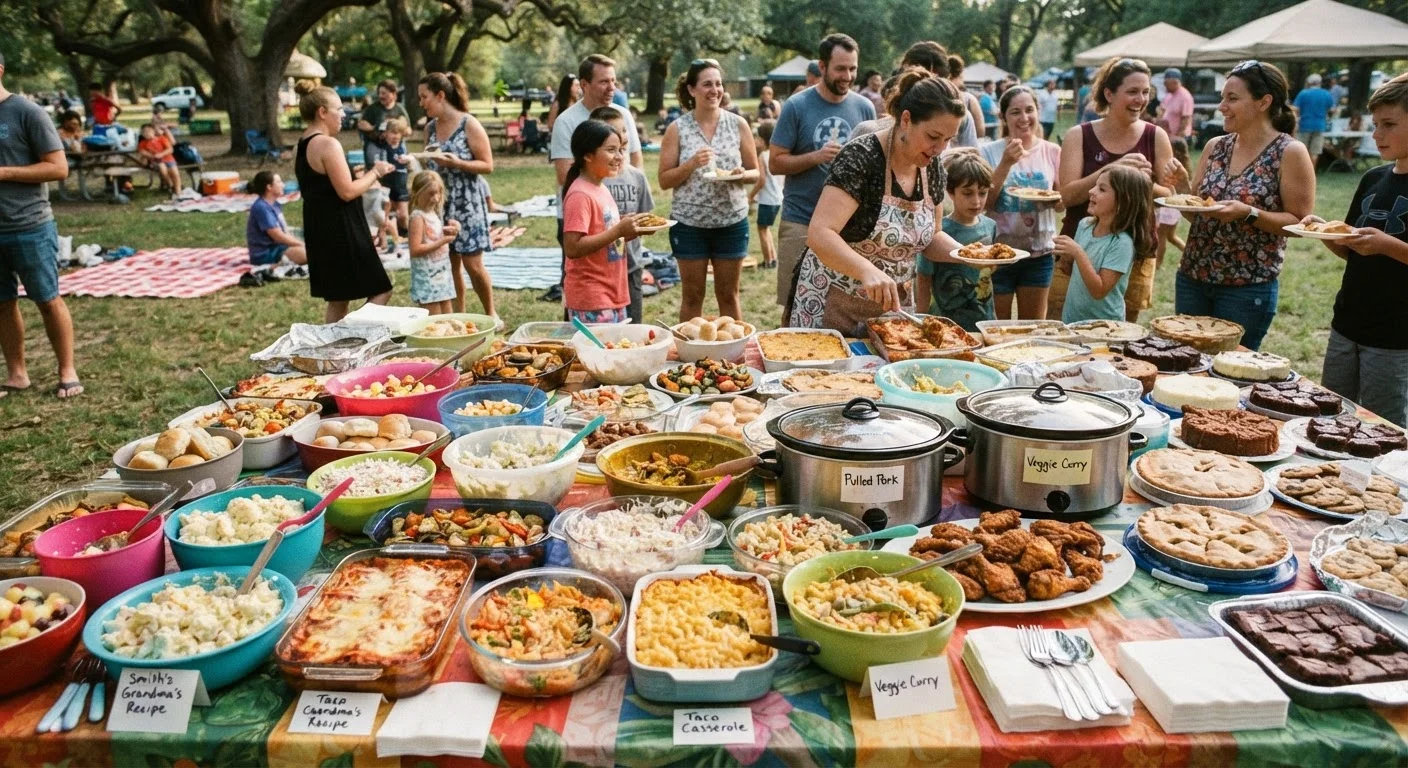
A potluck is a communal meal where each guest contributes a dish they prepared at home. Rather than one host bearing the full burden of feeding everyone, the meal is assembled collectively from whatever participants bring. The word historically meant 'whatever luck the pot holds' - food shared without ceremony or guarantee of what would appear.
Folklorists and food historians distinguish the potluck from the 'covered dish supper,' though in practice most Americans use the terms interchangeably depending on regional dialect.
What Makes a Potluck a Potluck
Strip away the folding tables and mismatched Tupperware, and the potluck is a remarkably clear social contract: everyone brings something, everyone eats together, and no single person carries the weight of the whole. That simplicity is the point. Where a dinner party places the host at the center - cook, curator, provider - the potluck distributes both the effort and the authority across the whole group.
This is not accidental. The potluck format emerged precisely in communities where resources were shared rather than concentrated. Early American examples include Indigenous feasting traditions, frontier-era hospitality where travelers contributed whatever they carried, and the church suppers that became a cornerstone of Protestant and Catholic community life through the 19th and 20th centuries. In each case, abundance was created collectively, not by one generous host but by many ordinary contributors.
The result is a meal that belongs to everyone at the table - and that is shaped by everyone who cooked for it. As food culture has grown more conscious of immigrant food traditions and their role in shaping everyday American eating, the potluck offers a useful lens: it is one of the few meal formats that actively invites culinary difference rather than suppressing it.
72%
Americans who have attended a potluck
A 2019 survey by the Harris Poll for Instacart found nearly three-quarters of American adults had participated in a potluck-style meal, making it one of the most broadly shared social food traditions in the country.
1 in 3
Potluck attendees who feel anxious about their dish
The same survey found a significant share of participants worry whether their contribution will be well-received, underscoring the social weight that even informal food sharing carries.
The Potluck as a Cultural Document
What a person brings to a potluck says something real about who they are. A grandmother's macaroni and cheese carries decades of family memory. A first-generation American's hand-rolled dumplings carry an entire immigration story. A church deacon's slow-cooked greens carry the foodways of a whole community. The potluck table, read carefully, is a cultural document - as rich and layered as the holiday table in any American home.
This is especially visible in communities with deep food traditions. Soul food has long traveled through potluck culture, with dishes like sweet potato pie, fried chicken, and black-eyed peas serving as both sustenance and solidarity. Community meals in Black churches in particular helped sustain social networks and mutual aid across generations - the potluck was never just dinner.
That connective function is not unique to any one group. Across faith traditions, ethnic enclaves, rural towns, and urban neighborhoods, the potluck recurs as a mechanism for community cohesion. It is, in the language of sociology, a ritual of reciprocity: I feed you this week, you feed me next time, and the relationship is renewed through the act of sharing food.
“Food is never just food. It is also a means, a medium, a rite, and a symbol. It is never simple activity; there is always something else going on.”
— Robin Fox, Anthropologist and author on the sociology of food
Potlucks and the Question of Belonging
Being invited to a potluck is a form of inclusion. Being asked to bring something - rather than just show up - is a form of trust. This distinction matters more than it might seem. The potluck is one of the few social meals in American life that asks participants to contribute rather than simply consume, which makes the invitation feel different from a ticket to a catered event or a seat at a restaurant table.
That quality connects potlucks to what urban planners and sociologists call "third places" - informal gathering spaces outside home and work where community life actually happens. As the decline of third places has reduced the casual social infrastructure many Americans once relied on, portable formats like the potluck have filled some of the gap. You don't need a building or a budget - just a group willing to cook and a table big enough to hold what they bring.
The changing structure of American families has also expanded the potluck's role. As chosen families, multigenerational households, and geographically scattered relatives increasingly define how Americans experience kinship, the potluck offers a flexible, low-barrier ritual that works across almost any social configuration. It scales from four people in a studio apartment to four hundred people at a park pavilion.
The Potluck's Quiet Resilience
For a format with no marketing behind it and no commercial infrastructure, the potluck has proven remarkably durable. Office holiday potlucks, neighborhood block parties, faith community fellowship dinners, and informal friend-group gatherings all continue the tradition without anyone having to organize a revival. It simply persists because it works.
Part of that staying power is economic. Potlucks are genuinely accessible - a bag of rolls or a store-bought pie is an acceptable contribution in most circles, and bringing what you can afford is understood rather than judged. Part of it is social: potlucks generate conversation naturally, because the food itself is a talking point. "What's in this?" and "Did you make this?" are some of the easiest openers in any room.
And part of the resilience is structural. Unlike the American diner, which requires a physical location and a business model, the potluck requires nothing more than willing participants. It travels, adapts, and reappears in whatever form a community needs it to take - which is, ultimately, what the best social traditions do.