

Key Takeaways
What Is Soul Food?
Soul food is a style of American cuisine with deep roots in the foodways of enslaved and later free African Americans, particularly those living in the rural South. It is characterized by ingredients and cooking methods shaped by both West and Central African culinary traditions and the harsh material conditions of slavery - where cooks worked with limited, often discarded ingredients and transformed them through skill, creativity, and time.
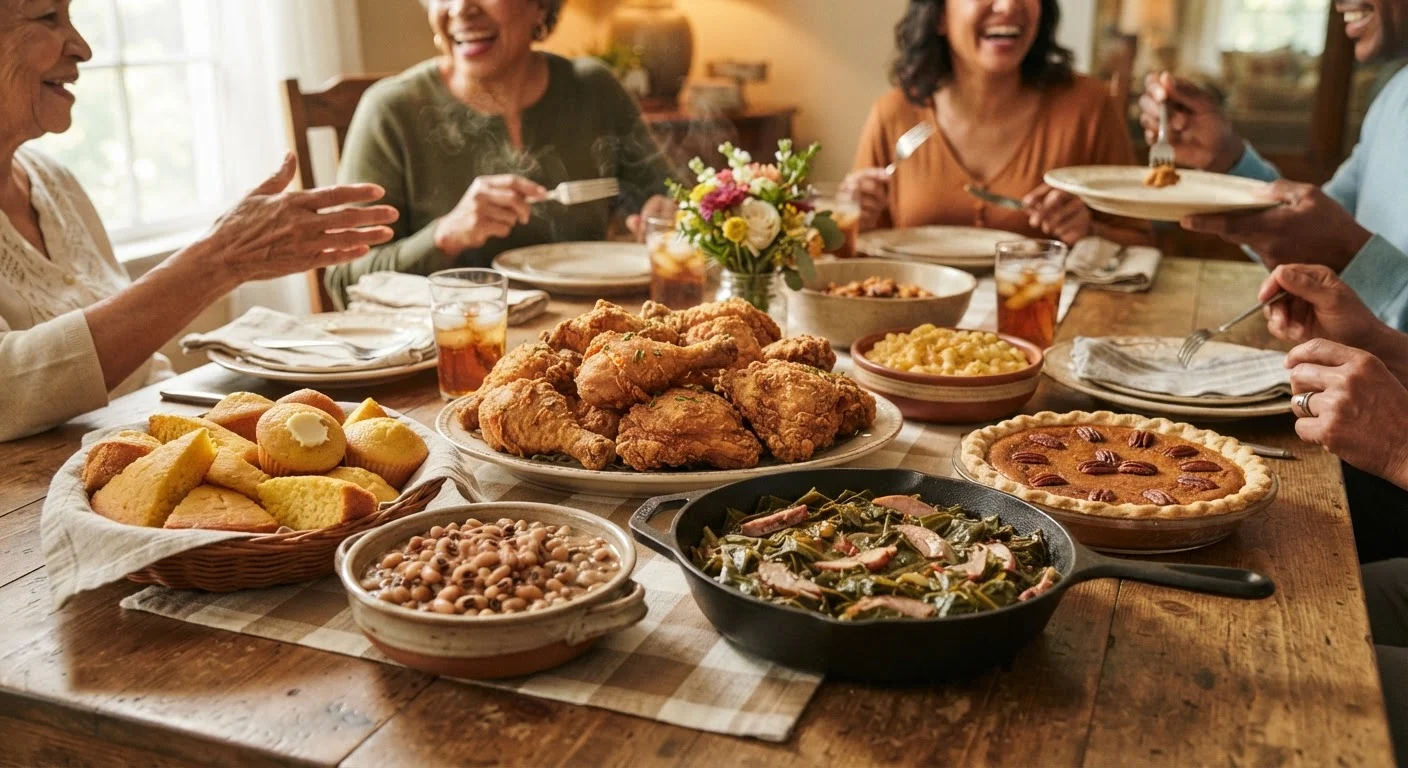
The cuisine typically centers on dishes like fried chicken, braised collard greens, black-eyed peas, cornbread, candied yams, macaroni and cheese, and smothered pork. But soul food is more than a list of recipes. It represents a living cultural inheritance - a way of cooking and sharing food that carries memory, community, and identity across generations. As comfort food across cultures takes different forms tied to history and circumstance, soul food is the deeply American expression of that universal human need.
Historical Roots: From Africa to the American South
The origins of soul food are inseparable from the transatlantic slave trade. Enslaved Africans brought with them seeds, agricultural knowledge, and culinary techniques from West and Central Africa. Okra, black-eyed peas, sorghum, and watermelon all arrived in the American South via this brutal passage. Rice cultivation in coastal South Carolina and Georgia - an industry that made planters wealthy - was built almost entirely on the expertise of enslaved people from West Africa's so-called "Rice Coast."
On plantations, enslaved people were typically given the least desirable food allotments: offal, salt pork, cornmeal, and whatever they could cultivate in small personal garden plots. The genius of soul food lies in what was done with these provisions. Slow-braised pig's feet, hog maws, and chitterlings became dishes of genuine flavor and nourishment. Pot likker - the nutrient-rich liquid left after cooking greens - was served with cornbread rather than discarded.
“Soul food is the story of a people who took what was left behind - the scraps, the cast-offs, the overlooked - and created something extraordinary. It is survival transformed into sustenance, and sustenance transformed into art.”
— Jessica B. Harris, Culinary historian and author of 'High on the Hog: A Culinary Journey from Africa to America'
After emancipation, these culinary traditions moved with African Americans into free communities, urban centers, and church kitchens. The Great Migration of the early-to-mid 20th century carried soul food north and west, planting it in cities like Chicago, Detroit, New York, and Los Angeles, where it became both a link to Southern roots and a foundation of new African American urban culture. Like other immigrant and migrant food traditions, these dishes quietly but powerfully reshaped the American table.
The Defining Dishes and Why They Matter
Every dish in the soul food canon carries a story. Fried chicken - technically a Scottish technique adopted and perfected by enslaved cooks - became a cornerstone because chickens were among the few animals enslaved people were sometimes permitted to raise themselves. Collard greens trace to African leafy green traditions and provide significant nutritional value, particularly when the pot likker is consumed. Cornbread evolved from Native American corn preparations adopted by early settlers and later central to African American cooking across the South.
Black-eyed peas, brought directly from West Africa, became iconic on New Year's Day as a symbol of good luck and prosperity - a tradition still observed in millions of American households. Sweet potato pie drew on both African yam traditions and the abundance of sweet potatoes in the antebellum South. Each dish is a layered artifact: practical, flavorful, and historically legible.
When cooking collard greens, allow a longer, slower braise - at least 45 minutes - to develop the complex, slightly bitter depth that defines the dish and helps break down the tough leaf fibers.
Quick-cooked greens miss the flavor transformation central to the soul food tradition, where low-and-slow cooking was both a practical necessity and an art form.
Cornbread made in a well-seasoned cast-iron skillet, started on the stovetop before finishing in the oven, yields a crackling crust that is the hallmark of authentic Southern technique.
The cast-iron skillet's heat retention creates a Maillard reaction on the crust that a standard baking pan simply cannot replicate - a difference any serious home cook will notice immediately.
It's worth noting the regional diversity within these traditions, as the regional variation visible in American BBQ applies equally to soul food.
Regional Variation Within Soul Food
Soul food is not a single uniform cuisine. Coastal South Carolina's Gullah Geechee cooking emphasizes rice and seafood; Louisiana's African-influenced traditions incorporate okra, roux, and bold spice; and Northern cities, shaped by the Great Migration, developed their own urban adaptations. Recognizing this diversity honors the full story of the cuisine.
Soul Food as Community and Identity
Soul food has always been as much about gathering as it is about eating. Church suppers, family reunions, funerals, and holiday celebrations are organized around these dishes, which function as edible expressions of belonging and continuity. The act of preparing and sharing soul food is itself a form of cultural transmission - grandmothers teaching grandchildren not just recipes but memory and meaning.
During the Civil Rights Movement, soul food restaurants in Southern cities served as safe gathering places for activists, organizers, and community members. In the 1960s, the term "soul food" gained explicit cultural-political resonance, becoming a proud identifier of African American heritage during the Black Power movement. Sylvia's Restaurant in Harlem, opened in 1962, became a landmark that embodied this connection between food, community, and identity.
This communal dimension connects soul food to broader American traditions of shared eating. As explored in the potluck's enduring place in American social life, food shared collectively carries social weight that transcends the meal itself.
A Cuisine Rooted in Resistance
It is impossible to understand soul food without acknowledging the brutal historical circumstances that gave rise to it. Enslaved people were denied access to premium cuts and quality ingredients, yet they transformed those constraints into a cuisine of remarkable depth. Celebrating soul food means recognizing this history - not as a footnote, but as the foundation of everything on the plate.
Evolving Traditions: Health, Modernity, and Reclamation
A meaningful conversation has emerged in recent decades about soul food and nutrition. Some traditional preparations - high in sodium, saturated fat, and added sugar - have been linked to elevated rates of hypertension and cardiovascular disease in African American communities. But it's critical to approach this conversation carefully: structural food access inequalities, not simply culinary tradition, are primary drivers of diet-related health disparities.
Avoid Oversimplifying the Cuisine
Soul food is sometimes reduced to a handful of stereotypes - greasy, unhealthy, or monolithic - that misrepresent its true breadth and complexity. The tradition encompasses a vast range of ingredients, regional variations, and cooking approaches. Treating it as a single, static thing erases the diversity of African American foodways across generations and geographies.
Contemporary African American chefs and home cooks are actively reclaiming and reimagining soul food - reducing sodium, incorporating more plant-based ingredients, and reviving older, pre-slavery African traditions that were naturally vegetable-forward. Chefs like Bryant Terry have built careers around honoring the soul food tradition while adapting it for modern nutritional awareness. These efforts are not a rejection of the cuisine but an extension of its core spirit: creative adaptation under constraint.
Cooking Soul Food at Home
Many soul food staples are genuinely accessible to home cooks. Start with dried beans, seasonal greens, and a piece of smoked pork for flavoring - these form the backbone of countless traditional dishes. Patience is the most important ingredient: low heat and time develop the deep, layered flavors that define the cuisine.
This article provides general cultural and historical information. For personal dietary guidance, consult a qualified healthcare or nutrition professional.
Soul Food's Place in the Broader American Table
The influence of African American cooking on mainstream American cuisine is vast and frequently underacknowledged. Techniques like frying in lard, flavor layering with smoked pork, and the use of hot sauce, okra, and field peas have woven themselves into Southern cooking broadly - and by extension into American food culture nationally. Without the labor, knowledge, and creativity of enslaved and free African American cooks, the culinary geography of the United States would look dramatically different.
Understanding what authenticity really means in food culture is essential here. Soul food is not a frozen museum piece - it is a living tradition that continues to evolve, absorb influences, and assert itself in new contexts, from fine dining to food trucks. Engaging with it seriously means appreciating both its historical depth and its ongoing creativity.
Soul food's story is, in many ways, America's story: one of cultural confluence, survival, transformation, and the extraordinary power of a shared meal. To sit down to a plate of it is to participate in a tradition that spans centuries and continents - and to honor the people whose ingenuity made it possible.
~1865
Era when 'soul food' traditions began consolidating
Following emancipation, African American cooks brought their culinary knowledge from plantations into free communities, cementing a distinct cuisine.
1960s
Decade the term 'soul food' entered mainstream use
During the Civil Rights and Black Power movements, 'soul food' became an explicit cultural and political identifier for African American cuisine.
300+
Years of culinary tradition behind soul food
Soul food's roots span from the transatlantic slave trade through Reconstruction, the Great Migration, and into contemporary American kitchens.