

Key Takeaways
Option A
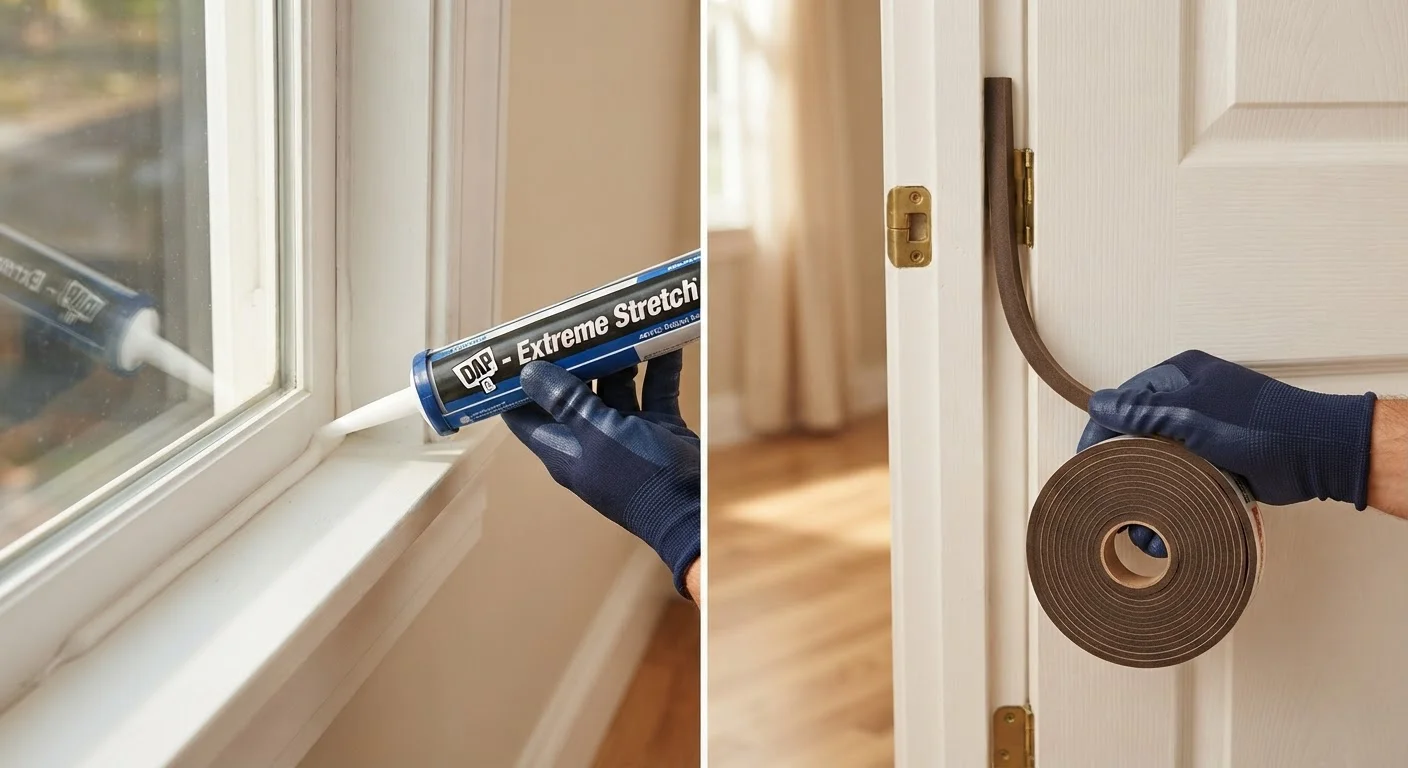
Caulk
The permanent, rigid seal for stationary gaps.
Best for: Filling fixed cracks and gaps around windows, door frames, baseboards, and where building materials meet.
Option B
Weatherstripping
The flexible, compressible seal for moving parts.
Best for: Sealing the movable edges of doors and operable windows that open and close repeatedly.
Sealing the gap where a window frame meets exterior siding
Caulk
This joint is completely stationary, so flexible caulk bonds permanently to both surfaces and keeps moisture and drafts out without degrading from movement.
Stopping cold air from sneaking around an exterior door when it closes
Weatherstripping
The door's repeated opening and closing demands a compressible material that returns to shape; rigid caulk would crack within weeks under that stress.
Filling gaps between baseboards and a concrete basement floor
Caulk
This is a fixed, non-moving joint where paintable latex caulk provides a clean finish and blocks cold air infiltration effectively.
Reducing drafts around a casement window that swings open
Weatherstripping
The operable sash needs a seal that compresses on closure and springs back on opening - self-adhesive foam or V-strip weatherstripping handles this well.
Why This Distinction Matters
Air leaks account for a significant share of heating and cooling losses in a typical American home. The U.S. Department of Energy estimates that sealing air leaks and adding insulation can reduce energy costs by up to 15%. Yet many homeowners apply the wrong product to the wrong gap - caulking a door stop where weatherstripping belongs, or trying to press foam tape into a crack in exterior siding. The result is a seal that fails fast and the problem returns.
The core rule is simple: if it moves, weatherstrip it; if it stays still, caulk it. Every exception traces back to this principle. Understanding it lets you approach any gap in your home with confidence and choose the right tool before you've opened a single package.
| Criterion | Caulk | Weatherstripping |
|---|---|---|
| Best application | Stationary joints and cracks | Moving door and window edges |
| Flexibility after curing | Semi-flexible to rigid | Fully compressible and resilient |
| Typical lifespan | 5-15 years (exterior grade) | 2-7 years depending on type |
| DIY skill required | Low - caulk gun, steady hand | Low - cut to length, press or screw |
| Paintable | Yes (latex/siliconized latex) | Rarely; usually left as-is |
| Moisture resistance | High (silicone) or moderate (latex) | Moderate; foam degrades with prolonged wet exposure |
| Fails if used wrong | Cracks on moving joints | Shears off on fixed, rigid surfaces |
Where Caulk Belongs - and Which Type to Choose
Caulk is a sealant applied wet that cures into a semi-flexible or rigid bead. It bonds two stationary surfaces together and stays put. Common fixed-joint applications include:
- Exterior window and door frames where the frame meets siding, brick, or stucco
- Gaps around pipes, conduit, and vents that penetrate walls or floors
- Interior trim joints - baseboards, crown molding, and door casings against drywall
- Gaps between a tub or shower surround and the wall (use mold-resistant silicone here)
For exterior work exposed to sun and temperature swings, a paintable siliconized latex or elastomeric caulk handles expansion and contraction better than plain latex. Pure silicone holds up outdoors and resists moisture, but it cannot be painted. Interior trim typically calls for paintable latex caulk, which cleans up with water and accepts paint cleanly. Always remove old, cracked caulk completely before applying fresh material - new caulk bonded over failed caulk won't hold.
Don't Caulk the Weep Holes
Window frames - especially those set in brick or masonry - often have small openings called weep holes along the bottom edge. These are intentional drainage points that allow water that enters behind the frame to escape. Filling them with caulk traps moisture inside the wall cavity, which can lead to rot and mold. Leave weep holes open when caulking around window frames.
Where Weatherstripping Belongs - and Which Type to Choose
Weatherstripping is installed along the moving edges of doors and operable windows. It compresses when the door or window closes, creating an airtight contact, then recovers its shape when opened. Three types cover most residential needs:
- Self-adhesive foam tape - inexpensive and easy to install; best for low-traffic windows and secondary doors. Typically lasts two to five years before compression-set failure.
- V-strip (tension seal) - a folded strip of plastic or metal that springs outward to fill gaps along the sides of a door or window sash. Durable and nearly invisible once installed.
- Door sweeps and threshold seals - address the gap at the bottom of exterior doors, where drafts and pests enter most easily. Look for adjustable models that accommodate uneven floors.
When shopping, measure the gap you're filling before buying. Compressible foam that's too thin won't seal; foam that's too thick prevents the door from latching. A paper test - sliding a sheet of paper around a closed door - is a simple way to find where your weatherstripping is failing: if the paper slides freely, air is getting through too.
A Seasonal Maintenance Approach
Fall, before the heating season begins, is the most productive time to inspect both caulk and weatherstripping. Walk the perimeter of each exterior door and window. Look for caulk that is cracked, pulling away, or discolored; press weatherstripping gently to test whether it still rebounds. Any seal that has hardened, flattened, or detached should be replaced before cold weather sets in.
In spring, repeat the inspection after the freeze-thaw cycle, which stresses all exterior materials. Pay particular attention to north-facing walls and any joint where dissimilar materials meet - wood to masonry is a common failure point because the two expand and contract at different rates.
Budgeting 30 to 60 minutes twice a year for this walk-around, combined with a modest investment in materials, is one of the most cost-effective home maintenance habits available to homeowners. Neither caulk nor weatherstripping is a permanent solution, but the right product in the right place will last many seasons before needing attention.
Up to 15%
Potential energy savings from sealing air leaks
The U.S. Department of Energy estimates homeowners can reduce heating and cooling costs by up to 15% by sealing air leaks and adding insulation.
25-40%
Share of home heating energy lost to air leaks
According to the U.S. Environmental Protection Agency's ENERGY STAR program, air infiltration through gaps and cracks accounts for a substantial portion of residential energy waste.