

Key Takeaways
Holiday Table as Cultural Document
The idea that what a family prepares and eats during holidays is not merely a meal but a living record of their cultural identity, history, and values. Like a document or archive, the holiday table preserves practices passed down across generations, carries meaning that goes beyond nutrition, and communicates who a community is and where it came from. Reading a holiday meal involves understanding the stories encoded in ingredients, recipes, and rituals.
Food scholars and cultural anthropologists refer to this as "foodways" - the study of what, how, and why people eat, especially in ceremonial contexts where food functions as social and symbolic communication.
What the Holiday Table Actually Documents
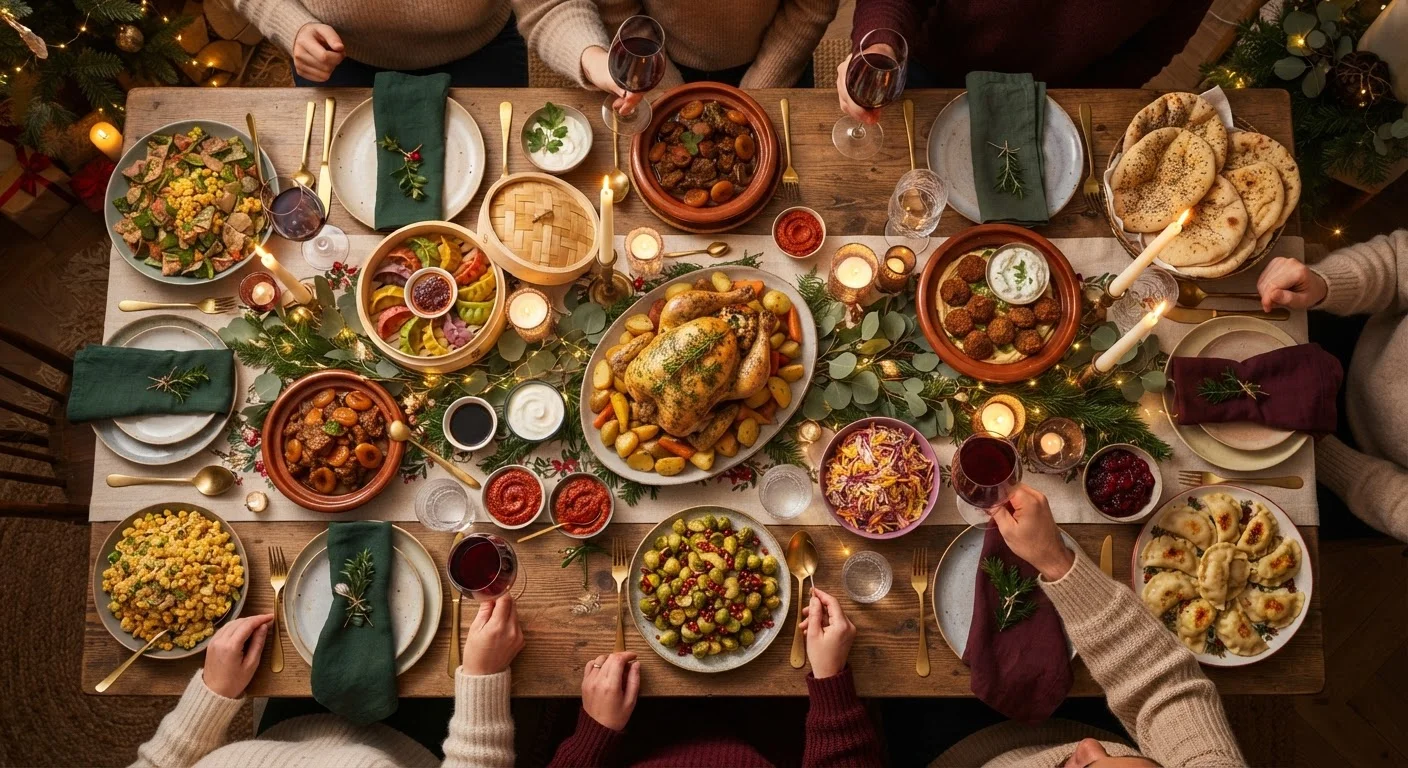
Pull up a chair at a Lunar New Year dinner in San Francisco's Sunset District, an Eid al-Fitr spread in Dearborn, Michigan, or a Thanksgiving table in rural Georgia, and you are sitting before a kind of primary source. Every dish on that table carries encoded information - about geography, religion, economics, memory, and belonging - that no single conversation could fully convey.
The concept of the holiday table as a cultural document asks us to treat festive meals the way historians treat letters or photographs: as evidence of how people understood their world, their community, and themselves. A dish doesn't need to be rare or elaborate to carry this weight. A pot of collard greens, a plate of tamales, or a bowl of tteokguk (Korean rice cake soup) can hold generations of meaning within something as simple as the way it's seasoned.
Food scholars describe this field of inquiry as foodways - the full set of practices, beliefs, and social contexts surrounding what people eat. Holiday meals represent foodways at their most concentrated and intentional. Families don't just eat; they perform a set of choices that say, this is who we are.
77%
Americans who say food is central to holiday traditions
According to a Pew Research Center survey on American family life and holiday practices, a large majority of Americans identify food as one of the most important elements of holiday gatherings.
44M+
Foreign-born residents in the U.S.
The U.S. Census Bureau reports more than 44 million foreign-born residents in the United States, each group contributing distinct holiday food traditions to America's cultural landscape.
3-4 generations
Typical span of oral recipe transmission
Food historians observe that family recipes passed orally - without written documentation - commonly survive intact across three to four generations before significant drift occurs.
How Dishes Carry History
The foods served at major holidays rarely arrived at the table by accident. Most reflect a convergence of agricultural history, religious observance, regional availability, and the economics of immigrant life. Understanding that convergence is what transforms a meal from backdrop to foreground.
Consider the Thanksgiving turkey. While it has become America's dominant national symbol of the holiday, the dishes surrounding it - cornbread stuffing in the South, oyster stuffing in New England, cranberry preparations that vary by region - reveal local histories that the centerpiece alone cannot. For many Black American families, side dishes like sweet potato pie and candied yams carry specific resonances tied to the Great Migration and the culinary adaptations made in new urban environments.
Similarly, the Lunar New Year table is a deliberate assembly of symbolism: whole fish for abundance, long noodles for longevity, round foods for wholeness and family unity. These are not decorative choices but a vocabulary developed over centuries, now carried into diaspora communities across the United States. Immigrant food traditions often preserve symbolic meaning long after other cultural practices fade, precisely because the meal is repeated annually and tied to emotion.
Evolution, Adaptation, and the Living Tradition
One of the most important things to understand about holiday food traditions is that they are dynamic, not static. Families adapt recipes to local ingredients, available time, dietary needs, and new household members. Far from weakening a tradition, this adaptation is often how traditions survive at all.
A Mexican-American family in Phoenix might serve tamales made with locally grown chiles that differ from those used in Oaxaca. A South Asian family might incorporate store-bought phyllo dough into a recipe that once required hours of hand-rolled pastry. These changes are not failures of authenticity - they are evidence that a tradition is alive and in conversation with its environment. As ideas about culinary authenticity continue to be examined more critically, there's growing recognition that adaptation is the norm in food history, not the exception.
The table also records who is absent. Dishes prepared by grandparents who have since died, recipes reconstructed from memory, flavors deliberately maintained because they connect the living to the lost - grief and love are both present at the holiday table in ways that rarely get named but are universally felt.
Reading Your Own Table
Most people participate in holiday food traditions without analyzing them - and that's entirely appropriate. The meal works emotionally whether or not anyone is consciously cataloging its meanings. But there is real value in occasionally pausing to ask: why this dish? Who brought this recipe? What does it connect us to?
Those questions don't require expertise to answer. They require conversation - usually with older relatives who remember when a tradition started, or what it replaced, or which ingredients were substituted and why. That kind of oral history, gathered around the table itself, is some of the most vivid cultural documentation available.
The holiday table also creates community beyond the immediate family. The potluck tradition in American life extends the same logic outward: when people bring dishes from their own households to a shared gathering, the table becomes a map of overlapping cultures and stories. Each contribution carries its own document inside it.
“Food is not just eating energy. It's an experience. The culture, the history, the story of how it was grown and prepared - all of that is part of what you're consuming.”
— Michael Pollan, Author and food culture journalist
Ultimately, what a family eats on its most significant days is one of the most honest self-portraits it can make. It is assembled not for an audience but for itself - which is precisely what makes it worth reading.