

Key Takeaways
American Family Structure
American family structure refers to the composition and organization of households across the United States - who lives together, how they are related, and what roles they play. Over recent decades, the traditional image of a married heterosexual couple raising biological children has given way to a far more diverse set of arrangements, including single-parent homes, blended families, cohabiting couples, and multigenerational households. Social scientists track these shifts using census data and longitudinal surveys to understand how household composition affects economic stability, child development, and community life.
Demographers often distinguish between 'family households' (containing at least two related individuals) and 'nonfamily households' (such as roommates or people living alone), a distinction that has grown more significant as solo living has increased.
From the Nuclear Family to Something More Complex
The postwar image of the American family - a married couple, two kids, a dog, and a suburban house - was always more aspiration than reality for many households. But by the mid-20th century, that model had become both a cultural ideal and a statistical norm. Today, neither is quite true.
According to the U.S. Census Bureau, the share of households consisting of a married couple with children under 18 has fallen from roughly 40 percent in 1970 to around 18 percent in recent years. That doesn't mean marriage has collapsed - it means the landscape of how Americans form households has diversified considerably. Single-parent families, blended families, cohabiting couples, same-sex couples with and without children, and adults living alone all represent substantial and growing portions of American life.
These aren't just demographic footnotes. Family structure shapes everything from household income and housing needs to children's educational outcomes and how communities knit together. Understanding what's driving these changes is essential to understanding modern American society - including the economic pressures covered in our Economy & Cost of Living hub.
18%
Share of U.S. households with married couple and children
Down from roughly 40% in 1970, according to U.S. Census Bureau data tracking household composition over time.
59M
Americans living in multigenerational households
Pew Research Center estimated approximately 59 million Americans, or 18% of the population, lived multigenerationally as of 2021.
~30%
U.S. children living with a single parent
The United States has one of the highest rates of single-parent households among wealthy nations, per Pew Research Center cross-national comparisons.
28
Median age at first marriage for women (years)
The median age at first marriage for American women reached approximately 28 years in recent Census Bureau data, up from 20 in 1960.
The Rise of Multigenerational and Extended Households
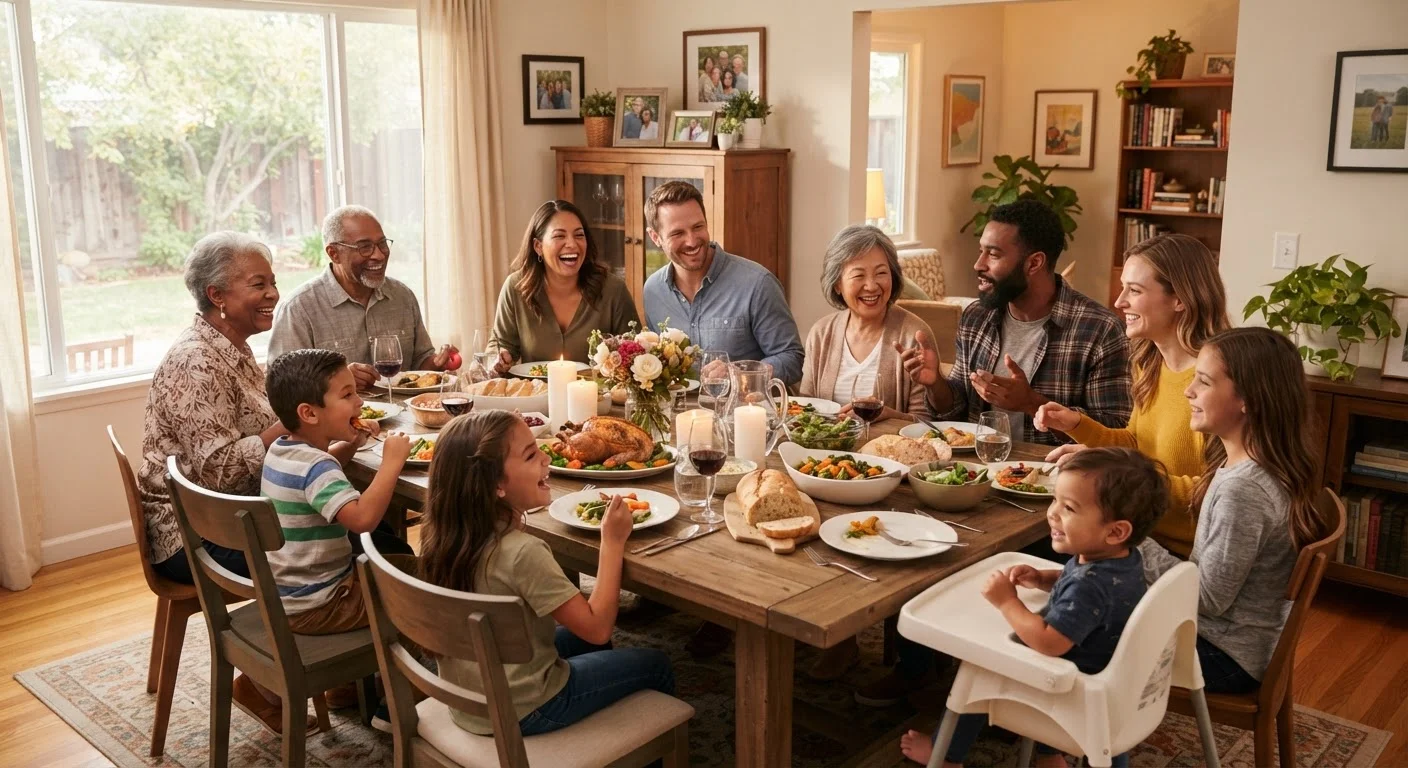
One of the more striking demographic shifts of recent decades is the return of multigenerational living. Pew Research Center has documented a sustained increase in the share of Americans living in multigenerational households - defined as homes with two or more adult generations, or grandparents and grandchildren - since the 1980s. By 2021, roughly 59 million Americans, or about 18 percent of the population, lived in such arrangements.
The drivers are layered. For younger adults, high housing costs and student debt make independent living more difficult. For older Americans, aging in place with family support is often preferable - and more affordable - than assisted living. For many immigrant families, multigenerational cohabitation reflects both economic strategy and deeply held cultural values around family obligation. Geography matters too, as explored in our look at rural vs. urban America, where housing costs and community structures differ sharply.
These households present both strengths - built-in childcare, pooled income, elder support - and challenges around privacy, space, and caregiving stress.
Chosen Families and the Redefinition of Kinship
Not all families are defined by blood or legal ties. The concept of the "chosen family" - a network of close friends and community members who provide the mutual support historically reserved for relatives - has moved from the margins into mainstream conversation.
Originally documented prominently within LGBTQ+ communities, where estrangement from biological families has historically been common, chosen family structures are now recognized by researchers as a significant feature of American social life more broadly. The loneliness epidemic now widely discussed by public health researchers has in some ways accelerated this: as traditional institutions like churches and civic organizations have declined, people construct their own webs of mutual obligation and care.
Chosen families don't appear in census data, which makes them easy to overlook in policy discussions - even as they function as primary support systems for millions of Americans navigating illness, financial hardship, and major life transitions.
“The diversity of family forms in America today is not a symptom of breakdown - it's evidence of adaptation. Families have always reorganized themselves in response to economic and social conditions.”
— Philip Cohen, Professor of Sociology, University of Maryland, and author of research on American family change
Economic and Cultural Forces Behind the Shift
No single cause explains the full picture. Researchers point to a confluence of economic, legal, and cultural changes. Women's increased participation in the workforce reduced economic dependency on marriage. The legalization of no-fault divorce in the 1970s made leaving unhappy marriages more accessible. Reliable contraception gave people more control over if and when they had children. And shifting cultural norms gradually reduced the social stigma attached to cohabitation, single parenthood, and same-sex partnerships.
Economic precarity has also played a role that is often underappreciated. Studies suggest that many Americans - particularly younger adults - hold traditional aspirations around marriage but feel financially unready to pursue them. This helps explain why marriage rates differ so substantially across income levels. Immigration has introduced additional diversity into American household patterns, as families from Latin America, Asia, and elsewhere bring distinct norms around extended kinship and household composition, a dynamic explored further in our coverage of immigration and American identity.
Generational identity also plays a role - generational cohort labels like Millennial and Gen Z often correlate with distinct attitudes toward marriage, cohabitation, and parenthood, even if those labels oversimplify complex realities.
What These Changes Mean for American Life
The diversification of American family structures carries real policy and social implications. Housing stock in many U.S. cities was built for the nuclear family model and doesn't accommodate multigenerational living easily. Tax codes, benefit systems, and workplace policies often still assume a primary earner with a dependent spouse. Schools and healthcare systems may not be designed to engage the range of caregiving adults who are actually involved in children's lives.
Culturally, the shift invites ongoing debate. Some observers see the changes as signs of social fragmentation and the erosion of stabilizing institutions. Others argue that families have always adapted to economic and cultural conditions, and that today's diversity reflects greater personal freedom and social tolerance rather than decline. The data doesn't resolve that argument - but it does establish that the changes are real, broad-based, and unlikely to reverse.
What hasn't changed is the underlying human need for connection, support, and belonging. Whether expressed through a multigenerational household, a chosen family, or a more traditional nuclear arrangement, those needs drive the structures Americans build around themselves - and will continue to reshape the face of family life for generations to come.