

Key Takeaways
The American Diner
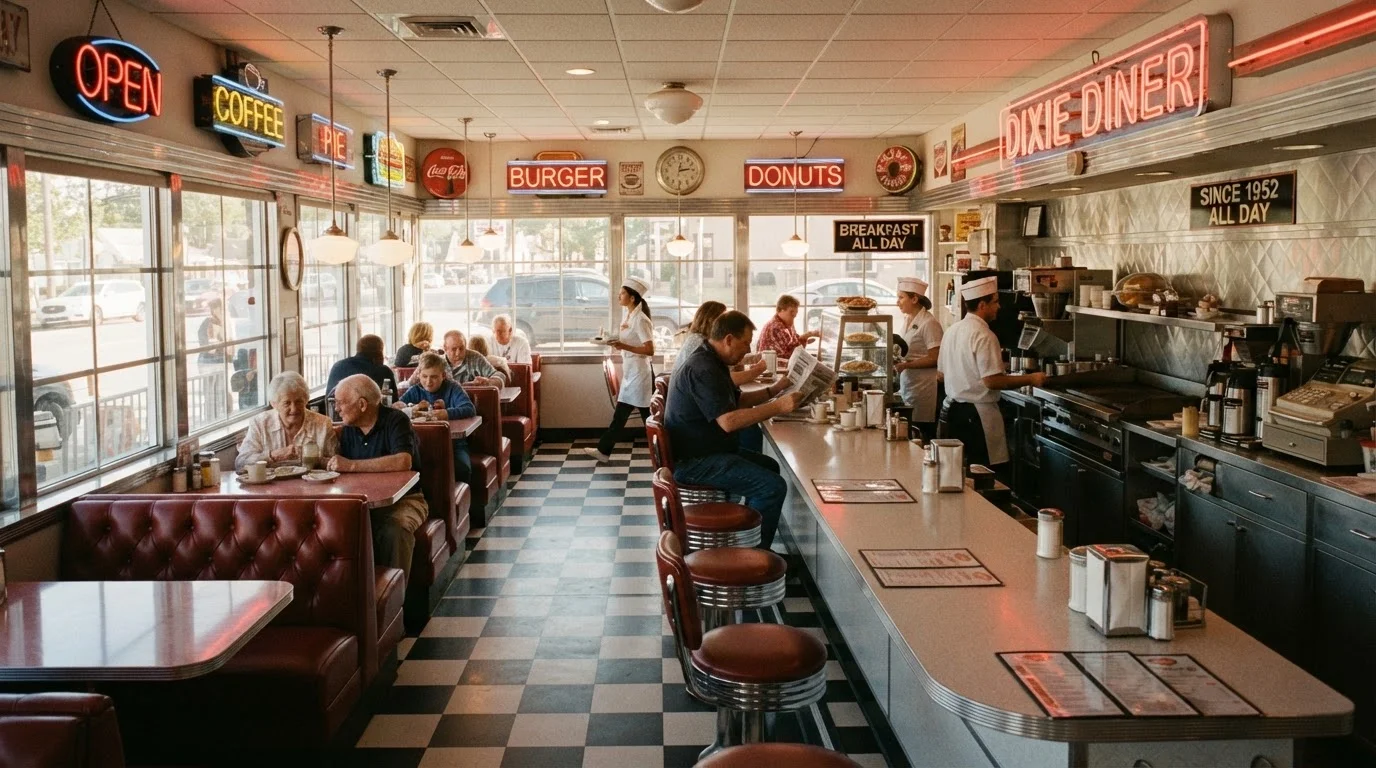
The American diner is a casual, counter-service restaurant - typically open long hours and serving affordable comfort food - that evolved from the horse-drawn lunch wagons of the 1870s. More than a food venue, it has long functioned as a democratic public space where people from different walks of life routinely share the same physical room. Diners carry deep cultural meaning as symbols of accessibility, local identity, and everyday American life.
Sociologists classify diners as 'third places' - social environments that are neither home nor workplace, where informal public life unfolds. Ray Oldenburg's foundational research on third places identified such spaces as essential to community cohesion.
From Rolling Wagons to Cultural Institutions
In 1872, a Providence man named Walter Scott began wheeling a horse-drawn food wagon to the city's late-night workers - factory hands, printers, and anyone who couldn't afford a proper restaurant or found one closed at midnight. That mobile lunch cart is widely recognized as the prototype of what became the American diner. Within decades, entrepreneurs across the Northeast were operating stationary versions, and by the mid-20th century, the gleaming, prefabricated stainless-steel diner had become a fixture of the American landscape from New Jersey to rural Ohio.
The format's design was never purely practical. Counter seating placed strangers shoulder to shoulder rather than isolating them at separate tables. That physical arrangement encouraged conversation - between the shift worker and the business owner, the retiree and the college student. The diner effectively built democracy into its architecture. For a look at how similar social design plays out at other food-centered gathering spaces, see farmers markets as cultural spaces.
The Diner as a Third Place
Sociologist Ray Oldenburg coined the term third place to describe social environments beyond home (the first place) and work (the second place) where informal public life takes root. Diners fit that category almost perfectly. They offer a warm, low-cost environment with a recognizable cast of regulars, a tolerance for lingering over coffee, and the kind of unhurried atmosphere that allows relationships to develop without agenda.
~7,000
Diners operating in the U.S. at peak mid-century
Diner historians estimate the format reached its height in the 1950s, with thousands of locations operating across the country, concentrated heavily in the Northeast.
~2,000
Diners estimated still operating in the U.S.
Various food history researchers and the American Diner Museum have cited figures suggesting the current count is a fraction of the mid-century peak, though precise national tallies are difficult to verify.
1870s
Decade diners first appeared in American cities
Food historians consistently date the diner format's origins to the rolling lunch wagons of Providence, Rhode Island, in the 1870s.
Unlike more curated community spaces, diners don't require membership, ideological alignment, or a specific purpose. You show up, you eat, you talk - or you don't. That low barrier is precisely what makes them socially valuable. The broader implications of losing such spaces are explored in depth in the decline of third places and what America loses without them.
Immigration, Labor, and the Diner Menu
The American diner was built substantially by immigrant hands. Greek immigrants in particular became synonymous with diner ownership throughout the 20th century, especially in the Northeast and Mid-Atlantic states. Jewish deli traditions, Central European baking, and Latin American cooking have each left visible marks on what most Americans think of as standard diner fare - the egg-and-cheese on a roll, the rice pudding, the gyro wrap slipped onto a laminated menu page.
“The diner is perhaps the most democratic of American restaurants - no reservations, no dress code, no menu you need translating. You just walk in and sit down next to whoever's already there.”
— Andrew Hurley, Historian and author of 'Diners, Bowling Alleys, and Trailer Parks'
This culinary layering mirrors the broader story of immigrant food traditions that quietly reshaped the American table. Diners didn't just feed immigrants; they provided economic entry points and, over time, became vehicles through which immigrant foodways entered the mainstream American diet.
What Survives - and What's at Stake
Diner numbers have declined sharply from their post-World War II peak. Rising commercial rents, changing eating habits, the dominance of fast-food chains, and the difficulty of succession when founding families retire have all taken their toll. Some regions - New Jersey is often cited as a stronghold - maintain a living diner culture. Elsewhere, surviving diners have taken on the weight of local landmarks, places where longtime residents measure neighborhood change by whether the booth where they had childhood breakfasts still exists.
The diner's role as a social equalizer also carries historical complexity. During the civil rights era, lunch counter sit-ins at diners and similar establishments were central acts of protest against segregation - a reminder that the democratic promise of the diner was not always honored. Its legacy is both genuinely communal and historically contested.
Understanding the diner alongside other community food rituals - like the potluck's place in American social life - reveals how Americans have consistently used shared eating as a way to negotiate identity, belonging, and community. As that rural and urban divide deepens, the spaces where different Americans still physically share a table matter more, not less.