

Key Takeaways
Our Verdict
Comfort food is less about specific ingredients and more about the emotional architecture surrounding a dish - who made it, when, and why. While the flavors and textures differ dramatically from one cuisine to the next, the underlying function is strikingly consistent: to soothe, restore, and connect people to something familiar. Understanding this universality enriches how we approach both our own food traditions and those of others.
| Best for | Recommended |
|---|---|
| Readers exploring cultural identity through food | Dishes tied to family and ethnic tradition |
| Those seeking warmth and simplicity during stress or illness | Soft, broth-based dishes like congee or khichdi |
| Curious eaters wanting to understand another culture's emotional landscape | Street-style or home-cooked regional classics |
| Home cooks celebrating American culinary diversity | Immigrant-rooted dishes like mac and cheese or matzoh ball soup |
What Makes a Dish 'Comforting' in the First Place?
Comfort food is one of those concepts everyone understands instinctively, yet almost no one defines the same way. Food researchers and psychologists generally describe it as food that evokes a sense of safety, nostalgia, or emotional ease - often tied to childhood, caregiving, or a specific cultural moment. The dish itself is almost secondary to the context in which it was first eaten.
Across cultures, a few patterns emerge consistently. Comfort foods tend to be warm, soft, and simple in preparation. They are rarely highly spiced or technically demanding. They are often associated with illness, cold weather, or emotional difficulty - moments when the body or spirit needs grounding. And they are almost always tied to a specific person: a grandmother, a parent, a neighbor who cooked without measuring.
This is why two people from entirely different backgrounds can share the same emotional relationship with food that, on a plate, looks nothing alike.
| Mac & Cheese | Congee | Khichdi | Matzoh Ball Soup | |
|---|---|---|---|---|
| Primary ingredients | Pasta, cheese, butter | Rice, water or broth | Rice, lentils, ghee | Chicken broth, matzo, egg |
| Typical texture | Creamy, chewy | Silky, porridge-like | Soft, thick | Light broth, soft dumplings |
| Common occasion | Everyday meals, nostalgia | Illness, recovery | Illness, simplicity | Illness, grief, holidays |
| Flavor profile | Rich, salty, dairy-forward | Mild, adaptable | Earthy, lightly spiced | Savory, clean, umami |
| Cultural origin | American South / European | China, East/SE Asia | Indian subcontinent | Jewish-American tradition |
| Ease of preparation | Moderate | Very simple | Very simple | Moderate |
A World Tour of Comfort: Four Signature Dishes
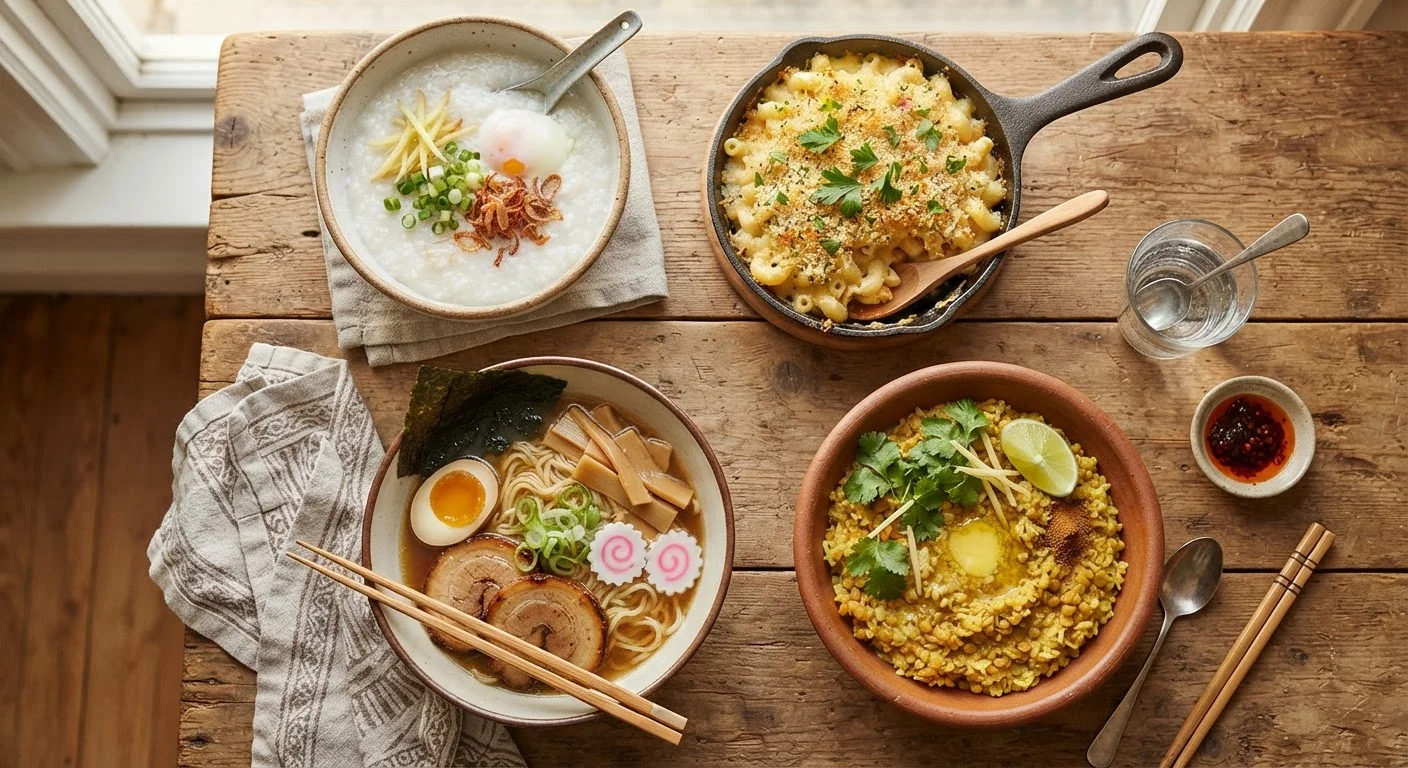
Mac and Cheese (United States): Few dishes are more embedded in American food culture than macaroni and cheese. Its origins trace to 18th-century European pasta dishes brought to America and later popularized through home cooking traditions, particularly in the American South, where it became a cornerstone of soul food. Creamy, starchy, and deeply familiar, it signals abundance without formality.
Congee (China and across East and Southeast Asia): This rice porridge, slow-cooked until grains dissolve into a silky, thick base, is the food of recovery in much of East Asia. It is served to the sick, the elderly, and the very young. Its genius lies in its neutrality - congee can be flavored with almost anything, which makes it universally adaptable and deeply personal.
Khichdi (India): A mixture of rice and lentils cooked down with turmeric and sometimes ghee, khichdi is considered Ayurvedic staple food - gentle on digestion, nourishing, and unpretentious. It is the dish Indian households make when someone is unwell or when simplicity is the only appropriate response to a difficult day.
Matzoh Ball Soup (Jewish-American tradition): Soft dumplings floating in clear chicken broth, this dish has been called "Jewish penicillin" in popular culture. It is a staple of the American Jewish table, particularly during illness or grief, and its presence in American food culture speaks to how immigrant traditions become part of a broader national comfort vocabulary. As explored in our piece on immigrant food traditions that reshaped the American table, these culinary journeys run deep.
Memory Is the Secret Ingredient
Food scientists have documented what cooks have always known: flavor memory is among the most powerful forms of human recollection. The olfactory system, which processes smell and taste, has direct neural connections to the hippocampus and amygdala - the brain regions governing memory and emotion. This is why a bowl of soup can transport someone across decades in an instant.
This neurological reality explains why comfort food is so resistant to substitution. A person raised on congee will not find mac and cheese particularly soothing during illness, and vice versa. The food itself is less a recipe than a cue - a signal to the nervous system that this is safe, known territory.
Try Someone Else's Comfort Dish
One of the most meaningful ways to connect with a colleague, neighbor, or friend from a different background is to ask about their comfort food - and then actually try it. You don't need a recipe; just ask what it tastes like and what it reminds them of. Food conversations often open doors that other topics cannot.
This also means comfort food evolves. Children of immigrants frequently describe navigating two comfort traditions simultaneously - the dishes of their family's origin and the American foods absorbed from school lunches, neighbors, and television. The result is a personal comfort food canon that is genuinely hybrid, reflecting exactly how culture actually works: not as a fixed inheritance but as a living, layered experience. Street food traditions around the world show a similar pattern of adaptation and layering.
What These Dishes Share - and What They Don't
The comparison across cultures reveals both remarkable similarities and meaningful differences. Texture is the most consistent thread: soft, yielding food appears in virtually every comfort tradition. Warmth is nearly universal, though notable exceptions exist - cold dishes like champorado (a Filipino chocolate rice porridge, sometimes served at room temperature) and certain chilled noodle dishes also carry comfort associations in their home cultures.
What differs most is flavor profile and richness. American comfort food often leans toward fat, dairy, and salt. South Asian comfort food tends toward warmth from spice and the clean richness of ghee. East Asian traditions favor the umami depth of broth and fermented condiments. These differences map onto agricultural history, climate, and trade routes as much as they do onto taste preference.
Portion size and context also diverge. In many cultures, comfort food is inherently modest - a small bowl of something restorative, not a generous serving. In others, abundance itself is the comfort. Neither approach is wrong; both are telling.
Understanding these differences is not just academically interesting. It is a practical tool for building empathy across cultural lines. When you know that someone's bowl of congee carries the same emotional weight as your grandmother's casserole, the world becomes a little smaller and a great deal warmer.