

Key Takeaways
Our Verdict
American BBQ is not a single cuisine but a family of distinct traditions, each inseparable from the landscape, people, and history that produced it. Whether you prefer the austere smoke of central Texas brisket or the vinegar-sharp tang of eastern Carolina pulled pork, you're tasting a community's identity on a plate. Appreciating these differences deepens both the meal and our understanding of American culture.
| Best for | Recommended |
|---|---|
| Those who love bold beef and smoke-forward flavor | Texas-style BBQ |
| Fans of tangy, vinegar-based sauces and whole-hog tradition | Eastern Carolina BBQ |
| Those who prize sweet-heat balance and fall-off-the-bone ribs | Memphis-style BBQ |
| Anyone who enjoys layered sauces and mixed-meat variety | Kansas City BBQ |
Why Regional BBQ Styles Diverged
American barbecue did not emerge from a single origin point. It grew from the convergence of indigenous smoking techniques, West African cooking traditions brought by enslaved people, and the specific livestock, hardwoods, and climates available across different regions. The result is four broadly recognized traditions - Texas, the Carolinas, Memphis, and Kansas City - that share a commitment to low-and-slow cooking but little else.
Understanding these differences matters because, as with soul food's deep roots in African American history, BBQ styles are inseparable from the communities that created them. Each tradition encodes agricultural history, cultural migration, and social ritual into smoke and fire.
| Texas | Eastern Carolina | Memphis | Kansas City | |
|---|---|---|---|---|
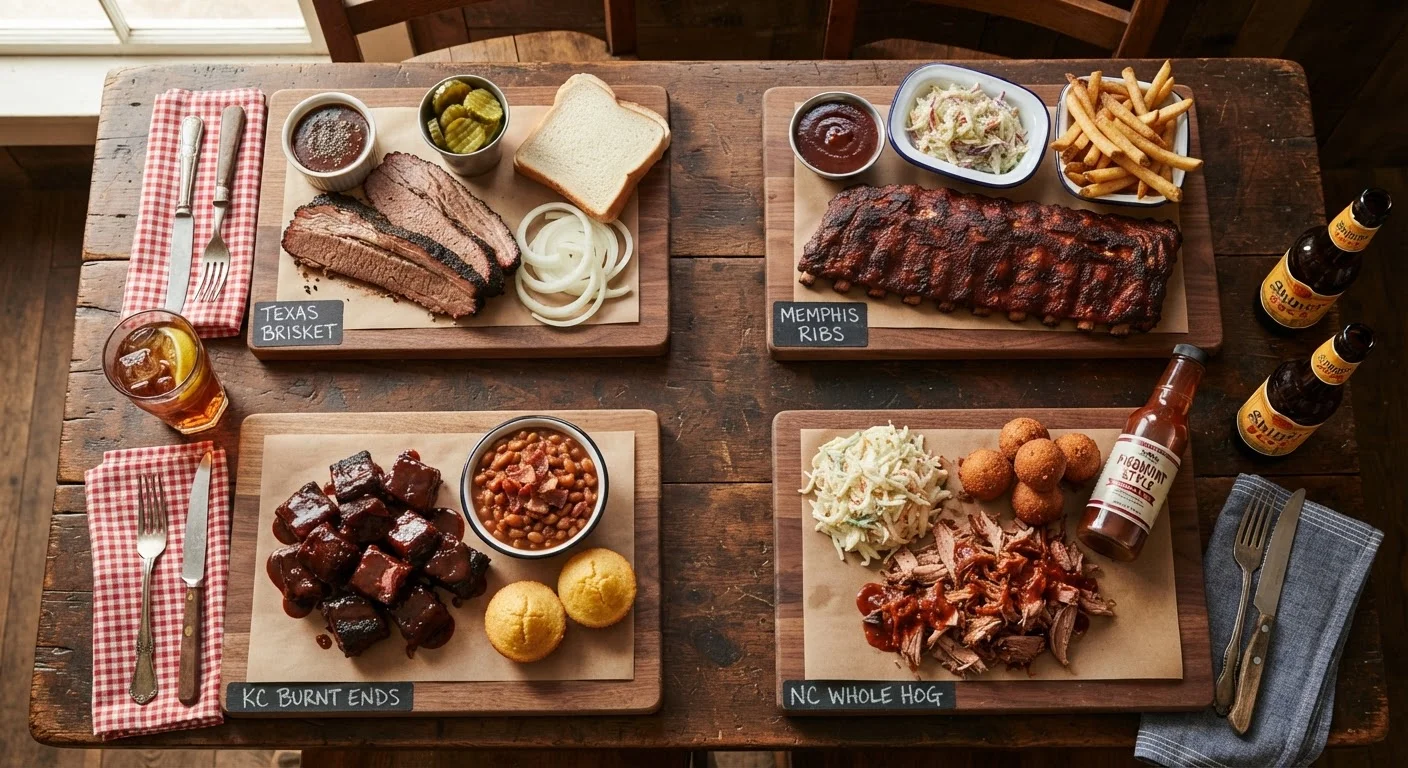
| Primary meat | Beef brisket | Whole hog | Pork ribs | Mixed meats |
| Preferred wood | Post oak | Hickory or oak | Hickory | Hickory or fruit wood |
| Sauce style | Minimal or none | Thin vinegar-pepper | Tomato-sweet or dry rub | Thick molasses-tomato |
| Cooking method | Offset smoker, indirect | Whole-animal pit | Slow smoke, wet or dry | Slow smoke, various cuts |
| Cultural roots | German/Czech butchers | West African & colonial | African American tradition | Meatpacking-era Kansas City |
| Signature dish | Smoked brisket | Pulled whole-hog pork | Dry-rubbed spareribs | Burnt ends |
Texas: Beef, Post Oak, and Minimal Interference
Central Texas BBQ is defined by restraint. Brisket - a tough, fatty cut from the steer's chest - is seasoned with little more than salt and pepper, then smoked over post oak for 12 to 18 hours. The tradition traces directly to 19th-century German and Czech butcher shops in the Hill Country, where meat was smoked as a preservation method and sold by the pound wrapped in butcher paper.
Sauce is often optional, sometimes absent entirely. Purists argue that a well-smoked brisket needs nothing added. The smoke ring - a pink layer just beneath the bark - is considered a badge of craft. East Texas, by contrast, favors pork over beef, uses hickory smoke, and serves chopped or pulled meat with a sweeter, tomato-based sauce, reflecting different settlement and agricultural patterns closer to the Deep South.
The Carolinas: Whole Hog and the Vinegar Debate
The Carolinas may represent America's oldest continuous BBQ tradition. Eastern North Carolina cooks entire hogs over hardwood coals - often hickory or oak - then dresses the pulled meat with a thin, fiery vinegar-and-pepper sauce. No tomato, no sweetener. This approach reflects both the region's hog-farming history and direct continuity with West African whole-animal cooking practices carried by enslaved people.
Move west to the Piedmont and Lexington style emerges: pork shoulder rather than whole hog, and a sauce that introduces a small amount of ketchup for color and mild sweetness. South Carolina adds a third identity with its mustard-based "gold" sauce, rooted in German immigrant settlement. These aren't just flavor preferences - they're geographic identities. The immigrant culinary journeys that reshaped American food are written clearly into Carolina BBQ's sauce map.
Explore Sauce Geography Before You Travel
If you're planning a BBQ road trip, research the subregional sauce traditions before you go - ordering a tomato-based sauce in eastern North Carolina may earn you a polite correction from your pitmaster. Asking locals where they grew up often reveals more about a region's BBQ loyalties than any menu description. Approach each style on its own terms rather than comparing it against a single standard.
Memphis and Kansas City: Ribs, Rubs, and Sweet Sauces
Memphis is rib country. Pork spareribs and baby back ribs dominate, prepared either "dry" - rubbed with a complex spice blend and served without sauce - or "wet," mopped with a sweet, tomato-based sauce during cooking. The dry-rib tradition in particular reflects a philosophy that seasoning skill matters more than sauce. Memphis-style pulled pork sandwiches, topped with creamy coleslaw, are equally iconic.
Kansas City takes an ecumenical approach: almost every meat appears on the menu - beef, pork, chicken, lamb, even burnt ends (the caramelized tips of smoked brisket, now prized in their own right). The defining element is a thick, sweet, smoky sauce built on molasses and tomato. Kansas City's BBQ culture developed alongside its early 20th-century meatpacking industry, with African American pitmasters playing a foundational role often underrecognized in popular accounts.
Just as authenticity in food culture is more complicated than most diners realize, no regional BBQ style owns the title of "real" American barbecue. Each is authentic to its place and people.
What These Traditions Share - and What They Protect
Across all four traditions, the fundamentals are consistent: tough cuts transformed by time, smoke, and carefully managed heat. The social dimension is equally consistent - BBQ is communal food, cooked for crowds, tied to gatherings, celebrations, and the slow rhythm of a day spent outdoors. It's a culinary form that resists shortcuts and rewards patience.
What differs is everything that reflects local identity: the animal, the wood, the rub, the sauce, the serving style. These distinctions aren't arbitrary. They document where people came from, what was available to them, and how they turned necessity and tradition into something worth defending across generations. The ongoing regional debates - which style is superior, which sauce is acceptable - are really arguments about identity and belonging, the same forces explored in how place continues to shape American identity.
Eating your way through these traditions is one of the most direct routes to understanding that America's culinary story is plural, contested, and constantly evolving.