

Key Takeaways
Our Verdict
Each feeding format has genuine strengths and real limitations. Dry food offers practicality and long shelf life; wet food delivers hydration and palatability; raw feeding appeals to owners seeking minimally processed options but demands the most planning and carries the highest safety burden. There is no one-size-fits-all answer - the most appropriate diet is the one that meets your individual pet's nutritional needs and fits your household's realities.
| Best for | Recommended |
|---|---|
| Busy owners seeking convenience and lower cost | Dry food (kibble) |
| Cats or dogs prone to urinary issues or low water intake | Wet food (canned) |
| Experienced owners willing to invest time in nutritional balance and safe handling | Raw diet |
| Pets with dental sensitivities or difficulty chewing | Wet food (canned) |
What Separates These Three Feeding Approaches
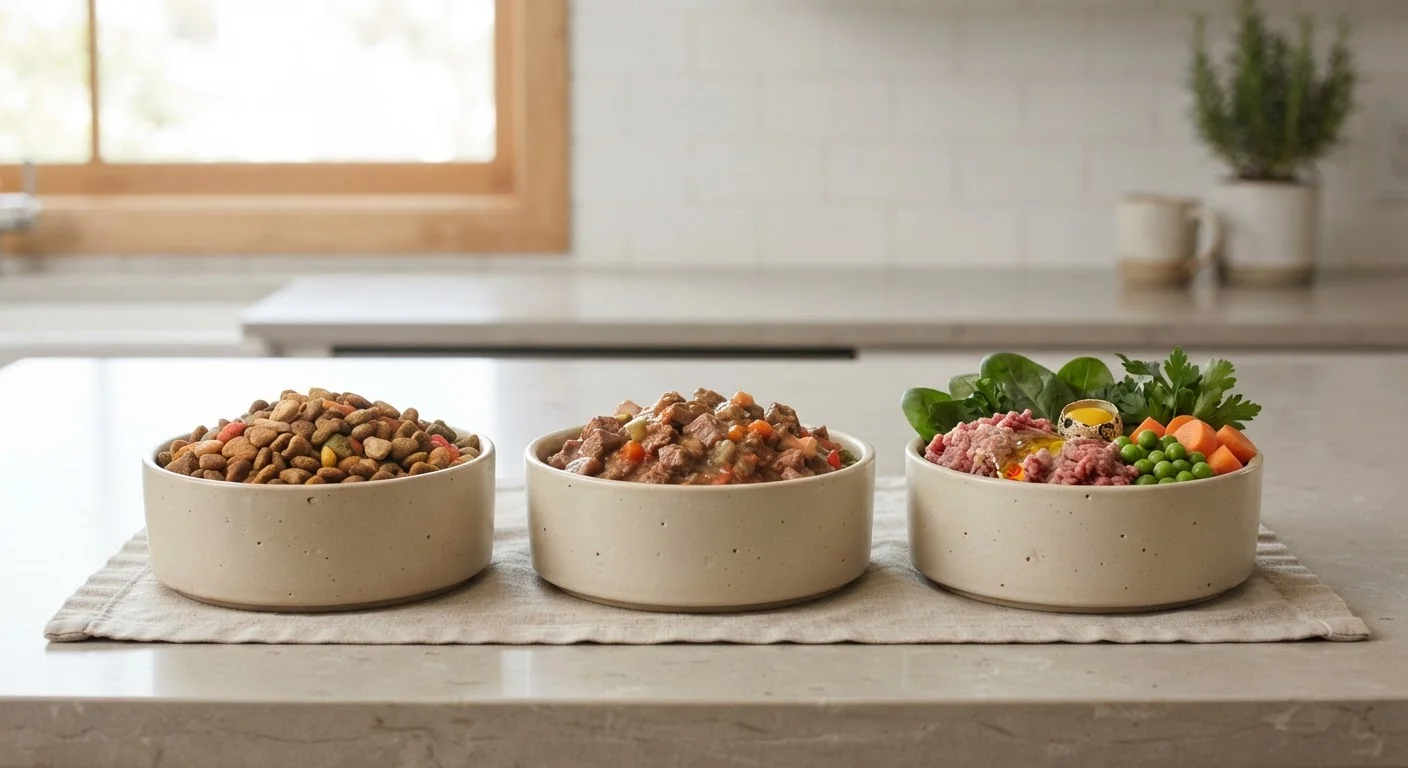
Dry food, wet food, and raw diets are not simply different flavors of the same thing - they differ in processing method, moisture content, ingredient composition, and the practical demands they place on pet owners. Understanding these differences is foundational to making a well-informed choice for your dog or cat.
Dry food (kibble) is manufactured through a high-heat extrusion process that combines proteins, carbohydrates, fats, and added nutrients into shelf-stable pellets. Its low moisture content - typically around 10% - makes it easy to store and portion. Wet food is cooked and sealed in cans or pouches, retaining significantly more moisture (70-80%) and often featuring fewer carbohydrates than kibble. Raw diets typically consist of uncooked muscle meat, organ meat, raw meaty bones, and sometimes fruits or vegetables - either commercially prepared and frozen, or assembled at home by the owner.
For a deeper look at what commercial labels across all three formats actually disclose, see what pet food labels actually tell you.
| Dry Food (Kibble) | Wet Food (Canned) | Raw Diet | |
|---|---|---|---|
| Moisture content | ~10% | ~70-80% | ~60-70% |
| Shelf life (unopened) | 12-18 months | 2+ years | Varies; frozen lasts months |
| Typical cost | Generally lower | Moderate | Often higher |
| Convenience | High - easy to store and serve | Moderate - refrigerate after opening | Low - requires thawing and prep |
| Food safety risk | Low | Low | Higher - bacterial contamination risk |
| Palatability | Variable | Generally high | Generally high |
| Dental benefit claims | Some evidence of mechanical cleaning | Minimal | Mixed evidence |
| Nutritional completeness (commercial) | Regulated; most are AAFCO-compliant | Regulated; most are AAFCO-compliant | Home-prepared may lack balance |
Nutritional Profiles: What Each Format Delivers
All three formats can, in principle, meet a pet's nutritional needs - but the likelihood of that outcome varies considerably depending on the product and how it's prepared.
Most commercial dry and wet foods sold in the U.S. are formulated to meet guidelines established by the Association of American Feed Control Officials (AAFCO), which sets minimum nutrient profiles for dogs and cats at different life stages. An AAFCO nutritional adequacy statement on a label indicates the food has been formulated - or tested - to support complete and balanced nutrition. Understanding what those label claims mean can help owners evaluate products more critically.
Raw diets present a more complex picture. Commercially prepared raw foods often include an AAFCO statement, but home-prepared raw diets - assembled from individual ingredients - frequently fall short of meeting complete nutritional requirements unless carefully formulated with veterinary or veterinary nutritionist guidance. Deficiencies in calcium, phosphorus, zinc, or specific vitamins are documented risks of improperly balanced raw feeding.
70-80%
Moisture in canned pet food
Canned food's high water content can meaningfully contribute to daily fluid intake, particularly relevant for cats, who have a naturally low thirst drive.
~10%
Moisture in dry kibble
Because kibble is so low in moisture, pets eating dry food exclusively rely entirely on their water bowl to meet hydration needs.
17%
Raw pet food samples with Salmonella
A U.S. FDA study of commercially sold raw pet foods found Salmonella in approximately 17% of samples, underscoring food handling concerns.
Hydration, Palatability, and Dental Health
One of the most clinically meaningful differences between these formats is moisture content. Cats in particular evolved as desert animals with a naturally low thirst drive, and many do not compensate adequately when eating only dry food. Chronic mild dehydration may contribute to urinary tract issues in some cats, which is one reason veterinarians sometimes recommend wet food for cats with a history of urinary problems.
Wet food is also generally more palatable - its aroma and texture appeal to many pets that are reluctant eaters, or those whose appetite has diminished with age or illness. This makes it a practical tool during recovery or for senior pets with reduced senses of smell.
Kibble is sometimes credited with dental benefits - the mechanical scrubbing action of crunching dry pellets can reduce tartar buildup compared to wet food. However, the effect is modest and varies by kibble shape and formulation. Dental chews and regular tooth brushing remain more reliable strategies for oral health.
The lifestyle context matters too - for instance, a cat's indoor or outdoor lifestyle can influence energy expenditure and therefore caloric needs, regardless of which food format is chosen.
Raw Feeding: Potential Appeal and Real Risks
Interest in raw diets often stems from a desire to feed pets something closer to what their wild ancestors would have eaten. Proponents cite potential improvements in coat quality, digestion, and energy levels - though robust clinical evidence supporting these claims is limited, and most of what exists is anecdotal.
The risks, by contrast, are well-documented. Raw meat can carry Salmonella, Listeria monocytogenes, E. coli, and other pathogens. The FDA has flagged contamination concerns in commercially sold raw pet foods, and major veterinary organizations - including the American Veterinary Medical Association (AVMA) - caution against raw feeding, particularly in households where vulnerable individuals may be exposed.
Raw Diets and Household Safety
Raw meat-based diets can harbor bacteria such as Salmonella and Listeria - pathogens that pose risks not just to pets but to the people handling the food. The FDA and many veterinary organizations advise particular caution in households with young children, elderly individuals, pregnant people, or anyone who is immunocompromised. Always wash hands and surfaces thoroughly after preparing raw pet food.
For owners committed to raw feeding despite these concerns, working with a board-certified veterinary nutritionist to develop a nutritionally complete recipe and following strict food safety protocols is strongly advisable. Freezing meat before use reduces - but does not eliminate - pathogen risk.
Raw feeding also intersects with broader questions about how minimally processed food compares nutritionally to more processed alternatives - a topic explored in depth at understanding the whole foods versus processed foods spectrum.
Practical Considerations: Cost, Convenience, and Your Pet's Needs
Beyond nutrition, day-to-day practicality shapes which approach is sustainable for most households. Dry food remains the most economical option per calorie and the easiest to store and measure. Wet food costs more per serving but may stretch further when used as a topper or supplement to kibble rather than as the sole diet. Raw diets - particularly commercially prepared frozen varieties - tend to be the most expensive format.
Convenience matters too. Kibble can be left in a bowl without spoiling quickly; wet food must be refrigerated after opening and used within a day or two; raw food requires thawing, handling, and thorough cleaning of prep surfaces and feeding bowls after every meal.
Transitioning Between Food Types
When switching your pet's diet from one format to another, a gradual transition over seven to ten days helps prevent digestive upset. Start by mixing a small amount of the new food with the old, slowly increasing the proportion. If your pet shows persistent vomiting, diarrhea, or appetite loss during the change, consult your veterinarian.
Some owners combine formats - using kibble as the daily base and adding wet food for palatability or hydration - and this hybrid approach is generally considered safe, provided the total diet remains nutritionally balanced and portion sizes are adjusted to avoid overfeeding.
Whatever approach you're considering, it's worth being aware of feeding habits that can quietly undermine a pet's health, including inconsistent schedules and inappropriate supplementation.
For owners specifically focused on dogs, a more detailed format-by-format analysis is available at dry food, wet food, and raw diets compared for dogs.
This article is for general informational purposes only and is not a substitute for professional veterinary advice. Always consult a licensed veterinarian before making significant changes to your pet's diet, particularly if your pet has underlying health conditions.