

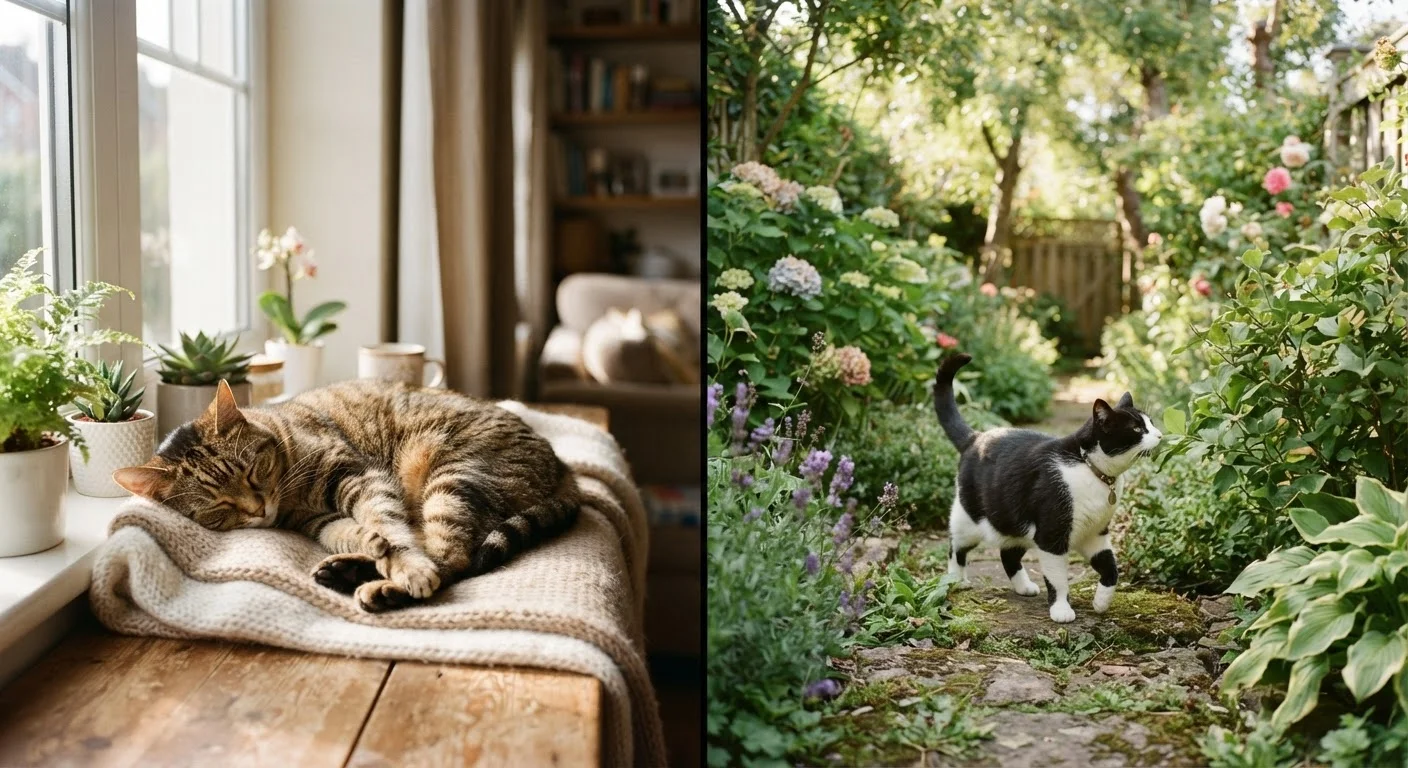
Key Takeaways
Option A
Indoor Lifestyle
The controlled, longer-lived choice.
Best for: Owners in urban or high-traffic areas who prioritize longevity and safety over maximum environmental stimulation.
Option B
Outdoor Lifestyle
The stimulating, higher-risk alternative.
Best for: Cats in low-traffic rural or suburban settings with owners who accept elevated risk in exchange for natural enrichment.
If you live near busy roads or in a dense urban area
Indoor Lifestyle
Traffic and urban hazards pose serious injury and mortality risks. A stimulating indoor environment is a far safer alternative.
If your cat was raised outdoors and shows persistent distress indoors
Outdoor Lifestyle
Some cats, particularly feral-raised or previously outdoor animals, may experience chronic stress when fully confined indoors.
If you want the longest possible lifespan for your cat
Indoor Lifestyle
Research consistently links indoor living with substantially longer average lifespans due to fewer injury and disease exposures.
If enrichment and behavioral health are your primary concerns
Indoor Lifestyle with supervised outdoor access
A leash-walked or catio-equipped indoor cat can enjoy outdoor stimulation without the mortality risks of free roaming.
If you live in a rural, low-traffic setting with minimal predator pressure
Outdoor Lifestyle
Risk levels are meaningfully lower in low-density environments, though parasites, disease, and wildlife encounters remain real considerations.
The Lifespan and Safety Gap
One of the most consistently cited findings in feline health research is the lifespan difference between indoor and outdoor cats. Veterinary organizations generally estimate that indoor cats live an average of 12-18 years, while outdoor cats average closer to 2-5 years - a gap driven primarily by injury, infectious disease, and predation rather than any intrinsic biological difference.
Outdoor cats face a wide range of hazards that indoor cats simply do not: vehicle traffic, exposure to toxins such as antifreeze or rodenticides, attacks from dogs or wildlife, and transmission of diseases including feline leukemia virus (FeLV) and feline immunodeficiency virus (FIV) through contact with other cats. Parasites - fleas, ticks, intestinal worms, and ear mites - are also dramatically more prevalent in cats with outdoor access.
These aren't marginal concerns. In heavily urbanized areas, traffic alone accounts for a substantial proportion of outdoor cat deaths and injuries seen in veterinary emergency settings. Owners who live near high-speed roads should weigh this risk heavily when considering their cat's living arrangement.
| Criterion | Indoor Lifestyle | Outdoor Lifestyle |
|---|---|---|
| Average lifespan | 12-18 years | 2-5 years |
| Traffic and injury risk | Minimal | High, especially near roads |
| Infectious disease exposure | Low (FeLV, FIV, etc.) | Significantly elevated |
| Parasite burden | Low with routine prevention | Consistently higher |
| Behavioral stimulation | Requires deliberate enrichment | Naturally high |
| Obesity risk | Higher without active play | Lower due to activity levels |
| Wildlife predation impact | None | Cats kill billions of birds annually |
| Owner control over environment | High | Low |
Behavioral and Mental Health Considerations
Safety statistics tell only part of the story. Cats are obligate predators with deeply ingrained hunting instincts, and the behavioral implications of confinement are real. Indoor cats that lack adequate stimulation are at higher risk for obesity, anxiety, repetitive behaviors (sometimes called stereotypies), and stress-related conditions such as feline idiopathic cystitis. Understanding why cats exhibit hunting behavior is useful context - these instincts don't disappear indoors, they simply need appropriate outlets.
The good news is that enrichment can meaningfully close this gap. Puzzle feeders, climbing structures, interactive play sessions, and window perches with bird-feeder views all engage the predatory drive. For practical strategies, see our guide to keeping an indoor cat mentally and physically stimulated.
Outdoor cats, by contrast, receive constant novel stimulation - new smells, terrain, prey animals, and social information - which naturally satisfies many of these behavioral needs. However, this enrichment comes packaged with unpredictable stressors including territorial disputes with other cats, which can be a significant chronic stress source of their own.
The Conservation Dimension
Outdoor cats are widely recognized as a significant threat to native wildlife, particularly birds and small mammals. Studies in the United States have estimated that free-ranging cats kill billions of birds and small mammals annually, making this an ecological consideration alongside the personal health and safety factors. This doesn't automatically resolve the debate for individual owners, but it is a meaningful part of the broader picture when assessing the full impact of outdoor access.
Finding a Middle Ground
For many owners, a hybrid approach offers a workable balance between safety and enrichment. Supervised leash walks, enclosed outdoor patios (commonly called "catios"), and securely fenced garden spaces allow cats to experience outdoor stimulation without unsupervised roaming. These solutions are increasingly popular and, when well-designed, address the behavioral needs that drive some owners toward full outdoor access.
Diet and preventive veterinary care also play a role in long-term feline health regardless of lifestyle. Cats living indoors may be more prone to weight gain from lower activity levels - something diet composition and portion control can help address. Regular veterinary check-ups, vaccinations, and parasite prevention are important for all cats but are non-negotiable for those with any outdoor exposure.
Ultimately, no single answer fits every cat or every household. A cat's age, health status, prior living experience, and temperament all matter - as does the physical environment the owner can provide. The research supports indoor living as the safer default, particularly in urban settings, but thoughtful owners can make either arrangement work by actively managing the risks specific to their situation. Consult your veterinarian if you're unsure which approach is appropriate for your individual cat's needs.
This article is for general informational purposes only and does not constitute veterinary advice. Always consult a licensed veterinarian for guidance specific to your pet's health and circumstances.