

Key Takeaways
Option A
Whole Foods
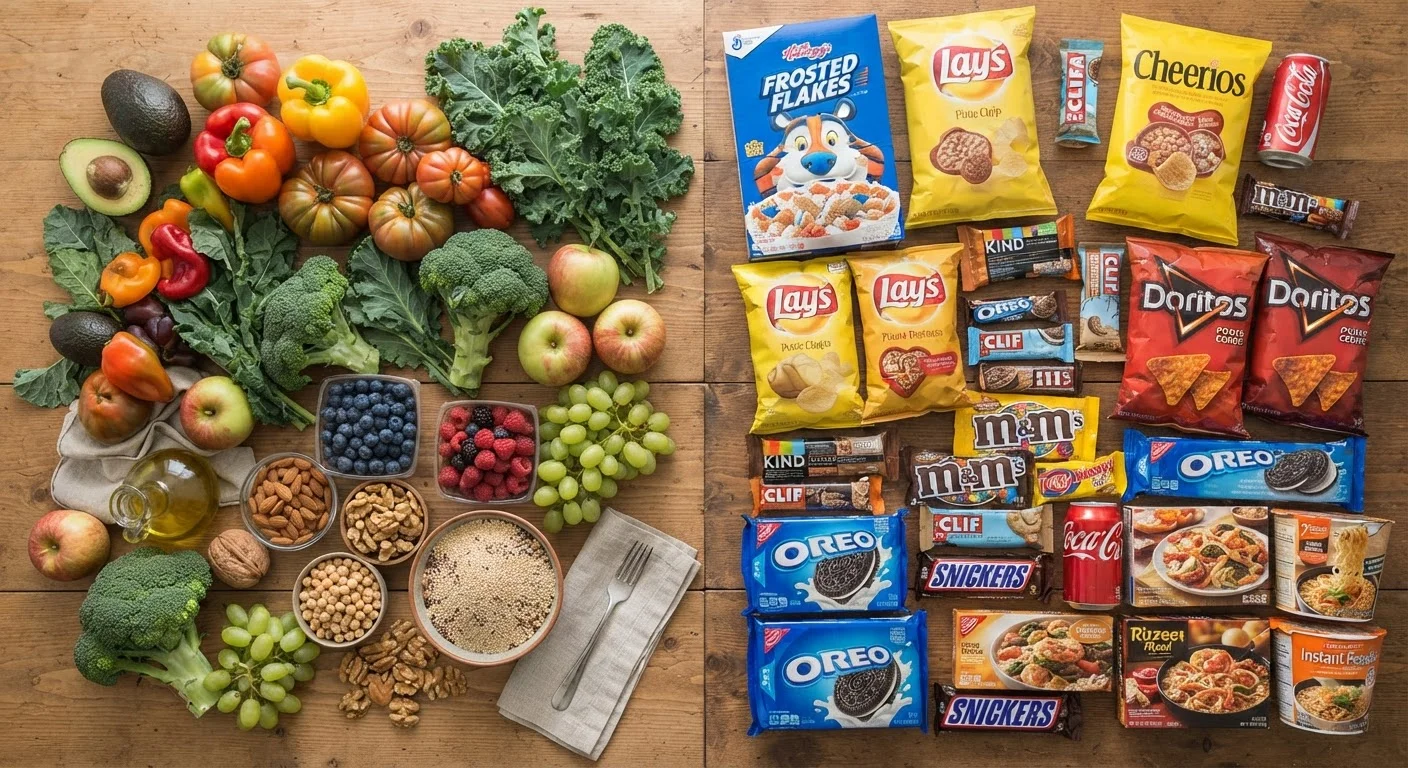
Foods closest to their natural state, with minimal alteration.
Best for: People looking to maximize nutrient density and fiber intake through diet.
Option B
Processed Foods
Foods altered from their original form - ranging from minimally to heavily changed.
Best for: Understanding that 'processed' covers a wide range, from frozen vegetables to packaged snack foods.
If you want to maximize nutrient density and fiber
Whole Foods
Whole foods like vegetables, legumes, and whole grains consistently deliver higher fiber and micronutrient content with fewer additives.
If convenience and budget are primary concerns
Processed Foods
Minimally processed options such as canned tomatoes, frozen vegetables, and plain rolled oats offer strong nutrition without sacrificing practicality.
If you are trying to reduce added sugar and sodium intake
Whole Foods
Whole foods contain little to no added sugars or sodium, making them a stronger foundation for people managing these dietary factors.
If you want to apply a nuanced, sustainable approach to eating
Whole Foods
Prioritizing whole foods while selectively including minimally processed options is broadly supported by nutrition research as a practical long-term strategy.
What 'Whole Food' and 'Processed Food' Actually Mean
The terms whole food and processed food get used constantly in nutrition conversations, but they often generate more confusion than clarity. A whole food is generally understood as one that has undergone little to no alteration from its natural state - think a raw apple, a handful of walnuts, or a dried lentil. What you see is essentially what grew.
Processed food, by contrast, refers to any food that has been deliberately changed from its original form before it reaches your plate. That definition, however, is remarkably broad. Washing, cutting, freezing, cooking, fermenting, pasteurizing - all of these technically count as processing. By this standard, plain frozen spinach is a processed food, and so is plain Greek yogurt.
The practical problem is that lumping all processed foods together obscures enormous differences in nutritional quality. Understanding the spectrum - rather than the binary - is what actually helps people make sense of food labels and dietary guidance. For a deeper look at one specific segment of this spectrum, see what ultraprocessed food actually means.
Processing Isn't Inherently Harmful
The word 'processed' carries a negative connotation in popular nutrition discourse, but processing itself is neutral - it describes a method, not an outcome. Pasteurization makes milk safer. Freezing preserves nutrients in vegetables. Fermentation creates beneficial probiotics in yogurt and kefir. What matters nutritionally is the degree and purpose of processing, not the fact of it.
The Processing Spectrum: From Minimal to Ultra
Nutrition researchers have developed classification systems to add precision here. The most widely cited is NOVA, developed by researchers at the University of São Paulo. NOVA groups foods into four categories based on the extent and purpose of processing - not just nutrient content.
- Group 1 - Unprocessed or minimally processed: Fruits, vegetables, plain meat, eggs, milk, plain dried legumes. These are foods altered only by drying, crushing, freezing, or pasteurizing - changes that don't add substances or fundamentally change the food's character.
- Group 2 - Processed culinary ingredients: Oils, butter, flour, salt, sugar. These are extracted from natural foods and used in cooking, not typically eaten on their own.
- Group 3 - Processed foods: Canned vegetables, cheese, cured meats, freshly baked breads. These combine Group 1 and Group 2 items and may include preservation methods like salting or fermentation.
- Group 4 - Ultraprocessed foods: Soft drinks, packaged snacks, reconstituted meat products, flavored cereals. These typically contain additives - emulsifiers, artificial flavors, colorings - not found in home kitchens, and are formulated for palatability rather than nutrition.
Most nutrition concern centers on Group 4. Research published in journals including The BMJ and JAMA Internal Medicine has associated high ultraprocessed food consumption with poorer health outcomes, though researchers continue to study the causal mechanisms.
| Criterion | Whole Foods | Processed Foods (Spectrum) |
|---|---|---|
| Definition | Little to no alteration from natural state | Any deliberate change before consumption |
| Examples | Fresh fruit, raw nuts, dried lentils | Frozen veggies to packaged snack cakes |
| Fiber content | Generally high in plant-based forms | Varies; often lower in ultraprocessed |
| Added sugar | None | Common in ultraprocessed products |
| Sodium | Naturally low | Frequently elevated in processed forms |
| Additives | None | Ranges from none to many emulsifiers/flavors |
| Nutrient density | Typically high | Highly variable across the spectrum |
| Convenience | Requires preparation | Often ready-to-eat or quick to prepare |
| Shelf life | Often short | Extended by preservation methods |
Nutritional Trade-offs Across the Spectrum
Whole and minimally processed foods tend to deliver advantages that matter nutritionally: more dietary fiber, a wider array of vitamins and minerals, and fewer additives like added sodium or sugar. Fiber, in particular, is one nutrient most Americans fall short on - and it's found almost exclusively in plant-based whole foods. For more on how fiber types differ in function, see soluble vs. insoluble fiber.
Processed foods, especially at the ultraprocessed end, tend to be engineered for convenience and palatability - often at the cost of fiber, micronutrients, and proportional macronutrient balance. Added sugars and refined fats frequently replace more nutritious components. For a closer look at that specific trade-off, added sugar versus natural sugar is worth reviewing.
That said, some processing genuinely enhances nutrition. Fortification adds vitamins to foods that might otherwise lack them. Fermentation produces probiotics. Cooking increases the bioavailability of certain compounds in tomatoes and legumes. Context and degree of processing both matter when assessing a food's actual nutritional contribution.
~57%
Share of US calories from ultraprocessed foods
Research published in BMJ Open estimated that ultraprocessed foods account for roughly 57% of daily energy intake among US adults.
17g
Average daily fiber intake for US adults
The CDC and dietary surveys consistently show US adults consume well below the recommended 25-38g of daily fiber, with whole foods being the primary source.
4 groups
NOVA food classification categories
The NOVA system, developed by researchers at the University of São Paulo, classifies all foods into four groups based on degree and purpose of industrial processing.
How to Think About This Practically
Rather than labeling individual foods as categorically good or bad, most registered dietitians and nutrition researchers recommend focusing on overall dietary patterns. A diet built primarily around whole and minimally processed foods - vegetables, fruits, whole grains, legumes, plain dairy, eggs, and lean proteins - provides a strong nutritional foundation. This is consistent with guidance from bodies like the U.S. Dietary Guidelines Advisory Committee.
This doesn't mean avoiding all processed foods. Canned beans, frozen vegetables without added sauces, plain yogurt, and rolled oats are all processed by definition - and all nutritionally solid options. The Nutrition & Wellness hub provides broader context on building balanced eating habits using this kind of spectrum-based thinking.
Practically speaking, a useful heuristic is to look at ingredient lists. Shorter lists with recognizable ingredients generally indicate less intensive processing. Heavy use of additives, refined starches, or multiple forms of added sugar are markers of ultraprocessed formulation. Protein quality is another dimension worth understanding - see why protein sources differ in quality for more on that.
This article is for general informational and educational purposes only and is not a substitute for advice from a registered dietitian or qualified healthcare professional. Individual nutritional needs vary - consult a professional for personalized guidance.