

Key Takeaways
Pet Food Label
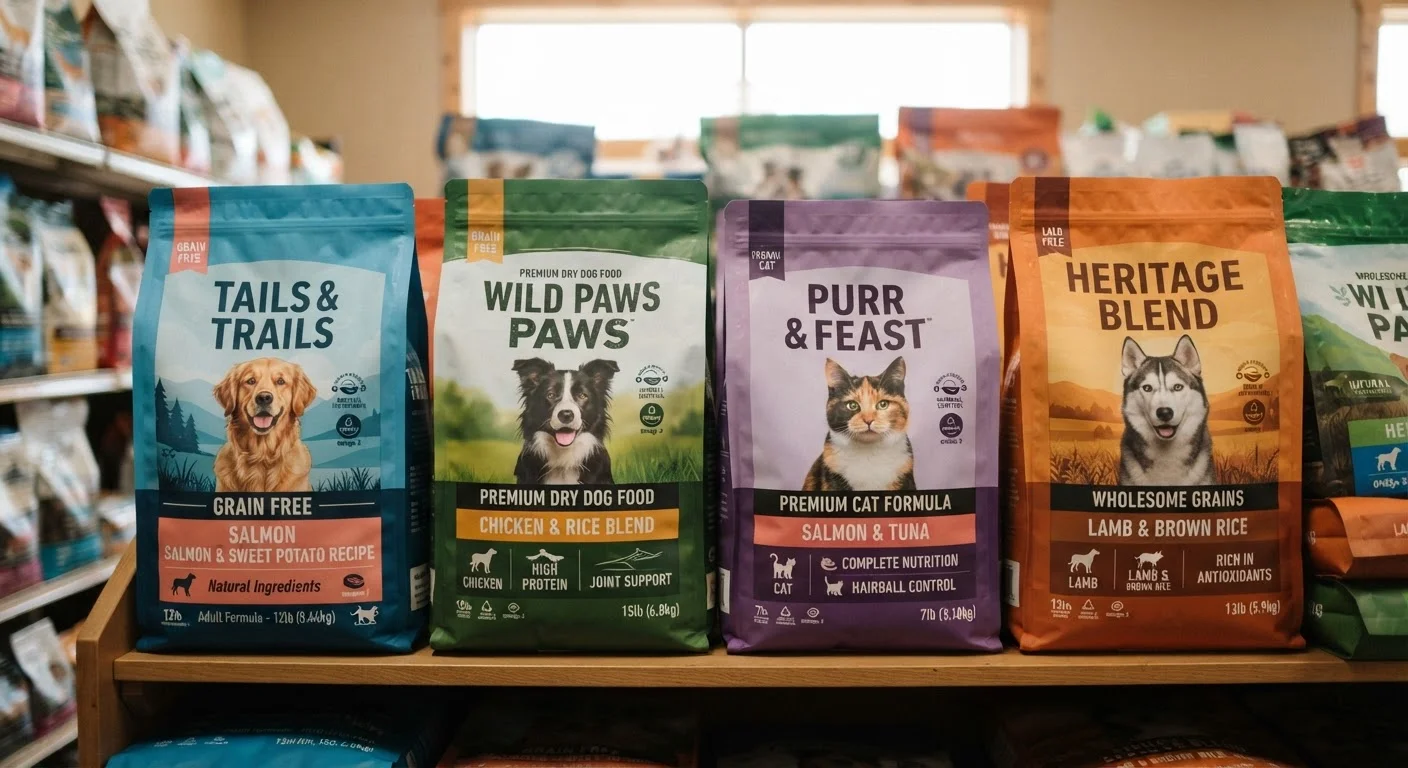
A pet food label is the regulated set of information printed on commercial pet food packaging. It must include specific elements - such as an ingredient list, guaranteed analysis, feeding directions, and a nutritional adequacy statement - as required by federal and state regulations. Together, these sections are meant to help pet owners understand what they're feeding their animals and whether it meets basic nutritional standards.
In the United States, pet food labeling is governed by the FDA and enforced at the state level through model regulations developed by the Association of American Feed Control Officials (AAFCO). Individual states may adopt AAFCO guidelines differently, so requirements can vary slightly by state.
The Five Mandatory Label Elements
Every commercial pet food sold in the United States must carry five core label elements: the product name, the net quantity of contents, the manufacturer's name and address, the ingredient list, and the guaranteed analysis. A nutritional adequacy statement and feeding directions are also required. Understanding what each of these sections can - and cannot - tell you is the foundation of smarter label reading.
The product name alone follows regulatory naming rules. If a product is called 'Salmon Cat Food,' it must contain at least 70% salmon by weight. A name like 'Salmon Dinner' or 'Salmon Entrée' only requires 10% salmon. A product 'with Salmon' needs just 3%. These thresholds, established under AAFCO guidelines, mean the name itself carries meaningful nutritional information most owners overlook. For a broader glossary of terms you'll encounter across pet and human nutrition labels, see Nutrition Terms Every Label Reader Should Recognize.
State-Level Variation in Enforcement
While AAFCO develops the model regulations that govern pet food labeling, individual states decide whether and how to adopt them. Most states follow AAFCO guidelines closely, but enforcement capacity and specific rules can vary. The FDA also maintains oversight of pet food safety under the Federal Food, Drug, and Cosmetic Act, providing a federal baseline layer of regulation.
How the Ingredient List Works - and Where It Falls Short
Ingredients are listed by pre-cooking weight in descending order. This sounds straightforward, but moisture content significantly distorts the picture. Fresh chicken, for example, is roughly 70% water by weight. After cooking, its contribution to the final product shrinks considerably - yet it may still appear first on the list, ahead of ingredients that ultimately supply more dry-weight nutrition.
Ingredient splitting is another common pattern worth recognizing. If a manufacturer lists 'ground corn,' 'corn gluten meal,' and 'corn flour' separately, each appears lower on the list than if they were combined - even though corn represents a significant total proportion. This is not inherently deceptive, but it's worth understanding when evaluating how prominently a single ingredient type features in the food. Cat Nutrition Labels Decoded covers ingredient list interpretation in detail for cat owners specifically.
Labels also cannot tell you how ingredients were processed, their digestibility, or where they were sourced - all factors that can influence nutritional quality in ways packaging alone doesn't reflect.
3%
Minimum ingredient required for 'with [ingredient]' claim
Under AAFCO naming rules, a product labeled 'with Salmon' only needs to contain 3% salmon by weight, compared to 95% for a single-ingredient named product.
4
Required guaranteed analysis nutrients on every label
All commercial pet foods must list minimum crude protein, minimum crude fat, maximum crude fiber, and maximum moisture in the guaranteed analysis panel.
10%
Minimum for 'Dinner,' 'Entrée,' or 'Platter' named products
AAFCO rules require that combination descriptor names like 'Chicken Dinner' contain at least 10% of the named ingredient, not the 95% required for a straightforward named product.
Guaranteed Analysis: Useful, But Limited
The guaranteed analysis panel lists crude protein (minimum), crude fat (minimum), crude fiber (maximum), and moisture (maximum). These are regulatory boundaries, not precise measurements of what's actually in the bag or can. The word 'crude' refers to the chemical testing method used - it measures nitrogen content to estimate protein, for instance - not the protein's digestibility or biological value for your pet.
Comparing guaranteed analysis numbers across wet and dry foods is also tricky without converting to a dry matter basis, because moisture content differs dramatically. A canned food at 78% moisture and a kibble at 10% moisture aren't directly comparable on a percentage-by-percentage basis. For a look at how different food formats compare in practical terms, Dry Food, Wet Food, and Raw Diets for Dogs offers a useful side-by-side overview.
The AAFCO Nutritional Adequacy Statement
Perhaps the most important line on any pet food label is the AAFCO nutritional adequacy statement. It declares whether the food is intended as complete and balanced nutrition for a specific life stage - such as growth (puppy or kitten), adult maintenance, reproduction, or all life stages - or whether it's a supplemental or intermittent food not meant to be fed alone.
A food can qualify in one of two ways: by being formulated to meet AAFCO's nutrient profiles, or by passing a feeding trial conducted according to AAFCO protocols. Feeding trial foods have been tested in live animals, while formulation-only claims are calculated on paper. Neither method guarantees a food is ideal for every individual pet - health conditions, breed, age, and activity level all matter - but the statement does confirm that the food clears a regulated minimum standard.
Marketing language like 'holistic,' 'premium,' or 'human grade' carries no regulated AAFCO definition and should not be treated as a quality indicator. Certifications and Safety Marks: Which Ones Actually Mean Something explains how to evaluate certification language across consumer products more broadly.
This article is for general informational purposes only and is not a substitute for personalized veterinary advice. Always consult your veterinarian before making significant changes to your pet's diet.