

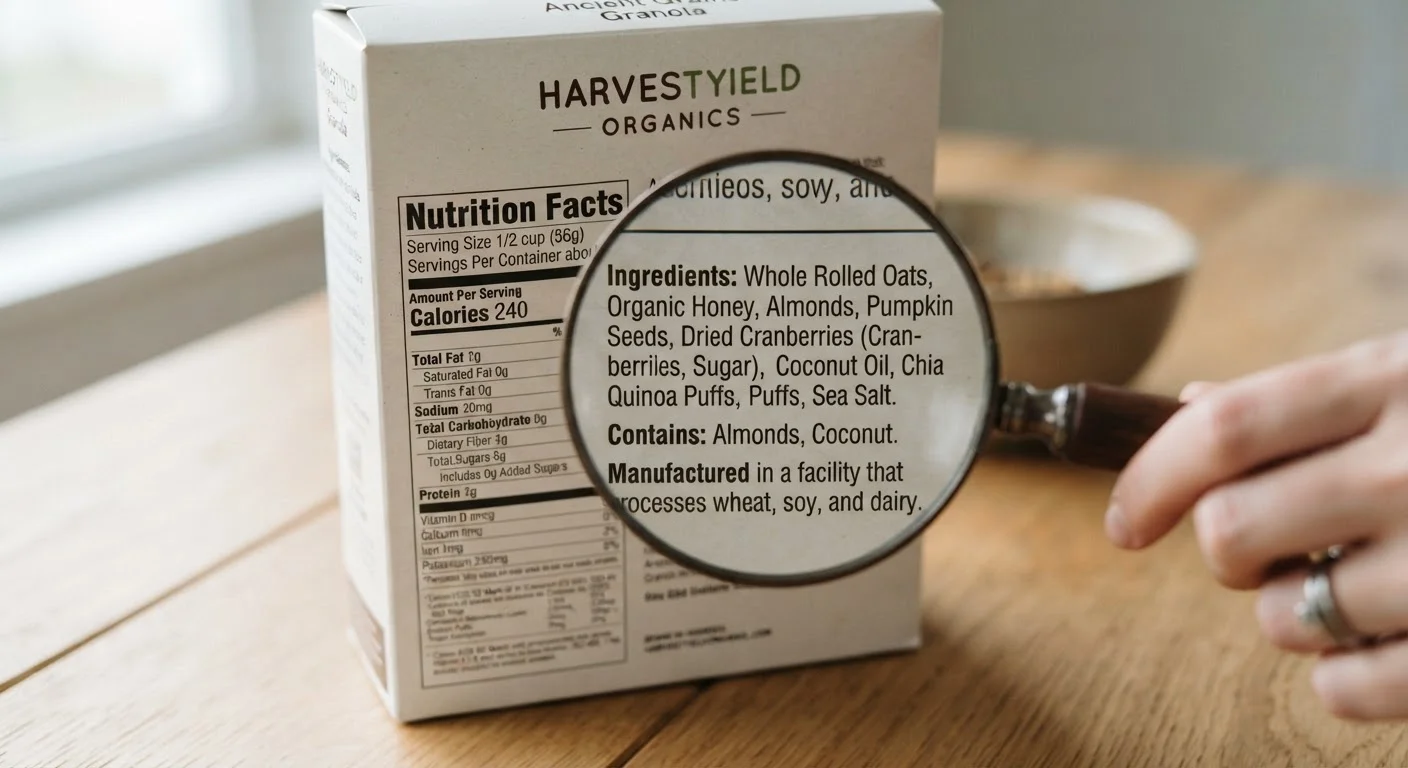
| Nutrients listed on FDA labels | Over 30 required or voluntary entries (U.S. Food & Drug Administration) |
| Daily Value calorie baseline | 2,000 calories per day (FDA Nutrition Facts label standards) |
| Essential amino acids | 9 (must come from food) (National Institutes of Health) |
| Dietary fiber intake gap | Most Americans get about half the recommended amount (Dietary Guidelines for Americans, 2020-2025) |
| Added sugars limit (general guidance) | Less than 10% of total daily calories (Dietary Guidelines for Americans, 2020-2025) |
Why Nutrition Vocabulary Matters
Walk down any grocery aisle and you'll encounter a cascade of terms - enriched, fortified, bioavailable, complete protein - that can feel more like marketing noise than meaningful information. But these words carry precise definitions, and knowing them gives you a practical advantage every time you read a label or a health article.
This reference guide covers the core nutrition terms you're most likely to encounter, explained plainly and without judgment. For a deeper look at how every line of the Nutrition Facts panel works together, see The Nutrition Facts Label, Line by Line.
This Article Is for General Education
The definitions here are intended to help you understand nutrition terminology - not to guide personal dietary decisions or medical treatment. If you have specific health conditions or nutritional concerns, consult a registered dietitian or your healthcare provider for personalized guidance.
Core Terms: The Glossary
The definitions below cover the terms most commonly found on food labels, in dietary guidelines, and in nutrition research. Use this as a quick-reference resource whenever a term stops you in your tracks.
For a focused look at vitamins and minerals specifically, Micronutrients: A Plain-Language Reference Guide offers a lookup-friendly breakdown of each essential micronutrient and the foods associated with it.
Putting the Terms in Context
These definitions become more useful when you see how they interact. Consider nutrient density alongside serving size: a food can appear high in vitamins on the label but deliver far less if the serving size is unrealistically small. Similarly, bioavailability explains why two foods with identical calcium content on a label may not deliver equal benefit - absorption depends on the food matrix and other nutrients present.
The distinction between enriched and fortified matters when evaluating processed grain products. Enriched means nutrients were restored; fortified means something new was added. Neither term automatically makes a food healthy or unhealthy - context is everything.
| Nutrients listed on FDA labels | Over 30 required or voluntary entries (U.S. Food & Drug Administration) |
| Daily Value calorie baseline | 2,000 calories per day (FDA Nutrition Facts label standards) |
| Essential amino acids | 9 (must come from food) (National Institutes of Health) |
| Dietary fiber intake gap | Most Americans get about half the recommended amount (Dietary Guidelines for Americans, 2020-2025) |
| Added sugars limit (general guidance) | Less than 10% of total daily calories (Dietary Guidelines for Americans, 2020-2025) |
Understanding complete vs. incomplete proteins is especially relevant if you follow a predominantly plant-based diet. For a deeper comparison, Plant-Based Protein vs. Animal Protein walks through amino acid profiles and bioavailability side by side. And to understand how macronutrients function once they're absorbed, see What Macronutrients Actually Do Inside Your Body.
If you find yourself reading about ultraprocessed foods or NOVA classifications in the news, What 'Ultraprocessed Food' Actually Means provides clear context on what that category includes and why researchers study it. For fiber specifically - one of the most underconsumed nutrients in the American diet - Dietary Fiber: The Nutrient Most Americans Don't Get Enough Of covers the differences between soluble and insoluble types in accessible terms.
This article is intended for general informational purposes only and is not a substitute for personalized medical or dietary advice. Consult a qualified healthcare professional or registered dietitian for guidance specific to your health needs.