

| Regulatory body | U.S. Food and Drug Administration (FDA) |
| Current label format effective | Fully phased in by January 2021 (FDA) |
| Reference daily calorie intake | 2,000 calories (adult average) (FDA label reference amount) |
| Required nutrients listed | 14 (including vitamins D, calcium, iron, potassium) (FDA Nutrition Facts label requirements) |
| %DV threshold for 'high' nutrient | 20% DV or more per serving (FDA) |
| %DV threshold for 'low' nutrient | 5% DV or less per serving (FDA) |
Why the Nutrition Facts Label Exists
The Nutrition Facts label is a federally mandated tool regulated by the U.S. Food and Drug Administration (FDA). Its purpose is straightforward: give consumers standardized, consistent information about what they're eating. The current label format was updated in 2016 and fully phased in by 2021, reflecting newer science on nutrition and public health. Once you understand each line, the label becomes one of the most reliable nutrition tools available - no nutrition expertise required.
For a complementary perspective, see how to decode an ingredient list, which covers what comes after the label itself.
| Regulatory body | U.S. Food and Drug Administration (FDA) |
| Current label format effective | Fully phased in by January 2021 (FDA) |
| Reference daily calorie intake | 2,000 calories (adult average) (FDA label reference amount) |
| Required nutrients listed | 14 (including vitamins D, calcium, iron, potassium) (FDA Nutrition Facts label requirements) |
| %DV threshold for 'high' nutrient | 20% DV or more per serving (FDA) |
| %DV threshold for 'low' nutrient | 5% DV or less per serving (FDA) |
Serving Size and Servings Per Container
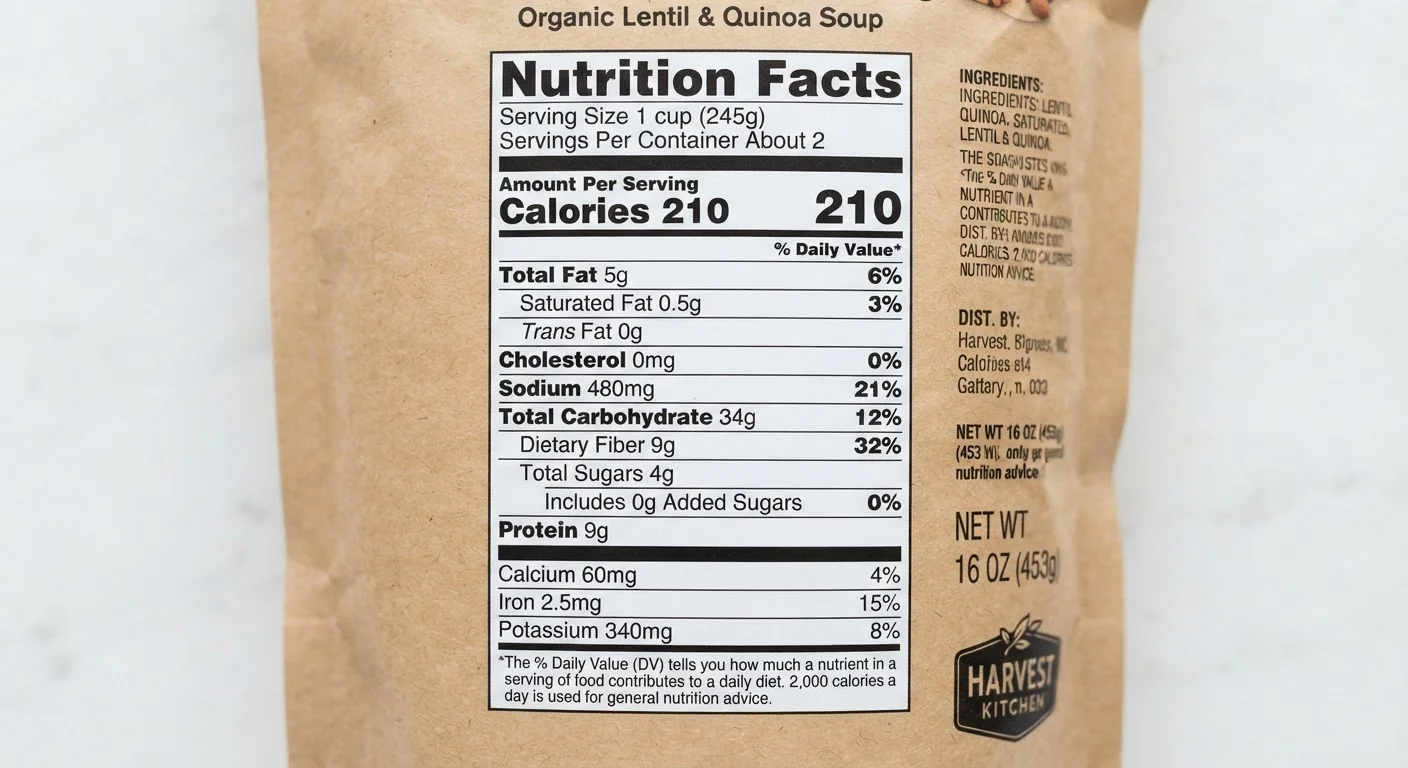
Serving size anchors everything else on the label. It reflects the amount people typically eat in one sitting - not a recommendation - and is now based on updated FDA reference amounts that better reflect real consumption patterns. All nutrient values listed on the label apply to one serving.
Servings per container tells you how many of those portions are in the package. If a bag of chips lists 2.5 servings and you eat the whole bag, you've consumed 2.5 times every value shown. This is one of the most commonly overlooked details on any label.
Serving size
The standardized amount of food used as the reference for all nutrient values on the label. It reflects typical consumption patterns, not a dietary recommendation.
% Daily Value (%DV)
The percentage of a nutrient's recommended daily intake provided by one serving, based on a 2,000-calorie reference diet. It helps compare foods quickly without doing math.
Added sugars
Sugars and syrups added to foods during processing or preparation, distinct from naturally occurring sugars in whole foods like fruit or milk.
Dietary fiber
A type of carbohydrate the body cannot fully digest. It supports digestive health and is considered a nutrient of public health importance in the U.S.
Saturated fat
A type of fat found mainly in animal products and some tropical oils. Dietary guidelines generally suggest limiting it, as high intake has been associated with elevated LDL cholesterol.
Trans fat
An industrially produced fat formed when liquid oils are partially hydrogenated. The FDA has effectively banned artificial trans fats; any amount listed is trace or naturally occurring.
Calories
Calories measure the total energy one serving provides. The updated label displays this number in a larger, bolder font than previous versions - a deliberate design choice to make it easier to spot at a glance. Calories come from three macronutrients: carbohydrates, protein, and fat. The label no longer lists "Calories from Fat" separately, since research shows the type of fat matters more than the raw calorie count from fat alone.
General federal dietary guidance uses 2,000 calories per day as a reference point for adults, though individual needs vary based on age, sex, activity level, and health status. For personalized caloric guidance, consult a registered dietitian or your healthcare provider.
The Nutrient Lines: What Each One Tells You
Below calories, the label lists specific nutrients in two groups:
- Nutrients to be mindful of: Total Fat, Saturated Fat, Trans Fat, Cholesterol, and Sodium. These appear first because most Americans consume them in amounts that may exceed recommended levels.
- Nutrients often under-consumed: Dietary Fiber, Vitamin D, Calcium, Iron, and Potassium. The FDA requires these because they are nutrients of public health concern in the U.S. population.
Total Carbohydrate is broken into Dietary Fiber and Total Sugars, with Added Sugars listed as a subcategory beneath Total Sugars. Added sugars are those incorporated during processing - distinct from naturally occurring sugars in fruit or dairy. Protein closes out the main nutrient section.
For deeper context on vitamins and minerals listed, this plain-language micronutrient reference guide is a useful companion.
70%+
U.S. adults who use nutrition labels
According to FDA consumer research, a majority of U.S. adults report using the Nutrition Facts label when making food choices.
2021
Year updated label format was fully required
The FDA's redesigned label, emphasizing added sugars and updated serving sizes, was required for all manufacturers by January 2021.
14
Nutrients required on every label
The current FDA format mandates disclosure of 14 specific nutrients, up from 13 in the previous version, adding potassium as a required listing.
Percent Daily Value (%DV): The Most Misunderstood Line
The % Daily Value column on the right side of the label shows how much of a nutrient one serving contributes toward the recommended daily intake for an average adult eating 2,000 calories per day. It's a quick benchmark, not a precise target for any individual.
A practical rule of thumb: 5% DV or less is considered low for a nutrient; 20% DV or more is considered high. Use this to quickly identify foods that are high in fiber or calcium, or foods that are high in sodium or saturated fat - whichever matters most to your health context.
Note that Trans Fat, Total Sugars, and Protein do not have a %DV listed. For trans fat, no safe daily reference amount has been established. For protein, a %DV is only required when a product makes a protein-related claim.
The full walkthrough of reading a nutrition label without confusion explores these nuances in additional detail. You can also explore common nutrition terms every label reader should know to build your overall vocabulary.
This article is for general informational and educational purposes only and is not a substitute for personalized medical or dietary advice. Consult a qualified healthcare professional or registered dietitian for guidance specific to your health needs.