

Key Takeaways
Why Knife Skills Matter More Than Recipes
Home cooks often spend more time at the cutting board than at the stove. Yet most cooking instruction skips straight to recipes without addressing the foundational skill that shapes every dish: how you handle a knife. Irregular cuts cook unevenly - thick pieces remain underdone while thin ones overcook. Slow prep makes weeknight cooking feel like a burden. And a poorly controlled knife is a genuine safety hazard.
The good news is that knife proficiency doesn't require years of culinary school. A handful of well-practiced techniques carry you through nearly everything you'll make at home. Once they become second nature, you'll move through prep faster and more calmly - which is exactly the mindset that leads to better cooking overall. This connects directly to skills like working with aromatics, where consistent cuts on onions, garlic, and herbs make all the difference in texture and flavor.
What you will need
Setting Yourself Up: Board and Blade Basics
Before making a single cut, two things need to be right: your board must be stable, and your knife must be sharp. Place a damp kitchen towel or non-slip mat beneath your cutting board so it doesn't slide. If you're working with a rounded ingredient - a potato, a halved cabbage - slice a flat side onto the board first to anchor it.
Knife sharpness is non-negotiable. A dull blade requires more downward force, which means less control and a higher chance of the knife glancing off the ingredient. A sharp knife bites cleanly with minimal pressure. Use a honing steel before each session to realign the edge, and have your knife professionally sharpened or use a sharpening stone every few months depending on use.
Chef's Knife (8-inch)
The primary cutting tool for nearly all prep tasks, from dicing vegetables to slicing proteins.
Honing Steel
Realigns the knife edge before each use to maintain sharpness and cutting performance.
Large Cutting Board
Provides a stable, spacious surface for all cutting tasks without crowding ingredients.
Non-Slip Mat or Damp Towel
Keeps the cutting board from shifting during use, improving both control and safety.
Paring Knife
Handles small, precision tasks like peeling, trimming, or coring that a chef's knife can't manage comfortably.
The Two Grips Every Cook Needs
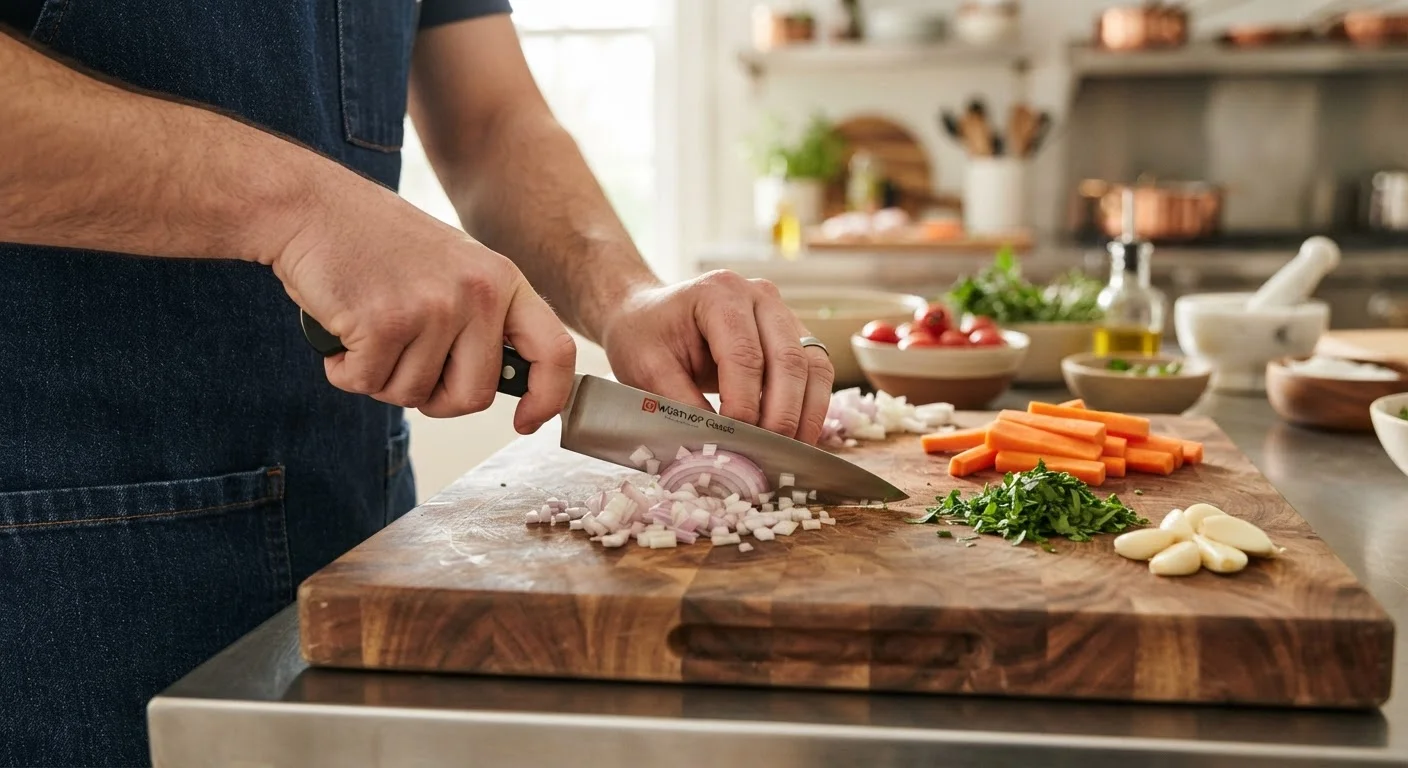
Most home cooks hold the knife handle like a hammer. Professional cooks use the pinch grip: the thumb and the side of the bent index finger pinch the blade itself, just in front of the bolster (the thick collar between blade and handle). The remaining fingers wrap the handle naturally. This grip gives you far more control over blade angle and cutting direction.
Your non-knife hand uses the claw position: fingers curl inward so your knuckles face the blade, fingertips tucked safely behind. The flat side of the blade rests lightly against the knuckles, which guide each cut. This arrangement makes it structurally near-impossible for the blade to reach your fingertips as long as you maintain the form.
Practice these grips slowly on a forgiving ingredient like a zucchini or carrot before moving to harder or more irregular produce. Pair these skills with a pre-cook prep checklist to make your entire kitchen routine more efficient.
Secure your cutting board
Lay a damp dish towel or non-slip mat flat on the counter, then place your cutting board on top. Press down firmly to confirm there's no slide or wobble. If working with a rounded ingredient, cut one flat side first and place that side down before continuing.
Adopt the pinch grip on your knife
Grip the blade itself between your thumb and the bent index finger, pinching just ahead of the bolster. Wrap your remaining three fingers around the handle. Avoid gripping the handle with your index finger extended along the spine - this reduces control.
Position your guiding hand in the claw
Curl the fingertips of your non-knife hand inward so only the knuckles protrude. Rest the flat of the blade lightly against your knuckles. As you cut, move your knuckles backward in small increments to guide each slice - the blade travels down the knuckles, never past the fingertips.
Practice the basic dice on an onion
Halve the onion through the root, peel it, and place it flat-side down. Make horizontal cuts parallel to the board (stopping before the root), then vertical cuts toward the root, then slice crosswise to produce a dice. Keep the root intact throughout - it holds the layers together.
Practice julienne on a carrot or zucchini
Trim and peel the vegetable. Slice off four sides to create a rectangular block. Cut the block lengthwise into planks about ⅛ inch thick. Stack the planks and cut them lengthwise again into uniform strips. Aim for consistent thickness - this is what makes the cut visually clean and culinarily useful.
Practice chiffonade on fresh basil
Stack 5-6 basil leaves with the largest on the bottom. Roll them tightly into a compact cylinder. Hold the roll with the claw grip and slice crosswise in thin, even strokes to produce delicate ribbons. Use immediately - chiffonade herbs oxidize quickly once cut.
Core Cuts and When to Use Them
Three cuts handle the majority of home cooking tasks:
- Dice: Square cuts in small (¼ inch), medium (½ inch), or large (¾ inch) sizes. Used for soups, stews, sautés, and salads. Consistency matters because uniform pieces cook at the same rate.
- Julienne: Long, thin matchstick strips, typically 2-3 inches long and about ⅛ inch wide. Common for stir-fries, salads, and garnishes. Start by squaring off the ingredient, then slice into planks before cutting those planks into strips.
- Chiffonade: Thin ribbons cut from leafy greens or herbs. Stack leaves, roll them tightly, and slice crosswise into fine strips. Ideal for basil, mint, kale, or chard.
Mastering these three cuts unlocks a huge range of dishes and feeds directly into techniques like deglazing and reducing, where uniformly prepped ingredients behave predictably in the pan. For efficient batch prep, these same cuts are central to effective weekly meal prep.
Practice on Forgiving Vegetables First
Carrots, zucchini, and potatoes are ideal for building knife confidence - they're dense, don't roll unpredictably, and show you clearly when your cuts are uneven. Spend 10 minutes practicing each new grip or cut before applying it to a recipe under time pressure. Muscle memory builds faster than most people expect.