

Key Takeaways
Prey Gifting Behavior
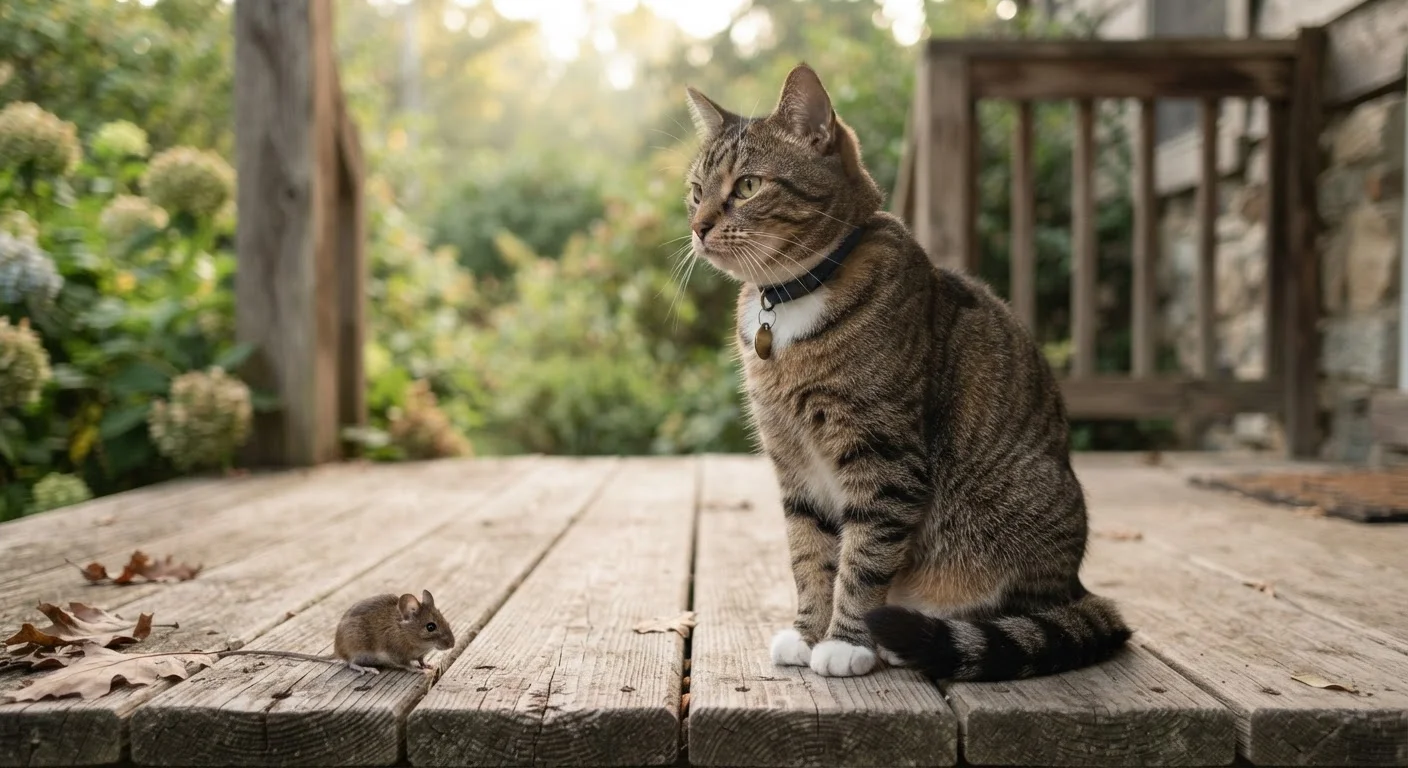
Prey gifting is when a domestic cat catches an animal - a bird, mouse, or insect - and brings the carcass (or sometimes a live animal) back to its home or owner. This is a deeply instinctive behavior rooted in evolutionary biology, not a sign of aggression or mischief. Even cats that are well-fed and kept primarily indoors may display it.
Behaviorally, this is classified under predatory motor sequence behavior, which in cats does not require hunger as a trigger - the drive to hunt is neurologically decoupled from the drive to eat.
Hardwired to Hunt: The Evolutionary Root
The domestic cat - despite generations of living alongside humans - retains the predatory neural architecture of its wild ancestors. Cats are obligate carnivores whose survival historically depended entirely on successfully catching prey. That hunting drive did not disappear when cats moved indoors.
What makes cats unusual among predators is that their motivation to hunt is largely independent of hunger. Research in animal behavior has consistently shown that a cat's predatory motor sequence - stalking, pouncing, catching - is triggered by movement and sensory stimulation, not an empty stomach. This is why a cat that just finished a full meal will still chase a bird across the yard.
The sequence itself is broken into discrete stages: orient, stalk, rush, grab-bite, kill-bite, and carry. Cats don't always complete every step, which is why prey is sometimes brought home alive. The drive to carry prey back to a safe location is one of the final steps in this ancient behavioral program.
~1-2 billion
Birds killed annually by cats in the U.S.
Estimates from the American Bird Conservancy suggest free-ranging domestic and feral cats are among the leading human-linked causes of bird mortality in North America.
~70%
Cats that hunt even when well-fed
Behavioral research consistently shows that satiation has little effect on a cat's motivation to engage in predatory behavior - the drive is stimulus-triggered, not hunger-triggered.
30-70%
Prey never brought home
Studies using cat-mounted cameras have found that a significant portion of prey caught by outdoor cats is consumed or abandoned on site, meaning owners often see only a fraction of total hunting activity.
The Social Signal: What Your Cat Is Actually Communicating
When a cat drops a dead sparrow at your feet, it is not being macabre. Behavioral scientists interpret prey gifting as an expression of social bonding and, in female cats especially, a maternal teaching instinct. In wild or feral colonies, experienced hunters - typically mothers - bring prey back to young kittens to introduce them to food sources and model hunting behavior.
Your cat may categorize you as a member of its social group who, from the cat's perspective, appears to be an incompetent hunter in need of assistance. This is not an insult - it reflects the cat's genuine social investment in your wellbeing. Understanding this reframes the behavior entirely: it's a gesture of care, filtered through a very different cognitive and instinctual framework than our own.
For more on how cats and other pets process social relationships, see our exploration of animal cognition. And if you're working through other puzzling feline behaviors, common animal behavior myths is worth a read.
“The domestic cat occupies a peculiar evolutionary position - it has been socialized enough to live alongside humans, but its predatory instincts remain essentially intact. Prey gifting is one of the clearest windows we have into the unmodified feline behavioral repertoire.”
— John Bradshaw, Anthrozoologist and author of 'Cat Sense,' University of Bristol
Outdoor Access, Prey Availability, and What the Research Shows
The single strongest predictor of prey-gifting frequency is outdoor access. Cats that roam freely are exposed to live prey and have both the opportunity and stimulation to complete the full predatory sequence. Studies on free-roaming domestic cats have found they can catch far more animals per year than most owners realize - with songbirds and small mammals being the most common targets.
This intersection of predatory behavior and outdoor lifestyle has real ecological consequences, particularly for local bird populations. It's one of the factors researchers and wildlife advocates weigh when discussing whether cats should live primarily indoors or outdoors. For a detailed look at those trade-offs, see the research on indoor vs. outdoor cat lifestyles.
Importantly, this behavior is not a signal that something is wrong with your cat. It should not be confused with signs of distress or illness. If your cat's behavior changes suddenly or dramatically, that warrants veterinary attention - subtle signs your cat may be in pain can help you identify when a vet visit is appropriate.
Practical Steps for Pet Owners
If you'd prefer fewer deliveries at your door, several approaches are supported by behavioral science:
- Structured play sessions: Daily interactive play using wand toys or laser pointers allows cats to complete the predatory sequence in a controlled way, reducing the urge to seek out real prey.
- Supervised outdoor time: Leash walks or enclosed catios provide environmental enrichment without giving cats unsupervised access to wildlife.
- Collar-mounted deterrents: Brightly colored collar covers designed to alert birds have shown measurable effectiveness in some studies, though results vary.
- Calm, neutral responses: Reacting dramatically may inadvertently reinforce the behavior. Quietly removing the prey and offering praise or play as a redirect is a more effective long-term strategy.
It's also worth noting that prey gifting is distinct from aggression. If you're navigating biting, swatting, or hissing, those behaviors have different triggers and responses - what aggression in cats is actually telling you covers that territory in depth.
Make Play Count Before Dawn
Cats are naturally most active at dawn and dusk - the same windows when they're most likely to hunt. A vigorous 10-15 minute interactive play session before these peak periods can meaningfully reduce predatory excursions. Use toys that mimic prey movement: quick, erratic, and low to the ground.