

Key Takeaways
Start here
Why Lighting Layers Matter
Build the base
Ambient Light: The Foundation
Add function
Task Light: Focused and Functional
Add character
Accent Light: Drama and Depth
Apply it
Putting It All Together by Room
Why Lighting Layers Matter
A single overhead light fixture can flood a room with brightness and still make it feel lifeless. That's because one light source, no matter how powerful, casts uniform illumination that flattens surfaces, erases depth, and leaves no room for mood. The solution interior designers rely on isn't more wattage - it's more layers.
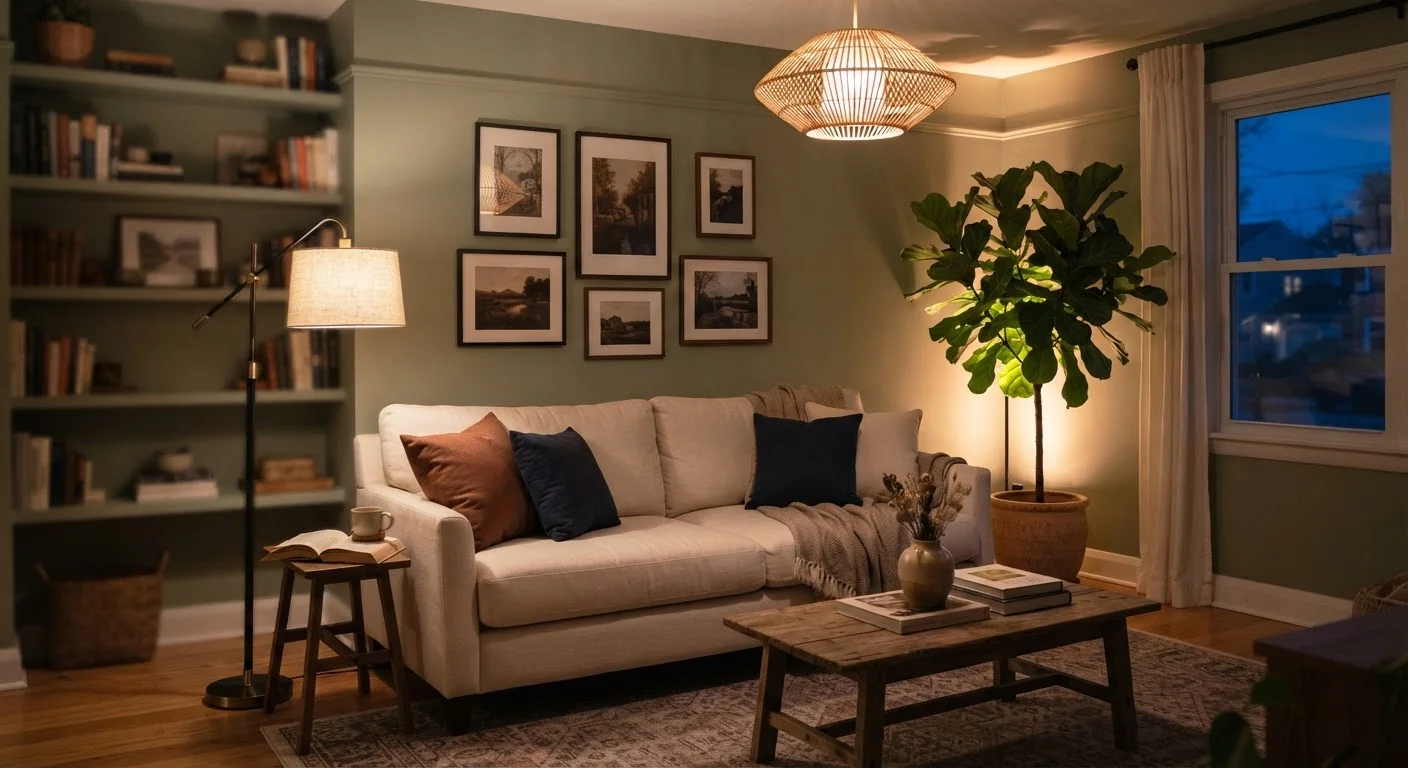
Layered lighting means deliberately combining three distinct types of light: ambient, task, and accent. Each plays a different role, and together they give a space dimension, function, and personality. The good news is that layering doesn't require a renovation. A few well-placed lamps can transform a room that currently relies on a single ceiling fixture.
Understanding how paint color interacts with your lighting choices matters too. See our guide to warm- and cool-toned paint for how light temperature can shift a wall color dramatically depending on the fixture you use.
Ambient light
The general, overall illumination in a room that allows you to see and move through the space comfortably. It's the baseline layer that every room needs.
Task light
Focused lighting aimed at a specific area where an activity takes place, such as reading, cooking, or working. It's brighter and more directed than ambient light.
Accent light
Decorative lighting used to highlight a specific object, architectural feature, or surface. It creates contrast and visual interest rather than general illumination.
Color temperature (Kelvin)
A scale that describes whether a light bulb produces warm (yellowish) or cool (bluish-white) light. Lower Kelvin numbers are warmer; higher numbers are cooler and crisper.
Lumens
The measurement of how much total light a bulb actually produces. More lumens means a brighter bulb, regardless of wattage.
Bias lighting
A soft light placed behind a television or monitor screen to reduce the contrast between the bright screen and the dark wall, which can reduce eye strain over time.
Ambient Light: The Foundation
Ambient light is your room's baseline illumination - the general glow that lets you move around safely and see the space as a whole. Think of it as the canvas everything else is painted on. Common ambient sources include ceiling-mounted fixtures, recessed downlights, flush-mount lights, and chandeliers.
The most common mistake homeowners make with ambient light is relying on a single overhead fixture at maximum brightness. This creates a harsh, institutional feel. Instead, aim for enough ambient light to comfortably navigate the room, then use the other layers to handle the rest. Adding a dimmer switch to your ambient fixture gives you instant control over the room's overall mood without buying new hardware.
Warm white bulbs in the 2700-3000 Kelvin range are a practical choice for living rooms and bedrooms, while kitchens often benefit from a slightly cooler temperature around 3000-3500 K to make food preparation easier on the eyes.
Task Light: Focused and Functional
Task lighting targets a specific area where you need concentrated, shadow-free illumination for an activity. Reading, cooking, applying makeup, working at a desk - each of these demands more focused light than ambient sources provide. Without dedicated task lighting, your eyes work harder to compensate, causing fatigue over time.
Good task light sources include desk lamps, under-cabinet kitchen lights, pendant lights positioned over a kitchen island, and bedside reading lamps. The key principle: position task lights so they illuminate the work surface directly without casting shadows from your body or hands.
Use Dimmers Across All Three Layers
Installing dimmer switches on your ambient fixtures - and choosing dimmable bulbs - lets you dial down the base layer whenever you want task or accent light to take center stage. Many modern plug-in lamps also include built-in dimmers or work with smart bulbs, giving you flexible control without any hardwiring.
For a home office or reading nook, look for a lamp with an adjustable arm so you can direct light exactly where it's needed. Bulbs in the 3000-4000 K range - sometimes labeled 'cool white' or 'neutral white' - reduce eye strain during extended focus.
Accent Light: Drama and Depth
Accent lighting is the layer most homeowners skip, and skipping it is why many rooms feel competent but not compelling. Accent light draws the eye to something specific - a piece of artwork, a textured wall, a bookshelf, or an architectural detail - by creating contrast between that feature and its surroundings.
Common accent sources include picture lights mounted above artwork, directional recessed spotlights aimed at a wall, uplights placed behind large plants or in corners, and LED tape lights installed inside shelving. A general guideline used in lighting design is that accent light should be roughly three to five times brighter than the surrounding ambient light to create visible contrast without looking glaring.
Accent lighting also interacts powerfully with surface texture and color. A wash of light across a textured wall - exposed brick, a plaster finish, or dimensional tile - makes that texture visible in a way that flat ambient light never would. See our guide to using texture in interior design for how to pair these elements effectively.
Putting It All Together by Room
In practice, layering looks different depending on how a room is used.
- Living room: A ceiling fixture or floor lamp provides ambient light. A table lamp beside the sofa handles reading. A directional spotlight or uplight behind a plant adds accent depth.
- Kitchen: Recessed ceiling lights or a surface-mounted fixture cover ambient needs. Under-cabinet strip lights illuminate countertops for food prep. A pendant over the island can serve as both task and decorative accent light.
- Bedroom: A ceiling fixture or flush-mount light provides ambient illumination. Bedside lamps handle nighttime reading. A small uplight or a picture light over a headboard wall adds a soft accent layer without disturbing sleep.
- Home office: Ambient ceiling light prevents eye strain from screen contrast. A desk lamp handles close work. A backlight behind the monitor (bias lighting) acts as an accent layer that reduces eye fatigue.
If your space already struggles with limited natural light, layering your artificial sources is especially valuable. Our article on making a dark room feel brighter covers how to pair these lighting strategies with mirror placement and color choices for maximum effect.
Start with one room, identify which layer is currently missing, and add a single fixture. Most people notice the difference immediately - and from there, the instinct to layer becomes second nature.