

| Most versatile style for mixed households | Transitional |
| Style defined by exposed raw materials | Industrial |
| Style most associated with wellness principles | Biophilic (Environmental psychology research) |
| Core principle of Scandinavian design | Functional simplicity with warmth |
| Decade that shaped Mid-Century Modern | 1950s-1970s |
| Key unifier in Maximalist rooms | A cohesive color story or recurring motif |
Why Knowing the Style Names Actually Helps
Interior design terminology can feel like a foreign language - words like "transitional" or "biophilic" get thrown around in decorating articles without much explanation. But having a working vocabulary matters. When you can name what you're drawn to, you can shop smarter, communicate clearly with contractors or roommates, and avoid expensive impulse purchases that don't fit the room.
This guide defines the most common interior design styles in plain English, with their key characteristics and typical materials. Think of it as a reference card you can return to whenever you're making a décor decision - no design degree required.
One quick note before diving in: most real rooms borrow from more than one style. Understanding each style individually makes it easier to blend them intentionally. For more on how design elements interact, see our article on common decorating myths that trip up homeowners.
Design Style
A recognizable set of aesthetic principles, materials, and visual rules that give a space a cohesive character. Styles evolve over time and often overlap.
Biophilic Design
An approach that incorporates natural materials, living plants, natural light, and organic forms to create environments that feel connected to the natural world.
Transitional Style
A hybrid approach blending traditional and contemporary elements. It typically features neutral palettes, classic furniture forms with cleaner lines, and timeless material choices.
Palette
The curated collection of colors used throughout a space. A cohesive palette usually includes a dominant color, one or two secondaries, and one or two accents.
Silhouette
The overall outline or shape of a piece of furniture or décor object. Different design styles favor distinctly different silhouettes - curved versus angular, tapered versus boxy.
Eclecticism
The intentional mixing of elements from multiple styles, periods, or cultures. Successful eclecticism requires a unifying thread - shared color, material, or scale - to avoid visual chaos.
The Most Common Interior Design Styles, Defined
Use this section as a lookup reference. Each entry covers the defining characteristics, typical materials, and the general mood the style creates.
| Most versatile style for mixed households | Transitional |
| Style defined by exposed raw materials | Industrial |
| Style most associated with wellness principles | Biophilic (Environmental psychology research) |
| Core principle of Scandinavian design | Functional simplicity with warmth |
| Decade that shaped Mid-Century Modern | 1950s-1970s |
| Key unifier in Maximalist rooms | A cohesive color story or recurring motif |
Scandinavian (Scandi)
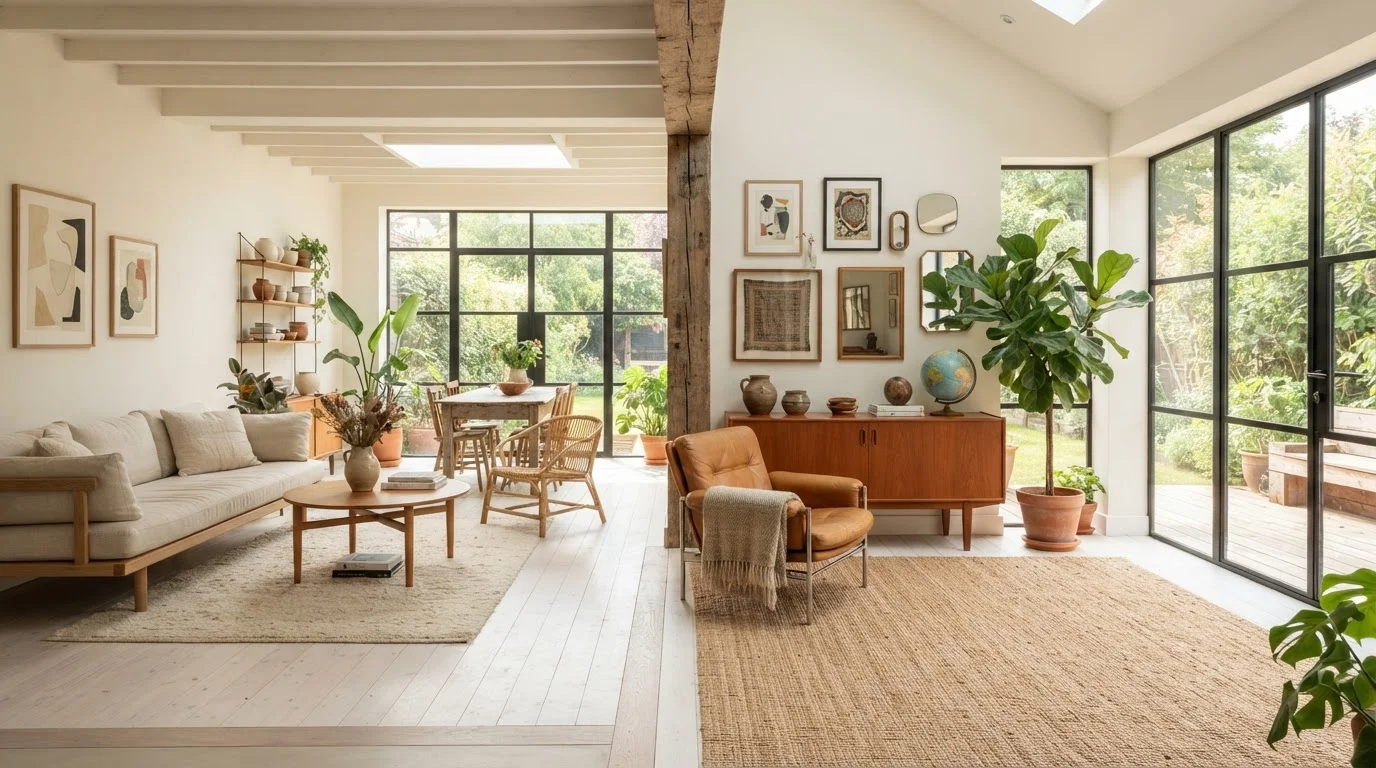
Mood: Calm, uncluttered, functional. Key traits: Neutral palette (white, gray, soft beige), natural wood tones, simple silhouettes, and an emphasis on letting in light. Décor is minimal but warm - a single plant, a woven throw, clean-lined furniture. Ornamentation is earned, not default.
Mid-Century Modern
Mood: Retro-optimistic, bold yet restrained. Key traits: Furniture with tapered legs and organic curves, a mix of natural and manufactured materials (wood + molded plastic or fiberglass), and accent colors drawn from the 1950s-70s palette - mustard, olive, burnt orange. Pattern use is deliberate: geometric or abstract.
Industrial
Mood: Raw, urban, unfussy. Key traits: Exposed brick, concrete, and metal; open shelving; Edison-style bulbs; dark neutrals. Industrial spaces celebrate the bones of a building rather than concealing them. Comfort comes through leather seating and warm wood tones that offset cooler materials.
Bohemian (Boho)
Mood: Layered, personal, globally influenced. Key traits: Rich jewel tones or earthy terracottas, mixed patterns, handcrafted or artisanal objects, textiles from varied cultural traditions, abundant plants. There are few rules - intentional eclecticism is the rule. Layering texture is central to achieving a cohesive boho look.
Transitional
Mood: Balanced, approachable, broadly livable. Key traits: Blends traditional and contemporary elements - classic silhouettes with cleaner lines, neutral base colors with selective pattern, quality over novelty. This is one of the most popular styles in American homes because it adapts to changing tastes without a full overhaul.
Maximalist
Mood: Abundant, expressive, deliberately bold. Key traits: Color saturation, pattern mixing, layered art and objects, full shelves. The guiding principle isn't "more is more" randomly - it's intentional abundance. Every surface tells a story. Edited maximalism differs from clutter by having a cohesive color story or recurring motif tying it together.
Biophilic
Mood: Restorative, grounded, nature-connected. Key traits: Living plants, natural light prioritization, organic shapes, stone, wood, water features, and materials that reference the natural world. Research in environmental psychology suggests exposure to natural elements indoors supports well-being, which is why this style has grown in popularity across residential and commercial spaces.
Applying This Reference to Your Own Space
Identifying your preferred style is only the first step. The second - and harder - step is applying it coherently to rooms with fixed constraints like existing flooring, cabinetry, or architectural details you can't change.
A practical starting point: pick one style as your primary reference and allow one secondary style as an accent. For example, Scandinavian as a base with Bohemian textile accents gives you the calm foundation of Scandi with the warmth and personality of Boho. This approach avoids the common mistake of buying pieces from five different styles and wondering why nothing coheres.
Proportion matters as much as style. A mid-century modern sofa with tapered legs will read very differently in a room with 8-foot ceilings versus one with 12-foot ceilings. For a deeper look at why, our guide on design scale explains how furniture and décor proportions interact with a room's dimensions. If you share your space with someone whose style preferences differ from yours, blending two design perspectives is its own skill - one worth approaching thoughtfully.