

Key Takeaways
Why the Label Exists - and What It's Actually Designed to Do
The Nutrition Facts label is a federally mandated tool, required by the FDA on most packaged foods sold in the United States. Its purpose is to give consumers standardized, comparable information about what's in a food - not to evaluate whether that food is "good" or "bad," but to make the contents visible and legible.
The label format was significantly updated in 2016 (with full compliance required by 2020) to reflect current nutrition science, updated serving sizes, and a new emphasis on added sugars. If you're reading labels on older packaging, some details may differ from the current format.
Understanding the label's design helps you use it as a comparison tool rather than a verdict. For a section-by-section reference guide, The Nutrition Facts Label, Line by Line offers a detailed companion walkthrough. The label is also most useful when read alongside the ingredient list - see How to Actually Read an Ingredient List for that parallel skill.
What you will need
Reading the Label Step by Step
Nutrition labels follow a consistent top-to-bottom structure. Working through it in order - rather than jumping to the one number you recognize - gives you a more complete and accurate picture of a food.
The food package itself
The primary source of the Nutrition Facts label you'll be reading.
Calculator or smartphone
Useful for multiplying per-serving values when you consume more than one serving.
Start with the Serving Size
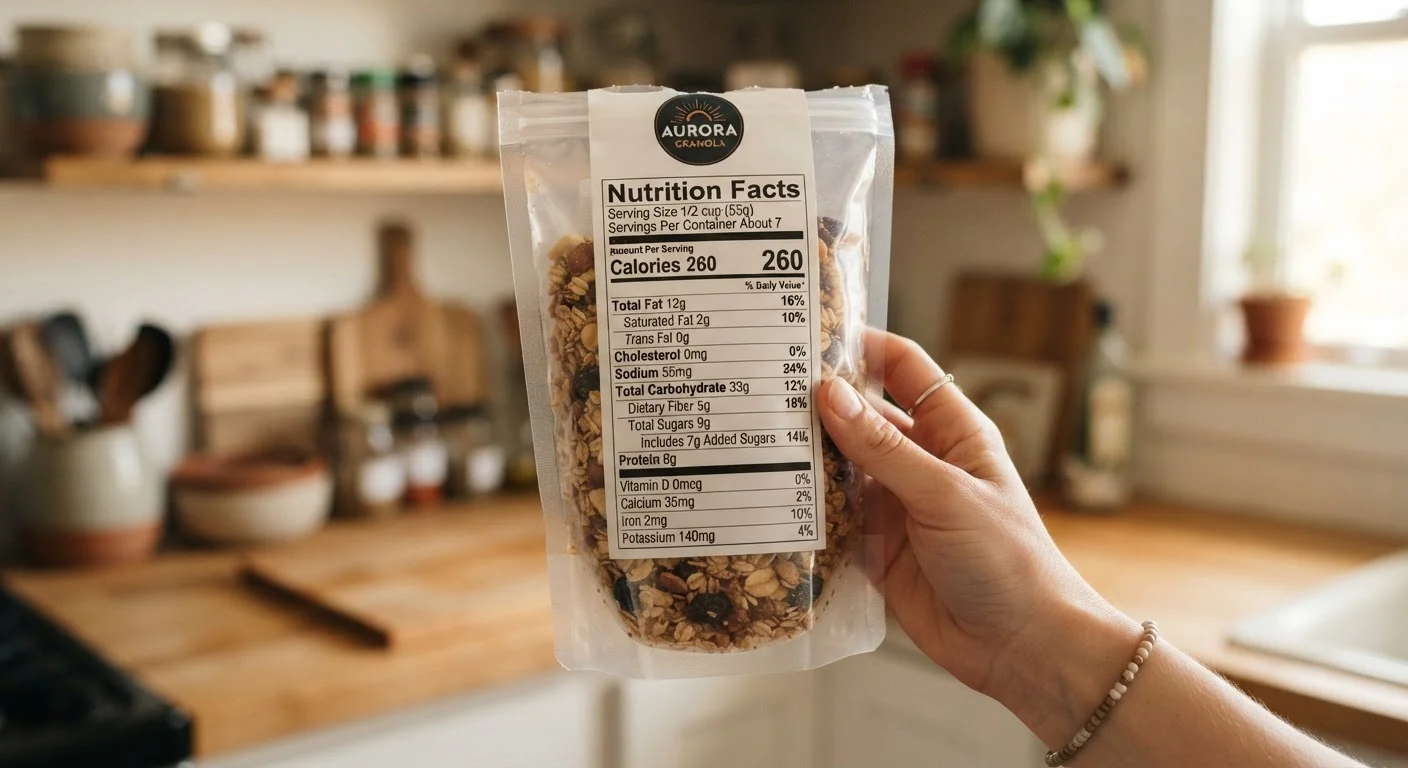
The serving size appears at the very top of the label, directly below the "Nutrition Facts" header. It tells you the amount of food all the numbers below it describe - for example, "2/3 cup (55g)" or "1 slice (28g)."
This is the single most important figure on the label because every calorie count, every gram of fat, and every milligram of sodium is calculated per serving. Before reading anything else, ask yourself: how much of this food am I actually planning to eat? If your portion differs from the stated serving, the numbers need to be scaled accordingly.
Note the Number of Servings per Container
Directly below the serving size, you'll find "Servings per container." This tells you how many of those measured portions are in the whole package. A bag of chips labeled "about 7 servings" means the calorie and nutrient totals repeat seven times if you finish the bag.
Some labels now include a dual-column format showing both per-serving and per-container values side by side - a helpful addition for smaller packages people commonly consume in one sitting.
Read the Calorie Count in Context
Calories are displayed in large, bold type directly below the serving information. They represent the total energy provided by one serving - combining energy from fat, carbohydrates, and protein.
Calories matter as part of your overall dietary picture, but they don't tell you anything about nutritional quality on their own. A food can be calorie-dense and highly nutritious (like nuts) or calorie-light and nutritionally sparse. For a broader perspective on this, nutrient density is a useful concept to understand alongside calorie counts.
Examine the Nutrients to Limit
The upper section of the nutrient list covers nutrients that, according to federal dietary guidance, many Americans tend to consume in excess: total fat, saturated fat, trans fat, cholesterol, and sodium. These are flagged not because they're inherently dangerous in all amounts, but because habitual overconsumption is associated with various health concerns.
Added sugars also appear here, listed separately from total sugars. This distinction matters: naturally occurring sugars in whole fruit or plain milk behave differently in the diet than sugars added during food processing. Understanding the difference can help you interpret this line more meaningfully.
Check the Nutrients to Get Enough Of
The lower section of the nutrient list highlights nutrients that dietary surveys suggest many Americans under-consume: dietary fiber, vitamin D, calcium, iron, and potassium. Higher % DV figures for these nutrients generally indicate a more nutrient-rich food.
Dietary fiber deserves particular attention - it supports digestive health and is found primarily in whole grains, legumes, fruits, and vegetables. Foods with 10-19% DV of fiber per serving are considered good sources; 20% DV or more qualifies as an excellent source.
Interpret the Percent Daily Values
The right column of the nutrient section shows % Daily Value (% DV) for most listed nutrients. These percentages indicate how much a single serving contributes toward the reference daily intake - based on a 2,000-calorie diet - for each nutrient.
Use % DV to make fast comparisons between similar products or to assess whether a food is a strong or weak source of a particular nutrient. For a deeper look at how these reference values are calculated, dietary reference intakes (DRIs) explain the science behind them. The footnote at the bottom of most labels clarifies that the values are based on a 2,000-calorie diet and are intended as a general reference.
Watch for Multiple Servings per Package
A package that looks like a single portion may contain two, two-and-a-half, or even more servings according to the label. If you eat the entire package, multiply every nutrient value by the number of servings listed. This is one of the most common ways calorie and sodium intake gets underestimated.
Use the 5/20 Rule as a Quick Reference
A % DV of 5% or less is generally considered low for a nutrient; 20% or more is considered high. This rule of thumb - recognized by the FDA - lets you quickly assess whether a food is a meaningful source of a nutrient or something to moderate, without doing any math.
Labels Reflect Reference Values, Not Prescriptions
Percent Daily Values are calculated using a 2,000-calorie reference diet established by the FDA - not a personalized recommendation for you. Your actual calorie and nutrient needs depend on age, sex, activity level, health status, and other individual factors. Use % DV as a general benchmark, and consult a registered dietitian for guidance tailored to your circumstances.
Putting It All in Perspective
A Nutrition Facts label describes one food at one moment. No single item defines the quality of your overall diet, and no label number should be treated as a pass-fail result. The label is most powerful as a comparison tool - holding two similar products side by side, scanning for meaningful differences in sodium, fiber, or added sugar, and making the choice that fits your broader eating pattern.
It's also worth remembering that many whole foods - fresh produce, bulk grains, unpackaged proteins - carry no label at all. Familiarity with label-reading supports informed choices among packaged foods, but a nutritious diet draws from the full range of what you eat. For a fuller grounding in food and diet knowledge, explore the Nutrition Basics hub.
This article is for general informational purposes only and does not constitute medical or dietary advice. For guidance tailored to your individual health needs, consult a registered dietitian or qualified healthcare professional.