

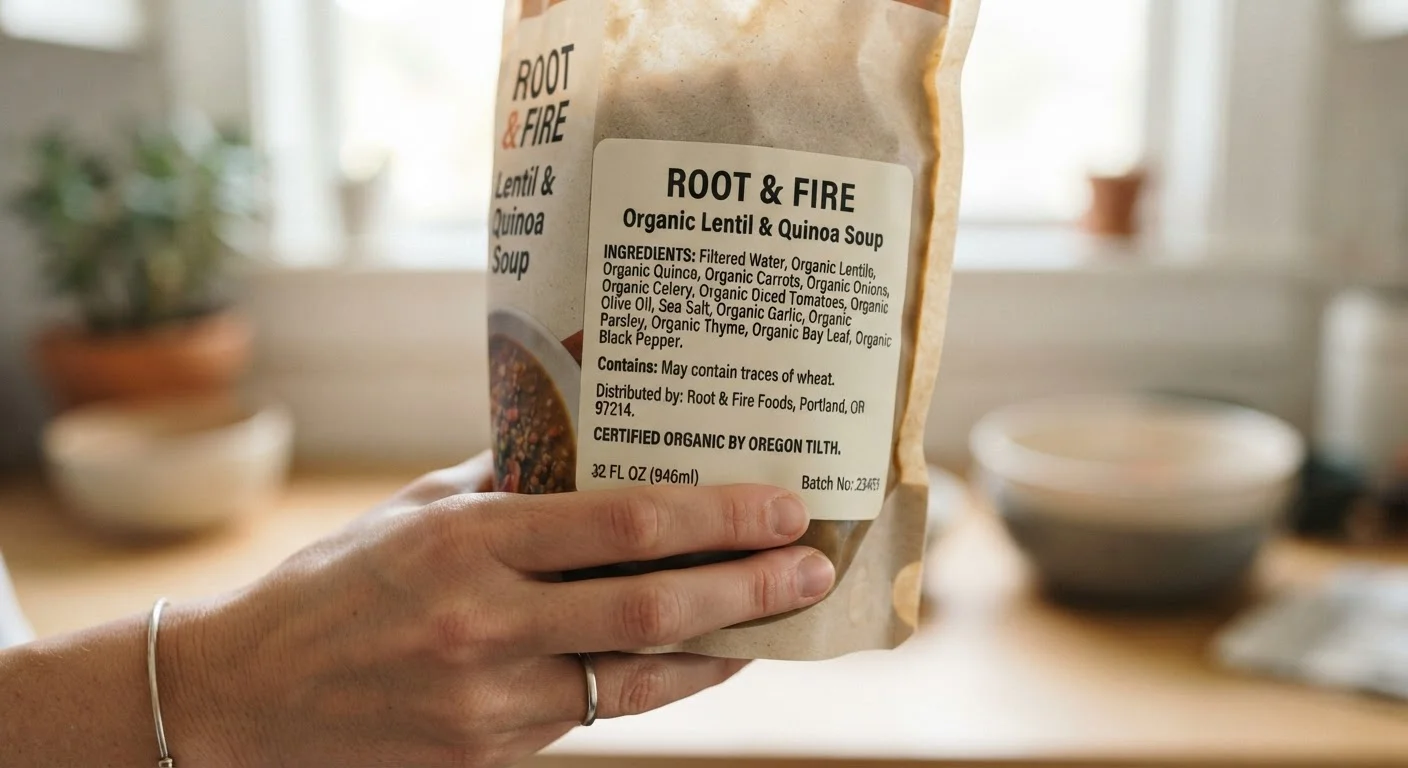
Key Takeaways
Why the Ingredient List Exists - and What It Must Tell You
The ingredient list on packaged food is federally regulated by the U.S. Food and Drug Administration (FDA). Under current rules, virtually every ingredient in a food product must be declared on the label, listed in descending order by weight. That single rule - order by weight - is the most important thing to understand before reading any list.
If whole wheat flour is listed first and sugar is listed tenth, that product contains substantially more flour than sugar, by weight. The reverse is also true: when sugar or a refined grain appears at or near the top, that ingredient dominates the product's composition. This structure means the first three to five ingredients on any list tell you the most about what you're actually eating.
For a complementary look at how serving sizes, daily values, and macronutrients are reported, see the Nutrition Facts label walkthrough - understanding both panels together gives you the clearest picture of any packaged food.
Decoding Naming Conventions and Common Disguises
One of the most practical skills in label reading is recognizing that a single ingredient can appear under many names. Added sugars are a prime example. Manufacturers may use sucrose, dextrose, high-fructose corn syrup, cane juice, maltose, barley malt, or agave nectar - among others - as distinct ingredients. Each one counts separately in the list, which can spread a significant total sugar contribution across multiple lower-ranked positions, making any one source appear minimal.
The same principle applies to sodium (listed as salt, sodium benzoate, monosodium glutamate, disodium phosphate, and others) and to fats (palm oil, hydrogenated soybean oil, interesterified fats). This isn't necessarily manipulative - different forms of an ingredient may genuinely behave differently in a recipe - but it's useful to scan the full list, not just the top entries.
Chemical-sounding names don't automatically signal danger. Ascorbic acid is vitamin C. Tocopherol is vitamin E. Lecithin, often derived from soy or sunflower, is a common emulsifier with a long safety record. If you encounter unfamiliar terms, the nutrition label glossary is a reliable quick reference.
Length Isn't the Right Metric
A common instinct is to avoid products with long ingredient lists, but list length alone isn't a meaningful indicator of quality. A multigrain bread with many whole-grain varieties and seeds may have a long list, while a product with three ingredients could still be high in refined carbohydrates or added sugar. Read what's on the list, not just how many items appear.
Allergens, Additives, and What 'May Contain' Actually Means
The FDA requires that the nine major food allergens - milk, eggs, fish, shellfish, tree nuts, peanuts, wheat, soybeans, and sesame - be clearly declared on the label, either within the ingredient list or in a separate "Contains" statement immediately after it. If you or someone in your household manages a food allergy, this section of the label is non-negotiable to check.
"May contain" or "processed in a facility that also handles" language is voluntary. Manufacturers include it to communicate cross-contact risk, but its absence does not guarantee an allergen-free environment. If cross-contact is a serious health concern, contacting the manufacturer directly is the most reliable approach.
Additives such as artificial colors (listed as "Red 40" or "Yellow 5"), preservatives (like sodium nitrate or BHA), and flavor compounds ("natural flavors" or "artificial flavors") are all required to appear in the ingredient list. "Natural flavors" is a broad, FDA-defined category and does not carry a specific nutritional implication - it simply means the flavor was derived from a natural source rather than synthesized entirely in a lab.
Allergen Labels Are Not Foolproof
Federal law requires major allergens to be declared, but manufacturing environments can change and human error exists. If you or a family member has a severe food allergy or anaphylactic history, verify ingredient information directly with the manufacturer and consult an allergist for guidance on managing food-label risk. Do not rely solely on packaged label text for life-threatening allergy management.
Putting It All Together as a Practical Habit
Reading an ingredient list well is a skill that gets faster with repetition. Rather than evaluating every product from scratch, most experienced label readers develop a quick mental checklist: What are the first three ingredients? Do I recognize most items on the list? Are there multiple names for the same base ingredient like sugar or sodium? Are any allergens present?
Pair the ingredient list with the Nutrition Facts panel for the most complete read - the panel tells you quantities while the list tells you sources. The plain-language guide to Nutrition Facts labels covers that side of the label in detail.
No single ingredient or list length defines whether a food is appropriate for your diet. A product with 25 ingredients might be nutritionally sound; one with five might not suit your needs. The goal of reading labels isn't to judge food - it's to make informed choices that fit your own priorities and health context. If you have specific dietary conditions or restrictions, a registered dietitian can help you apply this information to your individual situation.
This article is for general informational and educational purposes only and is not a substitute for professional nutrition or medical advice. Consult a qualified healthcare provider or registered dietitian for guidance specific to your health needs.