

Key Takeaways
Nutrient Density
Nutrient density refers to how much nutritional value - vitamins, minerals, fiber, protein, and other beneficial compounds - a food provides relative to the number of calories it contains. A nutrient-dense food delivers a lot of nutrition for relatively few calories. It's a way of evaluating food quality, not just quantity.
Researchers have proposed various nutrient profiling scoring systems, such as the Nutrient Rich Foods Index, to quantify nutrient density using standardized criteria for beneficial and limiting nutrients per serving.
Why Calories Alone Don't Tell the Whole Story
For decades, public health messaging leaned heavily on calorie counts. While understanding energy intake has genuine value, calories measure only one dimension of food: how much energy it delivers. They say nothing about what else a food carries - or doesn't carry.
Two foods with identical calorie counts can differ dramatically in their nutritional contribution. A 150-calorie serving of plain crackers and a 150-calorie serving of cooked lentils sit at the same energy point, but lentils bring protein, dietary fiber, iron, and folate to the meal. This is the gap that nutrient density helps close.
Thinking about food through the lens of nutrient density doesn't require abandoning awareness of calories. The two ideas work together: calorie awareness helps manage energy balance, while nutrient density helps ensure those calories are doing meaningful nutritional work.
What Makes a Food Nutrient-Dense?
A food earns the label "nutrient-dense" when it provides a meaningful amount of beneficial nutrients - vitamins, minerals, fiber, quality protein, or healthy fats - relative to its calorie load. No single nutrient defines the category; it's about the overall profile.
~75%
Americans fall short on vegetables and fruits
According to the U.S. Dietary Guidelines Advisory Committee, roughly three-quarters of Americans do not meet recommended intakes for vegetables, fruits, and dairy - food groups that tend to be highest in nutrient density.
57%
Of US calories come from ultra-processed foods
Research published in BMJ Open estimated that ultra-processed foods - which tend to be low in nutrient density - account for more than half of the average American adult's daily calorie intake.
Top 3
Most nutrient-dense food categories (USDA)
The USDA's Dietary Guidelines consistently identify vegetables, fruits, and legumes as among the most nutrient-dense food categories available within a typical diet.
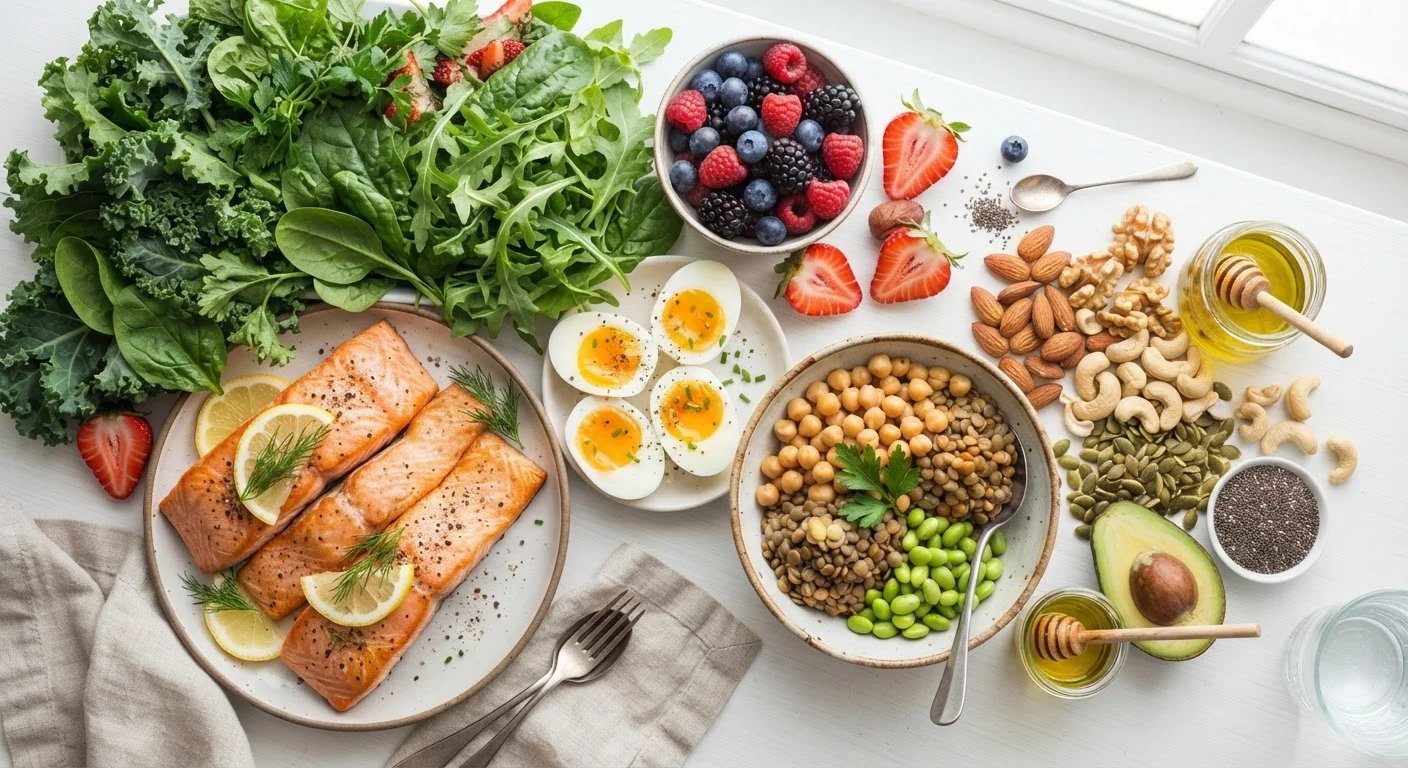
Vegetables and legumes consistently rank among the most nutrient-dense foods available. Leafy greens like kale and spinach deliver vitamins A, C, and K along with calcium and iron, all for very few calories. Eggs provide high-quality protein and a range of B vitamins within a modest calorie package. Fatty fish like salmon add omega-3 fatty acids alongside protein and vitamin D.
At the other end of the spectrum sit foods that are calorie-dense but nutrient-sparse - providing energy without meaningful vitamins, minerals, or fiber. These are commonly described as having "empty calories," though as our related article explores, the empty calories concept is more nuanced than it first appears.
For a deeper look at the specific vitamins and minerals that contribute to a food's nutritional profile, the micronutrients plain-language reference guide is a helpful starting point.
Applying Nutrient Density in Everyday Food Decisions
Understanding nutrient density doesn't require a spreadsheet. In practice, it's a mental framework for comparing foods and building meals with more nutritional payoff - without obsessing over numbers.
“The quality of the calories we eat matters just as much as the quantity. Shifting focus toward nutrient-dense foods - rather than fixating on calorie restriction alone - tends to support better long-term health outcomes.”
— Walter Willett, Professor of Epidemiology and Nutrition, Harvard T.H. Chan School of Public Health
One useful habit is looking at what a food brings rather than just what it costs in calories. A handful of almonds costs more calories than a rice cake, but it also contributes protein, magnesium, vitamin E, and healthy unsaturated fats. The rice cake offers mostly refined starch. That trade-off becomes visible once you're thinking in terms of nutrient density.
Nutrition labels are another practical tool. Learning to read them - particularly the vitamin and mineral percentages listed below the calorie figure - lets you quickly compare the nutritional return of different options. Our guide to reading a nutrition facts label without getting confused walks through exactly how to do that. And for a glossary of related terminology, nutrition terms every label reader should recognize is a useful companion resource.
Building meals around nutrient-dense foods over time - rather than engineering every plate with precision - is a sustainable approach that most nutrition researchers and registered dietitians broadly support. For practical guidance on meal assembly, see our piece on building a balanced plate without obsessing over numbers.
This article is for general informational and educational purposes only and does not constitute medical or dietary advice. Consult a registered dietitian or qualified healthcare provider for guidance tailored to your individual health needs.