

Key Takeaways
Option A
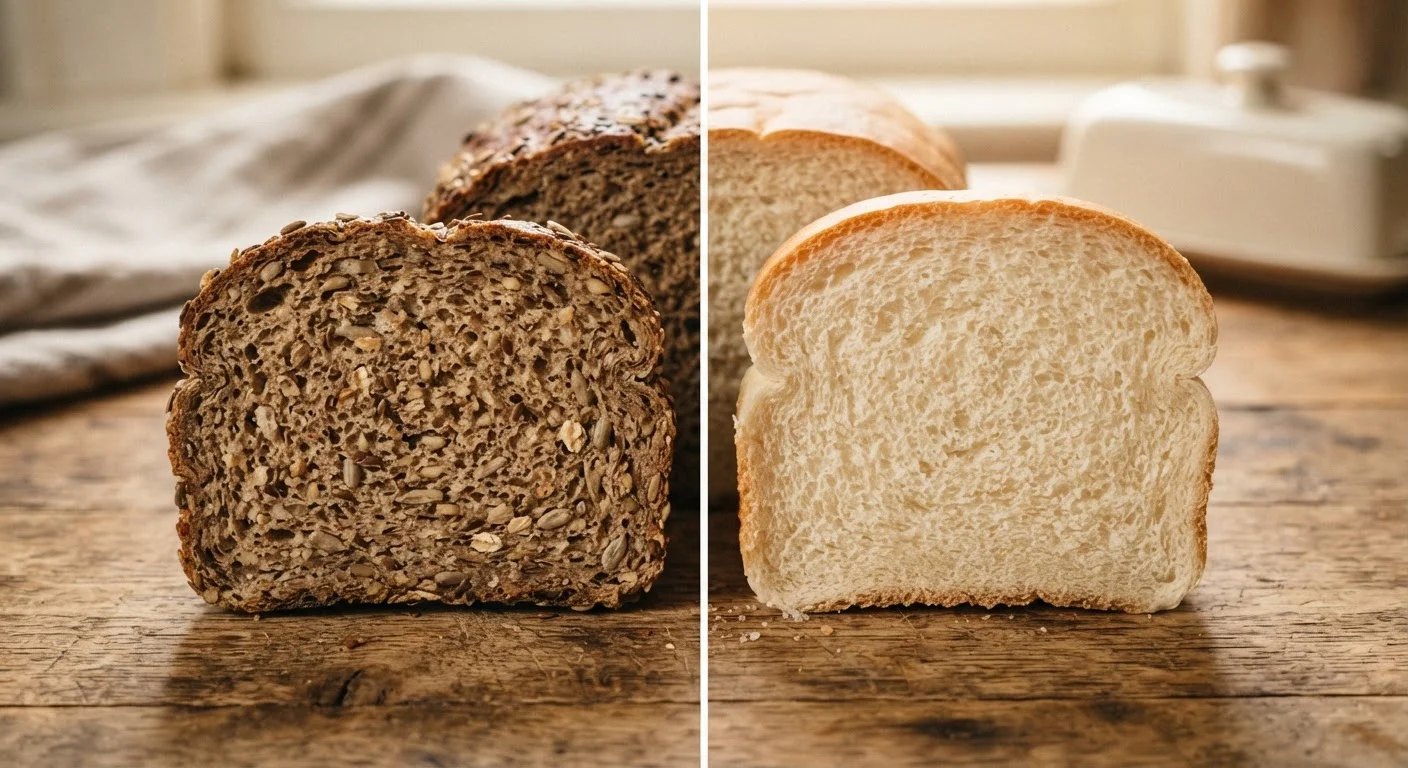
Whole Grains
The structurally complete, nutrient-dense original.
Best for: People seeking maximum fiber, vitamins, and minerals from grain-based foods.
Option B
Refined Grains
The milled, shelf-stable, widely available staple.
Best for: Applications where texture, palatability, or shelf life are the primary priorities.
If you want to maximize nutrient density from everyday carbohydrates
Whole Grains
Whole grains retain fiber, B vitamins, vitamin E, magnesium, and phytonutrients that refining removes. The nutritional advantage across these categories is substantial and well-documented.
If texture, digestibility, or specific culinary outcomes are the priority
Refined Grains
Refined flours produce lighter, more uniform textures in baked goods and are easier for some people with certain digestive sensitivities to tolerate in the short term.
If you're focused on blood sugar management through dietary patterns
Whole Grains
The fiber matrix in whole grains slows digestion and moderates the glycemic response compared to refined grain equivalents - a distinction backed by extensive research.
If long-term shelf stability is the main concern
Refined Grains
Removing the germ eliminates the oils that cause whole grains to go rancid, making refined products significantly more stable for storage and commercial distribution.
What Milling Actually Does to a Grain Kernel
A grain kernel has three distinct anatomical layers, each doing a different nutritional job. The bran is the outer shell - fibrous, rich in B vitamins, iron, and antioxidants. The germ is the embryo of the plant, concentrated with healthy fats, vitamin E, and additional B vitamins. The endosperm is the starchy interior that feeds the developing seed and makes up the bulk of the kernel.
When wheat is milled into white flour, both the bran and germ are stripped away, leaving almost exclusively the endosperm. This isn't accidental - bran and germ make flour coarser, shorter-lived, and harder to work with commercially. The result, however, is a product that has lost the majority of its dietary fiber (roughly 75 percent), most of its B vitamins, nearly all of its vitamin E, and a significant portion of its minerals including magnesium, zinc, and iron.
To understand milling in the context of broader food processing, the spectrum of food processing helps clarify where refined grains sit relative to minimally and ultraprocessed products.
| Criterion | Whole Grains | Refined Grains |
|---|---|---|
| Kernel layers retained | Bran, germ, and endosperm | Endosperm only |
| Dietary fiber | High - roughly 3-4g per serving | Low - roughly 0.5-1g per serving |
| B vitamins (natural) | Thiamin, riboflavin, niacin, B6, folate | Mostly removed; some added back via enrichment |
| Vitamin E | Present in germ | Largely absent |
| Glycemic response | Lower and more gradual | Higher and faster |
| Phytonutrients | Lignans, phenolic acids present | Substantially reduced |
| Shelf stability | Shorter - germ oils can oxidize | Longer - germ removed |
| Texture in baking | Denser, heartier | Lighter, more uniform |
Enrichment: Partial Restoration, Not Full Recovery
In the United States, most refined grain products are required by federal standards to be enriched - meaning four B vitamins (thiamin, riboflavin, niacin, and folic acid) and iron are added back after milling. Folic acid enrichment in particular has had measurable public health impact, contributing to a significant reduction in neural tube birth defects since its widespread adoption in the 1990s.
But enrichment is not equivalent to the original grain. Fiber is not restored. Vitamin E is not replaced. The dozens of phytonutrients - lignans, phenolic acids, and other plant compounds concentrated in the bran and germ - are not added back. Enrichment is a targeted intervention, not a nutritional reset.
Reading Grain Labels Accurately
In the U.S., the FDA requires that "whole grain" appear as the first or second ingredient for a product to credibly deliver whole grain nutrition. Terms like "multigrain," "seven-grain," "made with whole wheat," or "wheat bread" do not guarantee a predominantly whole grain product. Looking for the word "whole" before the grain name in the ingredients list is the most reliable label check. Some products also carry a voluntary Whole Grain Stamp from the Whole Grains Council, which specifies the grams of whole grain per serving.
It's also worth noting that "wheat bread" or "multigrain" on a label does not guarantee whole grain content. Regulatory labeling in the U.S. requires the words "whole grain" or "whole wheat" as the first ingredient for a product to be considered a meaningful whole grain source.
Glycemic Response, Fiber, and Satiety
One of the most discussed differences between whole and refined grains is how each affects blood glucose. The fiber matrix in whole grains physically slows the digestion of starch, moderating the rate at which glucose enters the bloodstream. Refined grains, stripped of this buffering structure, are digested more rapidly and tend to produce a steeper blood glucose curve - a higher glycemic response.
This connects directly to satiety. The fiber in whole grains adds bulk, slows gastric emptying, and interacts with gut hormones involved in hunger signaling. Refined grain products, digesting faster and lower in fiber, are generally less filling calorie-for-calorie. To understand the mechanics behind why fiber type matters in this process, soluble versus insoluble fiber explains how each behaves differently in the digestive tract.
~75%
Fiber lost during standard wheat milling
Estimates from nutritional analyses of whole versus refined wheat flour consistently show fiber losses in this range, reflecting the removal of bran.
3-5x
More magnesium in whole versus refined wheat
USDA nutrient data shows whole wheat flour contains substantially more magnesium than enriched white flour, a mineral not restored by standard enrichment.
~20%
Reduced cardiovascular disease risk associated with whole grain intake
A 2016 meta-analysis published in the BMJ found approximately this magnitude of association between high whole grain consumption and lower cardiovascular disease risk.
Large epidemiological studies - including analyses from the Harvard T.H. Chan School of Public Health - have consistently associated higher whole grain intake with reduced risk of type 2 diabetes, cardiovascular disease, and certain digestive conditions. These are observational associations, not proof of direct causation, and diet is always one factor among many. Still, the consistency of findings across populations is notable.
Refined grains also frequently appear in products with added sugars and sodium. For more on how added versus naturally occurring sugars factor into the broader nutritional picture, see what nutrition science says about sugar distinctions.
This article provides general nutrition information and education only, and is not a substitute for personalized dietary advice from a qualified healthcare or nutrition professional.