

Key Takeaways
Start here
What Umami Actually Is
Go deeper
The Science Behind the Taste
Make it familiar
Umami in the American Kitchen All Along
Put it to work
How to Cook with Umami in Mind
The bigger picture
Why Naming It Changes Everything
What Umami Actually Is
Most Americans grew up learning four basic tastes: sweet, salty, sour, and bitter. But there is a fifth - one that has been sitting quietly on the table the whole time. It's called umami (pronounced oo-MAH-mee), a Japanese word that roughly translates to "pleasant savory taste" or "deliciousness."
Umami doesn't announce itself the way sweetness or sourness does. It's the deep, mouth-coating satisfaction in a slow-braised short rib, the lingering richness of aged cheddar, the reason a bowl of tomato soup tastes more complete than the sum of its ingredients. It's less a flavor you identify and more a quality you feel.
Umami
The fifth basic taste, distinct from sweet, salty, sour, and bitter - characterized by a deep, savory, mouth-coating richness. The word comes from Japanese and roughly means "pleasant deliciousness."
Glutamate
An amino acid that occurs naturally in many foods and is the primary chemical trigger of the umami taste. When proteins break down through aging, fermentation, or cooking, they release free glutamate.
Nucleotides (inosinate & guanylate)
Naturally occurring compounds found in meat, fish, and dried mushrooms that amplify the umami sensation when combined with glutamate - creating a flavor stronger than either compound produces alone.
Synergy (flavor)
In food science, synergy refers to the way certain taste compounds intensify each other when combined - umami compounds are a textbook example, multiplying perceived richness when layered.
MSG (Monosodium Glutamate)
A purified, shelf-stable seasoning made from the same glutamate that occurs naturally in umami-rich foods. It produces the same taste response as naturally occurring glutamate.
The term was coined by Japanese chemist Kikunae Ikeda in 1908 after he isolated glutamic acid - the compound responsible for the distinctive taste of kombu seaweed broth. Western food science was slow to accept his findings, but by the early 2000s, researchers had confirmed dedicated glutamate receptors on the human tongue, firmly establishing umami as a genuine, distinct taste category.
The Science Behind the Taste
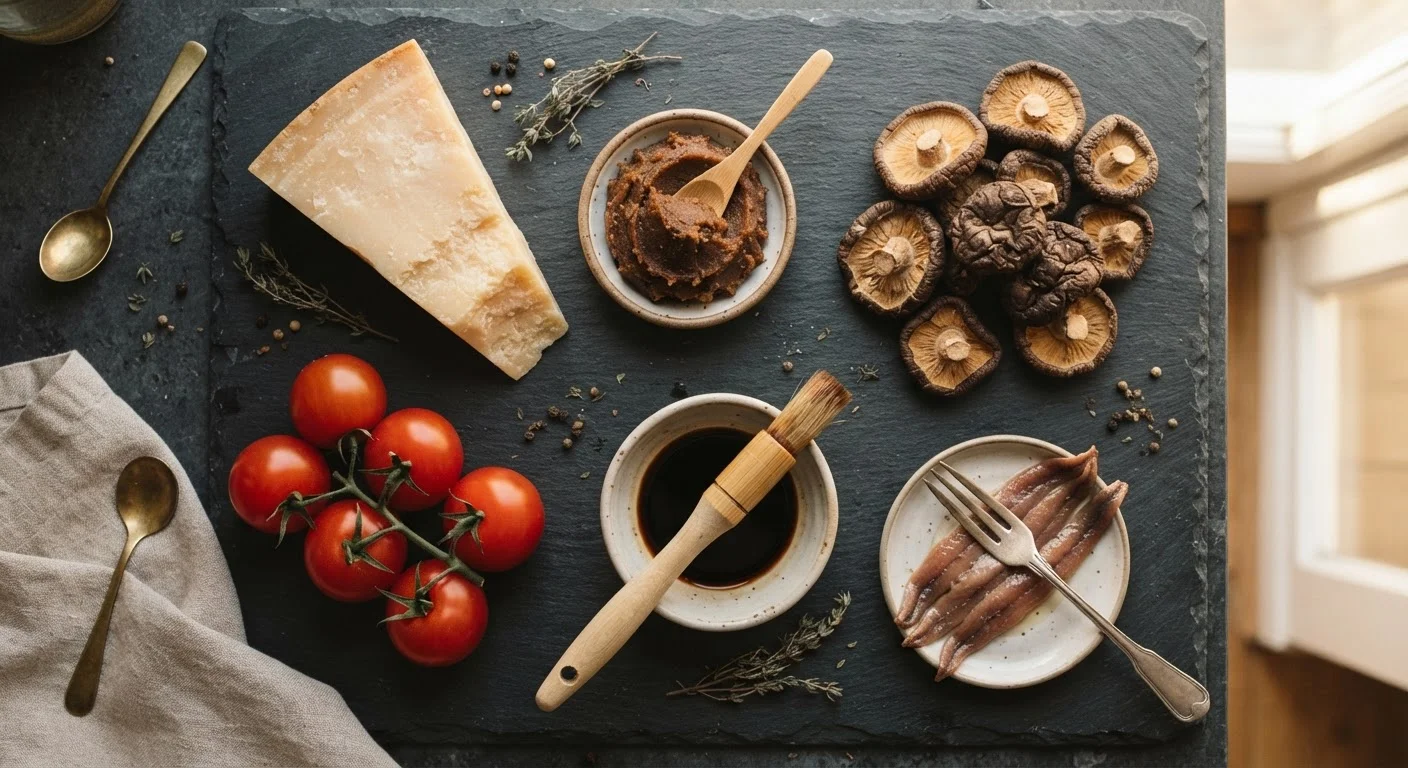
Umami is primarily driven by glutamate, a naturally occurring amino acid, and two nucleotides - inosinate (found in meat and fish) and guanylate (concentrated in dried mushrooms). When these compounds are present together, they amplify each other in a phenomenon called synergy, which is why a dish made with both parmesan and mushrooms tastes richer than either ingredient alone.
Unlike sweetness, which peaks quickly and fades, umami has a slow onset and a long finish. It also promotes salivation, which helps disperse flavor across the palate, contributing to that full, satisfying sensation. Researchers have also noted that umami can reduce the need for added salt while maintaining perceived flavor intensity - a finding with practical implications for everyday cooking.
Boost Umami Without Extra Salt
Because umami compounds enhance perceived flavor intensity, adding a small amount of a high-glutamate ingredient - like a half teaspoon of miso or a dash of Worcestershire - can make a dish taste more complete without increasing sodium. This makes umami awareness a genuinely useful tool for anyone watching their salt intake, though it's always worth discussing specific dietary needs with a healthcare professional.
Umami in the American Kitchen All Along
Here is the cultural irony: Americans have been enthusiastic umami consumers for generations, even without knowing the word for it. Ketchup - made from ripe, concentrated tomatoes - is one of the most glutamate-rich condiments on any table. Worcestershire sauce layers anchovies, tamarind, and fermented vinegar into a single umami-dense drop. Parmesan cheese grated over pasta, aged cheddar melted into a burger, a can of anchovy-laced Caesar dressing - all of it is umami, unnamed.
The broader story here is one of culinary knowledge crossing cultures. As immigrant food traditions reshaped the American table, so too did the ingredients and techniques that generate umami. Italian-American cooking's love of slow tomato sauces, the Southern tradition of long-simmered greens with cured pork, Jewish deli cuisine's deeply reduced broths - these are all umami-building practices, arrived at intuitively through cultural wisdom rather than laboratory analysis.
Fermented foods are a particularly rich umami source. The growing interest in miso, kimchi, and fish sauce in American kitchens reflects this. See how fermentation's global comeback is reshaping American kitchens for more on that parallel story.
How to Cook with Umami in Mind
Once you understand what umami is, you can start building it deliberately. A few reliable approaches:
- Layer glutamate sources. Combine two or more umami-rich ingredients in a single dish - tomato paste and a parmesan rind in a braise, or miso and dried mushrooms in a vegetarian soup base.
- Use fermented condiments as background flavor. A small spoonful of fish sauce, soy sauce, or miso stirred into a sauce adds depth without making the dish taste obviously Asian or salty.
- Toast, roast, or reduce. Heat concentrates glutamates. Caramelizing onions, roasting tomatoes, or reducing a stock all increase umami intensity.
- Don't forget aromatics. Onions, garlic, and other aromatics build the flavor foundation that makes umami compounds shine. Building flavor with aromatics is a natural companion skill to understanding umami.
Umami and MSG: Clearing Up Confusion
MSG has a complicated reputation in the United States, shaped in part by a 1968 letter to a medical journal that attributed certain symptoms to Chinese restaurant food - a claim that has not held up to rigorous scientific scrutiny. Major food and health organizations, including the U.S. Food and Drug Administration, classify MSG as generally recognized as safe. The glutamate in MSG is chemically identical to the glutamate found in parmesan, tomatoes, and soy sauce - the body does not distinguish between them.
Why Naming It Changes Everything
Language shapes how we perceive and seek out experience. For most of American culinary history, umami was the taste with no English name - recognized in practice, invisible in conversation. Chefs might call a dish "complex" or "deeply savory" without any shared vocabulary for what they were actually tasting.
Naming umami doesn't just satisfy intellectual curiosity. It gives home cooks a tool: a framework for diagnosing why a dish feels flat (it may be missing a glutamate source) and a rationale for classic combinations that have always worked without explanation. It also opens a door to appreciating the broader global pantry of umami-building ingredients - ingredients that, as discussions of culinary authenticity reveal, have long been dismissed or exoticized when they deserved to be understood.
Umami was never foreign. It was always here. We just finally have the word for it.