

Key Takeaways
What Street Food Actually Tells Us
Every civilization organizes itself around food - how it's grown, sold, prepared, and consumed in public spaces. Street food sits at that intersection more honestly than any fine-dining menu can. It isn't curated for tourists or critics; it evolved to feed real people on real schedules, using locally available ingredients at prices working people could afford.
That makes street food one of the most reliable cultural documents we have. The spices in a dish reveal trade routes. The protein choices reflect geography and religion. The portability of the food tells you something about the pace and structure of daily life. When you learn to read these signals, a bowl of noodles or a paper cone of fried dough stops being just a snack - it becomes a story.
The examples below span continents and cooking traditions, but each one illustrates a different dimension of what street food reveals. As you explore them, consider how many American favorites share the same working-class, immigrant origins - a connection explored further in our look at immigrant food traditions that reshaped the American table.
Mexican Tacos: Corn, Community, and Pre-Colonial Roots
The taco is arguably the world's most recognized street food, but its cultural depth often goes underappreciated. Corn tortillas trace directly to Mesoamerican civilizations, making the taco one of the oldest continuously prepared street foods in the Americas. The fillings - braised meats, fresh salsas, cactus - reflect both indigenous ingredients and centuries of Spanish colonial influence.
In Mexico City, taco stands operate at nearly every hour, serving workers between shifts, families after church, and late-night revelers. That around-the-clock availability reflects a city structured around long commutes, informal labor, and deeply social eating habits. The taco's portability is a feature, not a shortcut - it was designed for life in motion. For a deeper look at how this tradition translates (and gets distorted) in American culture, see our piece on taco culture versus taco marketing.
The taco's portability reflects a city - and a culture - designed for life in motion.
Thai Pad Thai: Nationalism, Noodles, and a Government Campaign
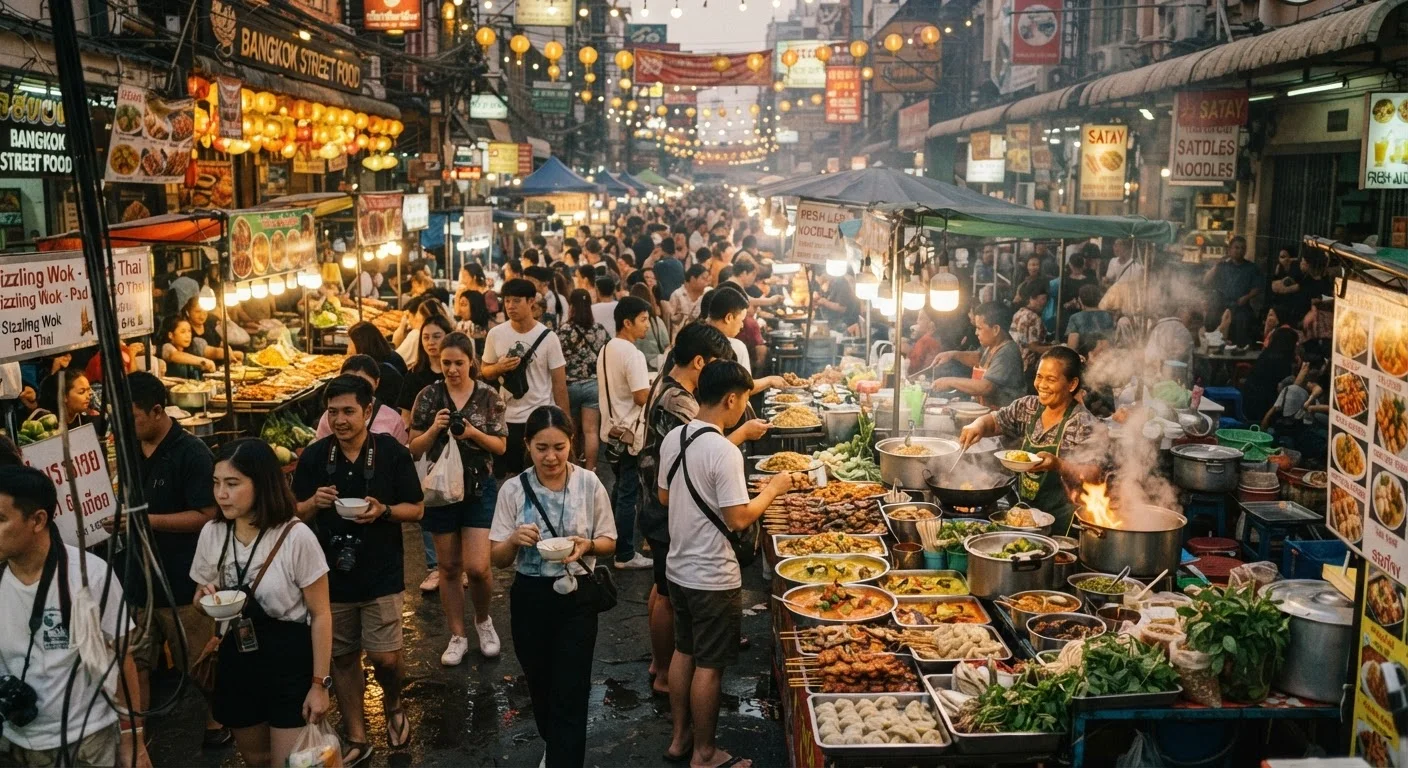
Pad thai is widely understood as Thailand's national dish, but its origins are surprisingly recent and deliberately political. In the 1930s and 1940s, the Thai government promoted a stir-fried rice noodle dish as a way to reduce rice consumption during a shortage and foster national unity. Street vendors were encouraged to sell it, and the dish spread rapidly through Bangkok's markets.
What's striking is how completely the campaign succeeded. Pad thai became a genuine cultural institution, adopted and adapted by home cooks and street vendors across the country. The dish reveals that national food identity can be consciously constructed - and that street food can serve as a vehicle for political as well as culinary goals. The wok hei (breath of the wok) technique used to cook it also signals Thailand's deep Chinese culinary influence, absorbed through centuries of trade and migration.
Pad thai's origins reveal that national food identity can be consciously and deliberately constructed.
Indian Chaat: Flavor Complexity as a Philosophical Statement
Chaat - a broad family of savory snacks sold across India - is defined by a deliberate collision of flavors: sweet tamarind, tart yogurt, fiery green chili, and crunchy fried dough, often all in a single bite. This complexity isn't accidental. It reflects an Ayurvedic culinary philosophy that prizes balancing six distinct tastes in a single meal or even a single dish.
The street-food format of chaat is equally revealing. Vendors assemble each serving to order, adjusting spice levels and toppings based on the customer's preference. This personalization within a fixed structure mirrors broader aspects of Indian social life - enormous diversity operating within shared frameworks. The regional variations of chaat, which differ dramatically between Delhi, Mumbai, and Kolkata, also map the subcontinent's linguistic, religious, and agricultural differences with remarkable precision.
Chaat's deliberate flavor collisions reflect an Ayurvedic philosophy of balance in every bite.
West African Suya: Spice Routes, Trade, and Communal Eating
Suya - skewered, spiced meat grilled over open flame - is a street food staple across Nigeria, Ghana, Cameroon, and neighboring countries. The spice blend used, called yaji, typically includes ground peanuts, ginger, paprika, and a range of dried chilies. Peanuts are central here: their presence in West African cuisine reflects centuries of agricultural history and their importance as a regional crop.
Suya is almost always eaten communally, often purchased in the evening from vendors whose smoke-filled grills become neighborhood gathering points. The food itself encodes social ritual - it's not a meal you eat alone on a walk. It's an occasion to linger, share, and talk. That communal dimension is common across sub-Saharan street food traditions and contrasts sharply with the solo-consumption model that defines much American fast food. The spice trade connections visible in yaji also echo the broader story of West African culinary influence in the Americas.
Suya's communal evening ritual reveals a food culture built around gathering, not individual convenience.
Japanese Takoyaki: Precision, Pride, and Regional Identity
Takoyaki - batter balls filled with diced octopus, cooked in cast-iron molds - originated in Osaka in the 1930s and remain fiercely associated with that city. Osaka residents take considerable pride in their takoyaki versus Tokyo's snack traditions, a rivalry that reflects Japan's strong regional food identities despite the country's relatively compact geography.
What takoyaki reveals about Japanese culture is the intersection of precision and informality. The cooking technique requires skill - vendors rotate the batter balls at exactly the right moment to form a perfect sphere - yet the food is eaten casually, standing at a stall, often at a festival. This combination of technical care applied to everyday eating is a recurring motif in Japanese food culture, visible from convenience store bento boxes to street-side ramen. Craftsmanship is not reserved for special occasions; it's embedded in the ordinary.
Takoyaki embeds technical craftsmanship into the most casual, everyday eating experience.
Colombian Arepas: Staple Food as Social Leveler
The arepa - a griddled or fried cake made from ground maize - is eaten across Colombia and Venezuela at every meal of the day, by every economic class. Unlike some street foods that began as elite cuisine and filtered down, the arepa has always been democratic. Its ingredients are inexpensive and widely available; its preparation is simple enough to be done at home or purchased for very little money on any street corner.
That universality makes it a social leveler. In Bogotá or Medellín, a businessperson and a construction worker are equally likely to eat an arepa for breakfast. The toppings and fillings vary - cheap salt and butter versus more elaborate cheese or meat - but the base food is shared. Street food that transcends class in this way is relatively rare and particularly meaningful as a cultural signal: it suggests a shared culinary foundation that persists despite economic inequality.
The arepa's universality across income levels makes it a genuine social leveler in Colombian daily life.
Reading the World Through What's Sold on the Corner
Street food is rarely static. It absorbs influences, adapts to new ingredients, and migrates with the people who cook it. That adaptability is itself culturally meaningful - it shows resilience, creativity, and the way communities metabolize change without losing their core identity.
How to Engage Thoughtfully With Street Food
When you encounter street food from an unfamiliar culture - at a festival, in a market, or traveling - approach it as a learner rather than a judge. Ask vendors about the dish's origins if there's an opportunity; many take genuine pride in explaining the tradition behind what they cook. Resist the impulse to compare it immediately to something familiar. Let the dish exist on its own terms first.
Understanding street food also deepens how we engage with unfamiliar cuisines closer to home. If you've ever stood in front of an unfamiliar menu and felt lost, our guide to navigating an unfamiliar restaurant menu offers practical, respectful strategies. And if the flavors you encounter feel unexpectedly comforting, that's no accident - our piece on comfort food across cultures explains why universally soothing dishes take such different shapes around the world.
The next time you pass a food cart, a night market stall, or a taco truck, look a little closer. The dish being served is doing a lot more than feeding someone - it's carrying a culture forward, one transaction at a time.