

Key Takeaways
Our Verdict
Neither store brands nor name brands win across the board. The gap between them is real in some categories, negligible in others, and the only way to tell which applies is to look past the label. For most commodity goods, store brands deliver comparable quality at lower cost; for specialized or heavily researched products, the name-brand premium can occasionally be justified.
| Best for | Recommended |
|---|---|
| Budget-conscious shoppers buying commodity staples | Store brands |
| Buyers of specialized or clinically studied products | Name brands (with verification) |
| Shoppers who want a systematic, category-by-category approach | Store brands for staples, name brands selectively |
Why the Price Gap Exists
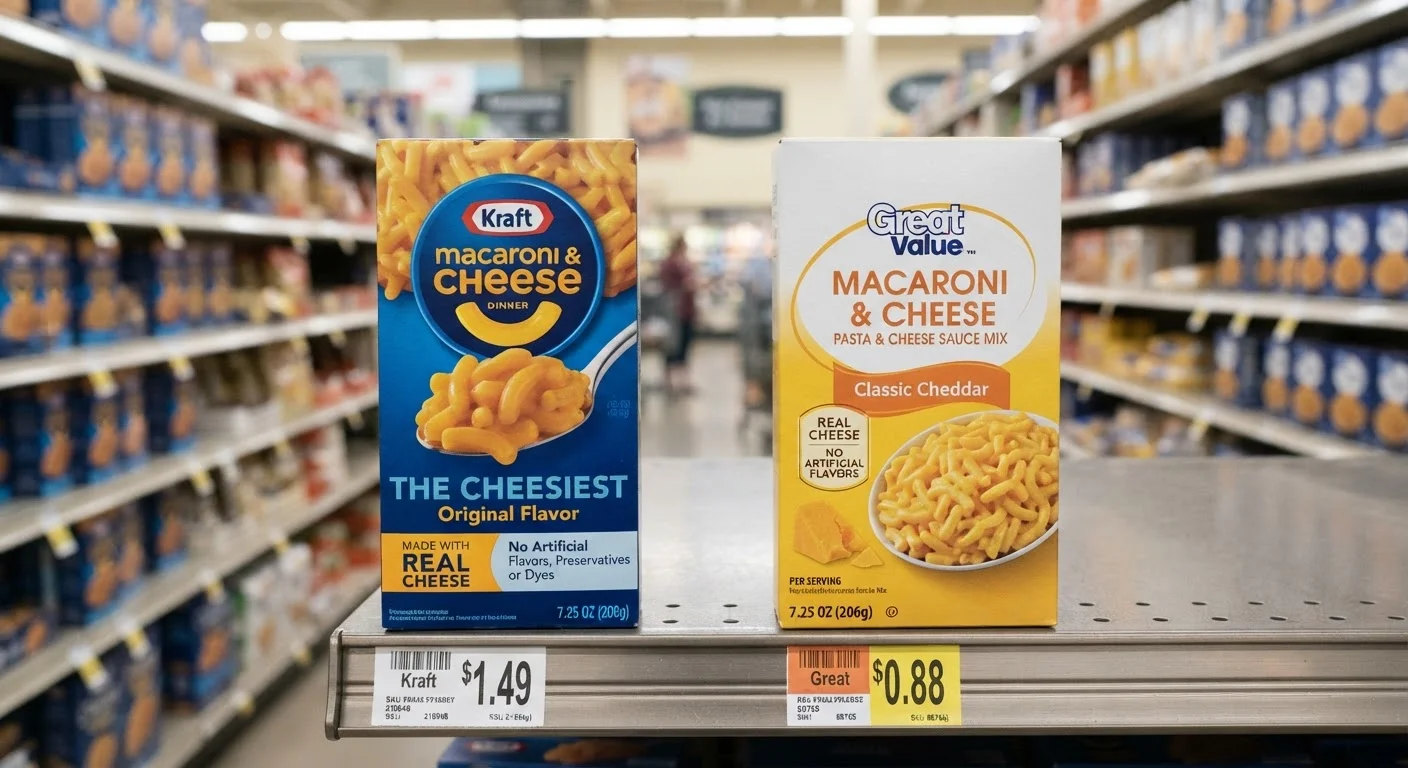
A name-brand product typically carries costs that have nothing to do with what's in the package: national advertising campaigns, slotting fees paid to retailers for shelf placement, and the overhead of maintaining a recognized brand identity. Store brands, by contrast, skip most of that. Retailers manufacture or contract-manufacture them under their own labels, cutting out the brand-building layer entirely.
That doesn't automatically mean the products are inferior. It means the cost structure is different. When you buy a name brand, a portion of the price funds marketing. When you buy a store brand, more of the price-in theory-reflects the actual product. Understanding this distinction is the first step to shopping the gap intelligently. See what really drives total cost at checkout for a broader framework.
Where Store Brands and Name Brands Are Often Identical
Contract manufacturing is common across many consumer product categories. In practice, a retailer may hire the same factory that produces a name-brand item to produce its store-brand equivalent on a different production run. The formulation, ingredients, and quality controls can be identical-only the label changes.
This arrangement is especially prevalent in:
- Over-the-counter medications: FDA regulations require store-brand generics to contain the same active ingredient at the same dosage as their name-brand counterparts. The inactive ingredients (fillers, binders) may differ, but the therapeutic component is equivalent by law.
- Pantry staples: Commodity goods like flour, sugar, vegetable oil, canned beans, and salt are largely indistinguishable by source-the underlying product is a standardized agricultural output.
- Basic household supplies: Plastic bags, aluminum foil, and similar utility items are often functionally identical at a fraction of the name-brand price.
| Category | Store Brand | Name Brand | |
|---|---|---|---|
| OTC medications | Equivalent active ingredients by law | Same therapeutic effect, higher cost | |
| Pantry staples (flour, sugar, oil) | Typically identical sourcing | Primarily a labeling difference | |
| Specialty skincare | Variable concentrations | May have clinical study backing | |
| Electronics / appliances | Often different internal components | Usually more established supply chain | |
| Condiments and sauces | Proprietary recipes vary widely | Consistent, recognizable formula | |
| Basic household supplies | Functionally equivalent, lower price | Higher cost, brand recognition only |
Ingredient lists are your most reliable verification tool. If the store-brand and name-brand ingredient lists match exactly, the meaningful difference is the label. Learning to read product construction signals can help you apply this kind of scrutiny across more categories.
Where Name Brands May Actually Differ
Not every category is a commodity. In some product areas, formulation investment, proprietary technology, or verified clinical research genuinely differentiates name brands from store equivalents.
Use Ingredient Lists as a Shortcut
Before assuming a name brand is superior, pull up both ingredient lists on your phone. For regulated product categories like OTC drugs, the active ingredient must match by law. For food products, a matching ingredient list in the same order is a strong signal of comparable formulation. This takes less than two minutes and is one of the most reliable shortcuts available to shoppers.
Categories where the gap is more likely to be real include:
- Specialty skincare and dermatological products: Some name-brand formulations have published clinical studies behind specific active ingredient concentrations. Store-brand versions may use the same active ingredient at a lower concentration or a different delivery system.
- Infant formula: While FDA standards set a baseline, subtle formulation differences exist between brands. Parents should consult a pediatrician rather than switching based on price alone.
- Complex appliances and electronics: Store-brand or white-label electronics often use different internal components than established manufacturers, which can affect durability and repairability.
- Flavor-sensitive food products: Recipe-driven items like sauces, spice blends, and condiments reflect proprietary formulas. Quality is genuinely variable here-taste-testing before committing is reasonable.
The key question to ask is: Is this product category regulated, standardized, or commodity-driven? If yes, the store brand is likely comparable. If it depends on a proprietary formula or design, scrutiny is warranted. Third-party test results are a better guide than brand marketing in either case.
How to Make the Call on Any Given Purchase
Rather than defaulting to one camp, a category-by-category approach produces the best outcomes. A practical decision framework:
- Check whether the product is regulated for equivalency. OTC drugs are; cosmetics largely aren't.
- Compare ingredient lists or specifications side by side. Differences matter; similarities are informative.
- Look for independent certification marks. A store-brand product carrying a recognized third-party certification may be more trustworthy than a name-brand product with only self-awarded claims. Not all certification logos carry equal weight-know which ones are independently verified.
- Be skeptical of packaging language. Terms like "premium," "professional-grade," or "advanced formula" carry no regulated definition on either store brands or name brands. Vague descriptor language is used across both to imply more than it states.
- Factor in trial risk. For inexpensive items, buying one unit of the store brand to test is low-stakes. For larger purchases, research more before deciding.
Over time, this approach builds a personal reference list of categories where the store brand earns trust and categories where the name brand's premium is worth examining more carefully.