

Key Takeaways
Retail Pricing Psychology
Retail pricing psychology refers to the strategies merchants use to influence how shoppers perceive and respond to prices. These tactics work by exploiting predictable mental shortcuts - called cognitive biases - that the human brain uses to make quick decisions. Rather than evaluating prices objectively, shoppers often rely on comparisons, context, and emotional cues planted by the retailer.
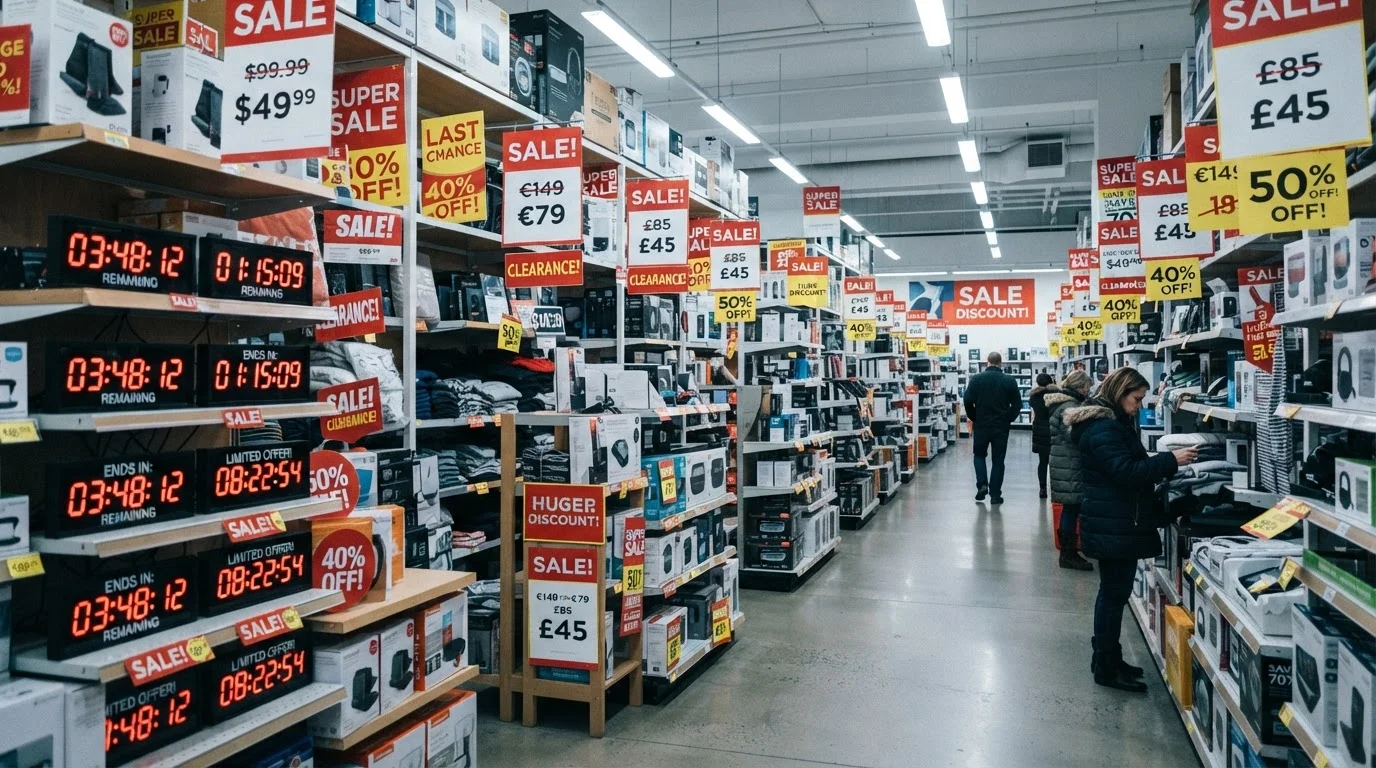
Two of the most studied mechanisms are anchoring (the tendency to over-rely on the first price seen) and artificial scarcity or urgency (time or quantity pressure that compresses decision-making).
How Anchoring Sets the Stage Before You Compare
When you see a jacket tagged at $180 now $89, your brain doesn't start from zero. It starts from $180. That first number - the anchor - becomes the benchmark against which everything else is measured. Even if $89 is a fair market price with no discount history, it will feel like a deal.
Anchoring was first documented in behavioral economics research and has since been replicated across retail, negotiation, and real estate contexts. The anchor doesn't have to be accurate to be effective. It only has to arrive first. This is why 'compare at' and 'was' prices are so common: they're not informational - they're positional.
The principle extends beyond marked-down items. High-priced items placed near mid-range ones make the mid-range seem reasonable by comparison, even without any explicit discount. Product line tiering - good, better, best - exploits the same mechanism: the premium tier anchors your sense of value, making the middle option feel prudent rather than expensive.
~60%
Purchases influenced by sale labeling
Consumer behavior research consistently finds that price presentation - not just price level - significantly affects purchase likelihood, with sale labels influencing a majority of unplanned buying decisions.
$0.01
Actual difference in charm pricing
The gap between $19.99 and $20.00 is one cent, yet behavioral studies show consumers perceive the former as meaningfully cheaper due to left-digit anchoring.
3x
Higher conversion under artificial urgency
Marketing industry analyses have found that countdown timers and scarcity messaging can triple conversion rates compared to standard product listings, regardless of actual stock levels.
To work around anchoring, identify your own reference point before engaging with a retailer's pricing. Ask what you'd pay for this item based on its function, durability, and alternatives - not based on what the tag says it used to cost. For a deeper look at how value is constructed beyond the sticker price, see our guide on total ownership costs.
Urgency, Scarcity, and the Compression of Judgment
Countdown timers, 'only 2 left in stock' banners, and 'sale ends tonight' notices share a single function: they compress your decision window. When time feels short, the brain shifts from deliberate analysis to fast, instinct-driven responses. Retailers know this, and they engineer it deliberately.
Not all urgency is fabricated. Genuine clearance events, limited production runs, and expiring promotions do exist. But the prevalence of countdown timers that reset, stock indicators that don't reflect real inventory, and 'flash sales' that recur weekly means urgency signals can't be taken at face value.
Set Your Own Price Ceiling First
Before browsing or comparing products, write down the maximum you'd willingly pay based on the item's practical value to you. When you encounter a 'sale' price, compare it to your number - not to the crossed-out anchor. This simple habit neutralizes anchoring and urgency effects by replacing the retailer's frame with your own.
A practical test: ask whether the urgency changes the product's actual value to you. If a slow cooker is worth $65 to your household based on use, the answer is the same whether a timer shows four hours or four days remaining. Urgency affects timing - it should not change your baseline assessment of worth.
Psychological urgency also interacts with social proof cues: 'bestseller' badges, view counts, and 'X people have this in their cart' notices. These signals imply others have already validated the purchase, offloading the burden of individual judgment. For context on how language shapes product perception more broadly, see how product descriptions are framed to shift perception.
Charm Pricing, Decoy Offers, and Structural Price Design
Beyond anchoring and urgency, retailers deploy structural pricing choices that are less obvious but equally influential. Charm pricing - ending prices in .99 or .95 - exploits the tendency to read numbers from left to right, causing consumers to perceive $49.99 as substantially cheaper than $50, despite a one-cent difference.
Decoy pricing introduces a third, strategically inferior option to make one of the other two look more attractive. A streaming plan might offer three tiers: basic at $8, standard at $15, and premium at $16. The premium tier exists partly to make standard look like an obvious choice - the decoy does its job by being close in price but richer in features than one tier while still far from the cheapest.
Bundle pricing obscures unit costs, making it harder to compare with alternatives. A kit that combines five items at $40 may seem economical, but if you only need two of the items, you're paying for volume you don't use. This connects directly to unit pricing literacy - something our article on unit pricing and shelf-tag detail covers in depth.
Understanding these structural choices doesn't mean avoiding sales or promotions. It means reading them as design decisions rather than objective signals of value. When you recognize the frame, you can evaluate what's inside it more clearly. For a full framework on comparing options beyond price alone, see price comparison done right.
Reclaiming Your Own Evaluation Framework
The most reliable defense against pricing psychology isn't skepticism - it's preparation. Shoppers who define their own value criteria before engaging with pricing displays are significantly less susceptible to anchoring and urgency effects. This means deciding, in advance, what a product is worth based on function, expected lifespan, and alternatives.
A few practical habits help. First, research price history through independent sources when making larger purchases - this reveals whether a 'sale' is a genuine reduction or a reference price set high for contrast. Second, apply unit pricing wherever label data is available, particularly in grocery and household goods contexts. Third, impose a self-set waiting period on non-essential purchases. The urgency imposed by a retailer dissolves when you've made an intentional choice to decide on your own timeline.
Retailers operate within legal frameworks around pricing and advertising, but those frameworks leave considerable room for persuasive design. Understanding your rights - around deceptive pricing, false advertising, and return policies - adds another layer of informed decision-making. You can explore the broader landscape of consumer protections available to shoppers to understand where the law draws the line.
None of this requires treating every purchase as an adversarial exercise. It simply means that the more you understand the systems shaping your choices, the more freely you can make them on your own terms.