

| Tail positions studied in research | 5-7 distinct postures (Feline ethology literature, broadly cited) |
| Most reliable friendly signal | Tail straight up (Consistent across behavioral studies) |
| Warning signal most often ignored | Tail lash / whip (Commonly reported in veterinary behavior consultations) |
| Context always needed | Yes - read alongside ears, pupils, posture (Applied animal behavior consensus) |
Why the Tail Is Your Cat's Most Expressive Tool
Cats communicate through a layered system of posture, vocalizations, scent, and movement - but the tail is one of the most dynamic and readable channels available to human observers. Unlike facial expressions, which can be subtle and easily missed, tail position and motion are visible from a distance and change in real time as a cat's emotional state shifts.
Understanding feline tail language isn't just a curiosity - it's a practical skill. Recognizing early warning signals can prevent bites and scratches, while spotting signs of comfort and trust deepens the relationship between cat and owner. For a broader overview of how body language works across multiple species, see our guide on reading your pet's body language.
It's important to read the tail alongside other cues - ear position, pupil size, whisker angle, and overall posture all contribute context. No single signal tells the whole story.
Piloerection
The involuntary bristling of fur caused by contraction of small muscles at the hair follicle base. In cats, it typically occurs along the tail and spine in response to fear or high arousal.
Affiliative behavior
Friendly, bonding actions directed toward another individual - such as tail wrapping, head bunting, or mutual grooming. These signals indicate comfort and social connection rather than threat.
Overstimulation
A state in which a cat's sensory threshold is exceeded during petting or play, causing a rapid shift from tolerance to irritability. A tail lash is a common early indicator.
Feline ethology
The scientific study of cat behavior in natural and domestic contexts. Ethological research forms the evidence base for interpreting body language signals accurately.
Tail Positions and What They Mean
Each tail configuration carries a distinct meaning. The following positions represent the most common and behaviorally significant ones documented in feline ethology research.
| Tail positions studied in research | 5-7 distinct postures (Feline ethology literature, broadly cited) |
| Most reliable friendly signal | Tail straight up (Consistent across behavioral studies) |
| Warning signal most often ignored | Tail lash / whip (Commonly reported in veterinary behavior consultations) |
| Context always needed | Yes - read alongside ears, pupils, posture (Applied animal behavior consensus) |
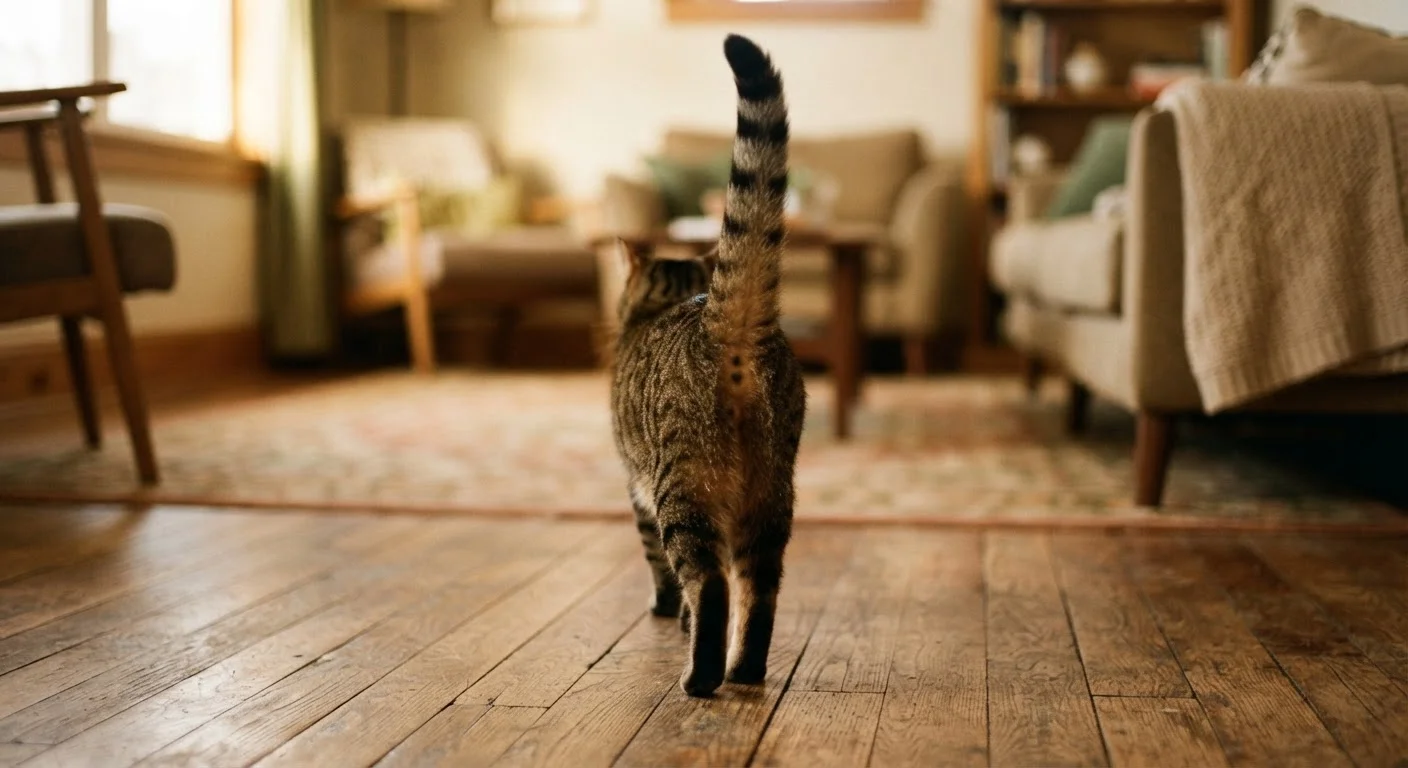
Tail Straight Up
A fully upright tail - sometimes with a slight curl at the tip - signals confidence, friendliness, and a willingness to engage. Cats typically greet familiar humans or feline companions this way. It's an invitation, not a threat.
Tail Curved Like a Question Mark
This upright tail with a hooked tip indicates a playful, curious mood. If your cat approaches you with this shape, they're likely open to interaction and may be interested in play.
Tail Tucked Low or Between the Legs
A tail pulled down or curled under the body signals fear, submission, or significant stress. This is a cat trying to make itself smaller. Forcing interaction at this point usually escalates anxiety.
Puffed-Up or Bristled Tail
Piloerection - the involuntary raising of fur along the tail - indicates high arousal, usually from fear or aggression. A cat with a puffed tail and arched back is in a defensive threat posture. Give the animal space immediately.
Slowly Swaying or Lashing Tail
A slow, deliberate side-to-side sweep is a concentration signal, often seen during hunting focus. A faster, harder lash - sometimes called a "tail whip" - is an unambiguous warning that the cat is irritated or overstimulated. Many bites follow this signal when it's ignored. Our article on what aggression in cats is actually telling you explains the escalation pathway in detail.
Wrapped Around Another Cat or Person
A tail gently draped over another animal or curled around a human's leg is an affiliative gesture - a sign of social bonding and comfort.
Common Misreads and What to Do Instead
One of the most frequent mistakes owners make is interpreting any tail movement as friendliness - a logic that works for dogs but not cats. A rapidly lashing tail in a cat is almost the opposite of a wagging tail in a dog. Confusing the two often results in an unwanted bite that the cat, from its perspective, clearly telegraphed. See our companion piece on misreading your pet's signals for more examples across species.
Another common error: assuming a tucked tail always means the cat is timid by nature. Sudden changes in tail carriage - especially if a previously confident cat begins consistently holding its tail low - can sometimes reflect physical discomfort. Pain and illness can alter posture and behavior. If you notice persistent changes without an obvious environmental trigger, a veterinary evaluation is appropriate. Our guide on subtle signs your cat may be in pain covers related behavioral shifts worth watching for.
Sudden Behavioral Changes Warrant a Vet Visit
If your cat's typical tail posture shifts noticeably - becoming consistently low, tucked, or still - without any obvious environmental change, consult a veterinarian. Chronic pain, neurological changes, or illness can alter posture and movement. Behavioral changes are health data, not just personality quirks.
When in doubt, let the cat lead. Giving a stressed or overstimulated cat space - rather than attempting to calm it through handling - is almost always the more effective response.