

Key Takeaways
The American Tradition of Protest
From the Boston Tea Party to the Women's March, dissent has functioned as a core civic technology in the United States. The First Amendment's protections for peaceful assembly and petition were not incidental - the founders encoded them after witnessing protest movements catalyze a revolution. Scholars of social movements often describe this heritage as a "contentious politics" tradition: ordinary people using collective action to challenge those who hold power.
That tradition has never been seamless or universally welcomed. Protesters in every era have faced legal restrictions, social stigma, and at times physical danger. Yet the historical record consistently shows that movements willing to sustain pressure over time have altered the arc of American law and culture in measurable ways. Understanding that process helps explain the social forces currently reshaping American life - a story explored in depth when looking at how U.S. family structures have shifted alongside political ones.
Landmark Movements That Reshaped U.S. Law
The clearest evidence that protest produces tangible policy change comes from examining specific legislative outcomes. The suffrage movement, organized over more than seven decades, secured the 19th Amendment in 1920, granting women the constitutional right to vote. The labor movement's campaigns in the early 20th century - including strikes, marches, and civil disobedience - laid the groundwork for the Fair Labor Standards Act of 1938, which established the federal minimum wage and 40-hour workweek.
The Civil Rights Movement of the 1950s and 1960s is perhaps the most studied example. Nonviolent direct action campaigns in Birmingham, Selma, and across the South - combined with litigation through the NAACP Legal Defense Fund and sustained lobbying - culminated in the Civil Rights Act of 1964 and the Voting Rights Act of 1965. Historians note that these legislative victories did not emerge from protest alone; they required the convergence of grassroots organizing, sympathetic media coverage, and political opportunity.
When evaluating a movement's likely impact, look past its largest single demonstration and examine its organizational infrastructure - sustained membership, legal capacity, and electoral engagement are stronger predictors of legislative success than crowd size alone.
Historical analysis of successful movements - suffrage, labor, civil rights - consistently shows that durable change required institutional capacity beyond the protest event itself.
Pay attention to counter-movement activity as a signal of a primary movement's momentum: organized opposition typically intensifies once a movement has already won meaningful concessions, not before.
Sociologists studying movement dynamics document this counter-mobilization pattern across multiple historical cases, from Reconstruction through the culture wars of the late 20th century.
More recent decades added further examples: the disability rights movement produced the Americans with Disabilities Act of 1990, and the marriage equality movement achieved a landmark Supreme Court ruling in Obergefell v. Hodges in 2015 after years of state-level campaigns and litigation.
How Protest Shifts Public Opinion
Legislative change rarely arrives without a corresponding shift in public attitudes, and protest movements are one documented mechanism for producing those shifts - though not always in the direction activists intend. Research in political science and sociology suggests that the relationship between protest and opinion is non-linear: large, visible demonstrations can initially harden opposition among those who feel threatened by the movement's demands, while gradually normalizing those demands for persuadable audiences.
55%
Americans supporting same-sex marriage by 2015
Gallup polling found majority support for same-sex marriage had reached 55% by the time the Supreme Court issued its ruling in Obergefell v. Hodges - up from roughly 27% in 1996.
70+ years
Duration of the U.S. suffrage movement
The organized campaign for women's voting rights spanned from the Seneca Falls Convention of 1848 to ratification of the 19th Amendment in 1920, illustrating the long timelines of structural change.
26 million
Estimated U.S. participants in 2020 racial justice protests
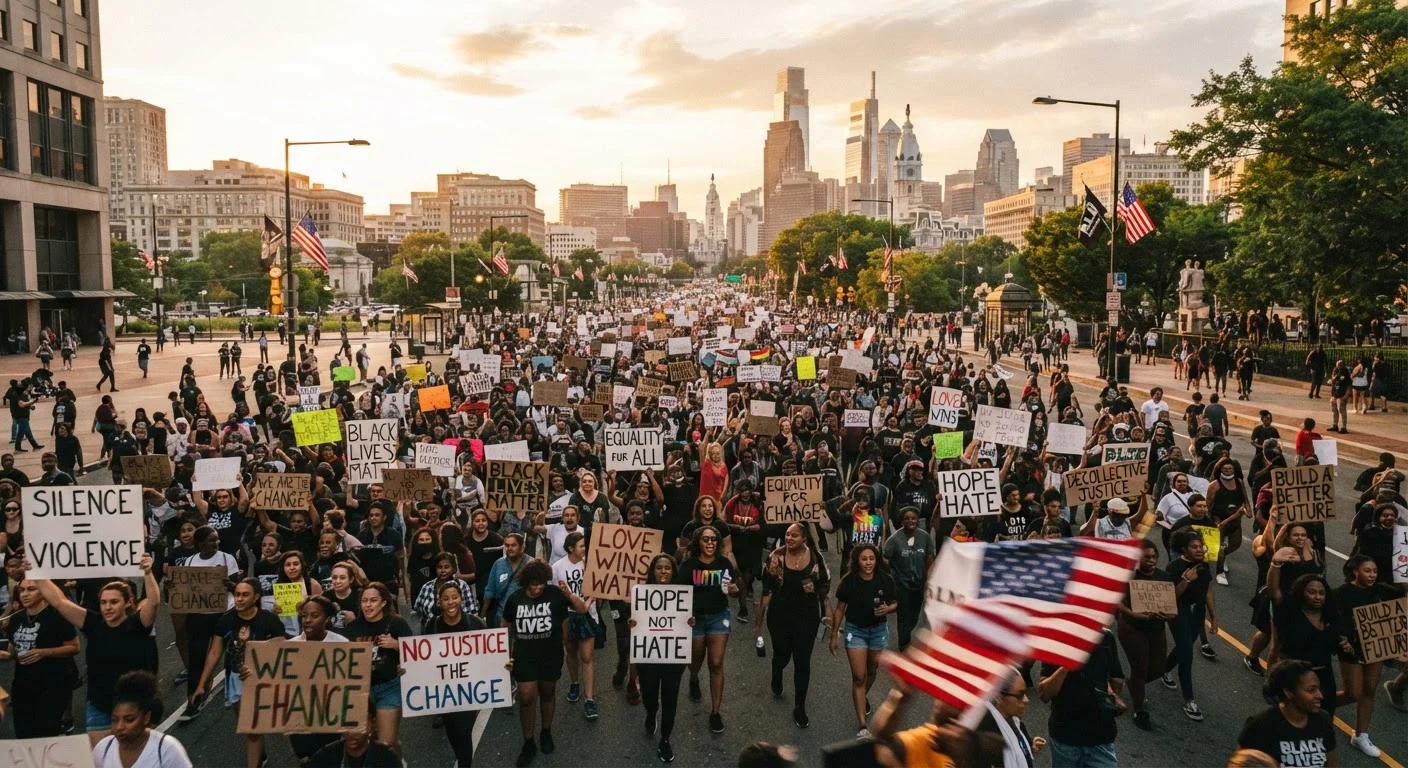
The New York Times, citing crowd-counting research, reported that protests following George Floyd's death in 2020 may have been the largest in U.S. history by number of participants.
Polling data on civil rights attitudes, for example, showed majority white American support for school integration increasing steadily through the 1960s and 1970s - tracking, with some lag, behind the movement's most prominent campaigns. Similarly, national polling on same-sex marriage shifted from majority opposition to majority support between roughly 2010 and 2015, a period coinciding with heightened public visibility of the marriage equality movement. Causation is difficult to establish cleanly, but the correlation is consistent across multiple movement contexts.
The Role of Media and Technology
No movement operates in an information vacuum. Television coverage of fire hoses and police dogs turned against peaceful marchers in Birmingham in 1963 is widely credited with accelerating federal action on civil rights - compelling evidence that media framing can amplify or suppress a movement's moral claims. Print journalism played an analogous role in the Progressive Era, with investigative reporters (then called muckrakers) exposing labor abuses that fueled reform campaigns.
The digital era has introduced new dynamics. Social media platforms allow movements to organize rapidly and bypass traditional gatekeepers, as demonstrated by the Arab Spring internationally and the rapid growth of the Black Lives Matter movement domestically following specific incidents captured on smartphone video. However, researchers caution that viral moments do not automatically translate into durable organizing, and that algorithm-driven attention can be as fragmenting as it is mobilizing.
The full spectrum of how Americans engage with civic life - beyond marching and social media - is worth examining: voter registration, advocacy, and community organizing each play distinct roles in converting movement energy into lasting change.
Backlash, Limits, and the Long Game
Historians and sociologists consistently document a backlash dynamic: as movements gain visibility and win early concessions, they frequently generate organized counter-movements. The Reconstruction era was followed by the rise of Jim Crow. The feminist gains of the 1970s triggered a well-organized conservative counter-mobilization. Understanding backlash as a predictable feature - rather than evidence of failure - is essential to reading movement history accurately.
Backlash Is Not the Same as Defeat
A common misreading of movement history treats organized opposition or legislative setbacks as proof that a movement has failed. In practice, backlash often signals that a movement has been effective enough to threaten entrenched interests. Reconstruction-era gains, for example, were rolled back for decades before the Civil Rights Act addressed many of the same underlying issues. Readers and analysts should resist interpreting short-term reversal as the final word on a movement's trajectory.
Movements that achieve durable change typically combine multiple tactics: street protest generates visibility and moral urgency; litigation secures or defends legal rights; electoral organizing shifts the balance of power in legislatures; and cultural work - art, storytelling, education - gradually shifts the frame of what the public considers normal or acceptable. No single tactic alone has consistently produced lasting structural change.
What History Tells Us About Social Change Today
Contemporary Americans witnessing debate over climate policy, racial equity, immigration, and gun legislation are experiencing a pattern that echoes prior eras: heightened mobilization on multiple sides, intense media amplification, and significant uncertainty about legislative outcomes. History does not guarantee that any particular movement will succeed, but it does offer a framework for understanding the conditions under which social change becomes more or less likely.
Key factors include the breadth of coalition (movements that expand beyond their founding base tend to be more durable), the existence of institutional allies (sympathetic legislators, courts, or executive agencies), and the capacity to sustain organizing through periods when public attention has moved on. The civil rights, labor, and suffrage movements all endured decades of incremental progress, setback, and renewed mobilization before achieving their landmark victories.
For everyday Americans trying to make sense of the movements reshaping their communities, the most accurate lens is a long one - measured in years and decades, not news cycles. Protest, at its most effective, is less a single event than a sustained conversation between citizens and the institutions that govern them.