

Key Takeaways
The Full Picture of Civic Life
Every two or four years, Americans are reminded that voting is a civic duty. And it is - electoral participation shapes who holds power and what policies get prioritized. But democratic health isn't measured at the ballot box alone. Researchers, political scientists, and community organizers point to a much broader ecosystem of civic activity that sustains public life between elections.
Civic engagement encompasses any action taken to influence community decisions, address shared problems, or build social cohesion. That range is vast - from testifying at a city council meeting to joining a neighborhood association, from volunteering at a local food bank to writing a letter to an elected official. Understanding this fuller spectrum matters, especially as polling data from organizations like the Pew Research Center consistently shows that Americans feel disconnected from political institutions even as many remain deeply involved in their communities.
Geography plays a real role in shaping who participates and how. Rural and urban Americans often have access to very different civic infrastructure - from public meeting spaces to volunteer networks - which can meaningfully affect engagement patterns.
Attending local government meetings
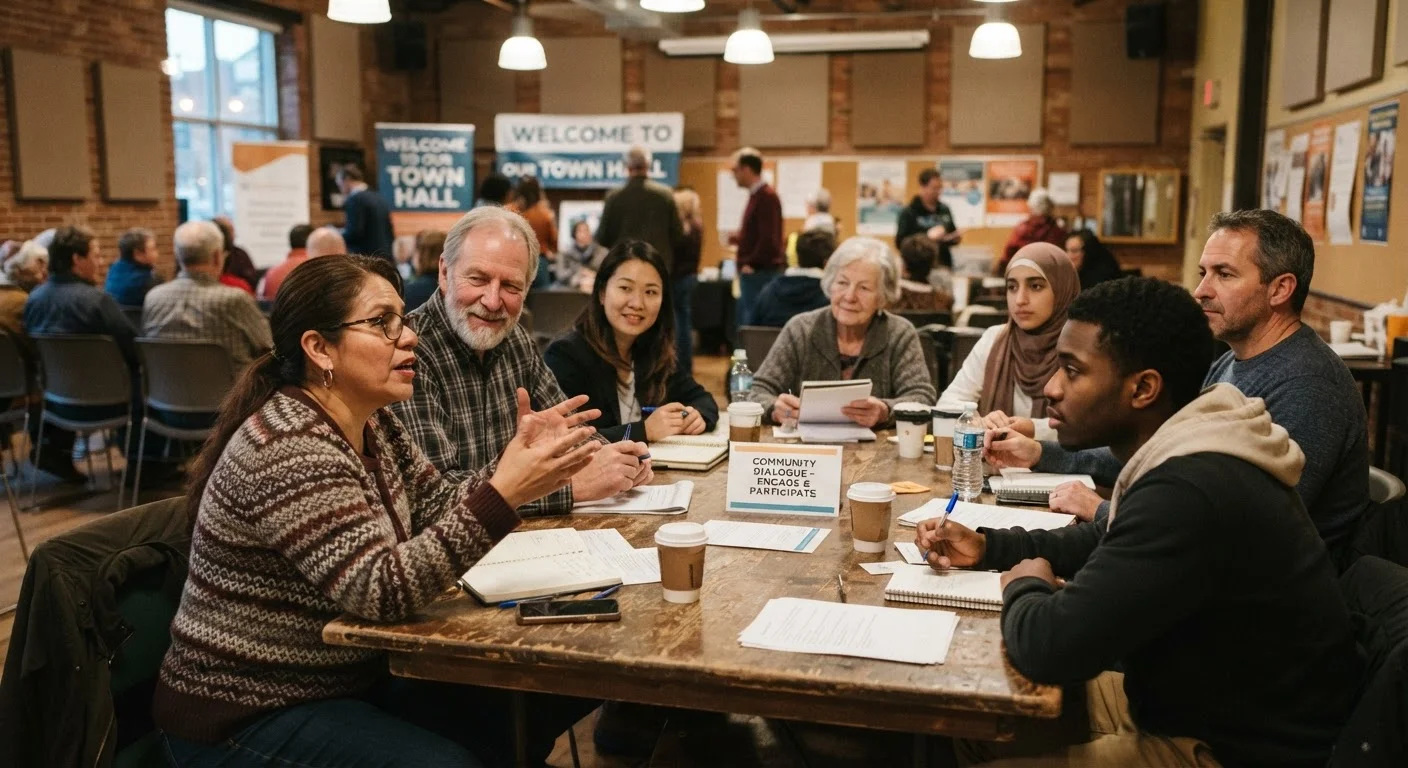
City councils, school boards, zoning commissions, and planning boards make decisions that directly affect everyday life - property taxes, school curricula, housing density, transit routes. Yet these meetings routinely draw only a handful of attendees. Public comment periods at these sessions give any resident the legal right to speak on the record, making them one of the most direct forms of civic influence available to ordinary Americans.
Research from political science suggests that local officials are more responsive to constituent contact than federal legislators, partly because the constituent pool is smaller and voices are harder to ignore. Showing up - even once - signals to elected officials that the public is watching.
Local officials are often more responsive to constituent input than any other level of government.
Volunteering with community organizations
The Corporation for National and Community Service has tracked volunteerism in the U.S. for decades, consistently finding that tens of millions of Americans contribute time to nonprofits, religious institutions, and civic groups each year. This unpaid labor builds what sociologists call social capital - the networks of trust and reciprocity that make communities more resilient.
Volunteer roles span an enormous range: tutoring students, staffing food pantries, organizing neighborhood cleanups, serving on nonprofit boards, or mentoring youth through established programs. Each of these activities addresses community needs while simultaneously creating relationships across social lines that might not otherwise intersect.
Volunteerism builds social capital - the networks of trust that make communities more resilient.
Contacting elected officials
Phone calls, written letters, and in-person visits to legislative offices are forms of advocacy with documented impact. Congressional staffers have noted in published interviews that a relatively small volume of constituent calls on a specific issue can shift how an office prioritizes a legislative matter. The key factors are specificity - identifying a bill or policy by name - and personal relevance, explaining how the issue affects the constituent directly.
This form of engagement works at every level of government. State legislatures, county commissioners, and municipal offices all receive far less constituent contact than federal offices, meaning individual voices can carry comparatively more weight at those levels.
A small volume of specific, personal constituent calls can meaningfully influence a legislative office's priorities.
Participating in community spaces and local institutions
Libraries, community centers, farmers markets, and faith communities function as civic infrastructure - spaces where people from different backgrounds encounter one another and build shared identity. Farmers markets, for instance, have become documented sites of community formation in many American towns, not just venues for commerce.
Participation in these spaces, even casually, contributes to what urban researchers call a sense of place - a shared investment in the character and future of a neighborhood or town. That attachment, in turn, tends to motivate more formal civic action over time.
Civic infrastructure like libraries and community markets builds the social bonds that drive formal engagement.
Organizing and joining civic associations
Neighborhood associations, civic leagues, parent-teacher organizations, and issue-based coalitions allow citizens to aggregate influence they couldn't exercise alone. These groups can petition local governments, mobilize voters, pool resources for community projects, and advocate before regulatory bodies. They also serve as training grounds for civic leadership - many elected officials began their public lives in these informal structures.
The decline of civic associations in the late 20th century - documented in sociological literature as part of a broader retreat from public life - has been linked to weakened democratic participation at the local level. Efforts to rebuild these institutions, including digitally organized neighborhood networks, represent one of the more active areas of civic innovation today.
Civic associations amplify individual voices and have historically served as incubators for democratic leadership.
Engaging in nonpartisan voter education
While voting itself is a separate act, supporting informed participation is its own civic contribution. Organizations focused on voter registration drives, candidate forums, ballot measure explainers, and civic education in schools work to lower the information barriers that suppress turnout - particularly among young voters and communities historically excluded from the political process.
The difference in outcomes between midterm and presidential election cycles is a good example of how information gaps shape participation. Midterm turnout is consistently lower despite the local and statewide offices at stake often having more direct impact on daily life than federal races.
Voter education work lowers information barriers that suppress participation, especially in lower-turnout elections.
Building a Civic Life That Sticks
Civic participation isn't a single act - it's a practice. Researchers who study social capital, including the foundational work associated with Robert Putnam's analyses of American community life, have long observed that sustained involvement, not one-time action, is what strengthens democratic institutions over time.
Start Local for the Fastest Impact
If you're new to civic engagement, local government is the most accessible entry point. Most city council and school board meetings are open to the public, listed on municipal websites, and held in the evenings to accommodate working residents. Attending just one session - even as an observer - builds familiarity with how decisions get made and who makes them.
Protest and direct action also occupy a critical place in this ecosystem. Grassroots protest movements have historically been among the most effective drivers of legislative and cultural change in the United States, from labor rights to civil rights to environmental protections. What connects all these forms of engagement is that they require showing up - consistently, locally, and with others. That's a harder ask in an era of fractured attention, but civic research suggests it remains the most reliable path from individual concern to collective impact.
And civic participation has spillover effects. Studies have found correlations between community involvement and physical and mental wellbeing - an echo of findings explored in discussions about active versus sedentary daily patterns more broadly. Being embedded in community life keeps people moving, connected, and purposeful.