

Key Takeaways
Supply Chain Disruption
A supply chain disruption is any event that interrupts the normal flow of goods from producers to consumers - including factory shutdowns, shipping delays, port congestion, or raw material shortages. When those interruptions occur, they raise costs at every stage of production and delivery. Those added costs are typically passed along to retailers, and ultimately to shoppers.
Economists refer to these as 'supply shocks,' which shift the aggregate supply curve leftward, reducing output while raising the price level - a core driver of cost-push inflation.
The Journey From Disruption to the Checkout Lane
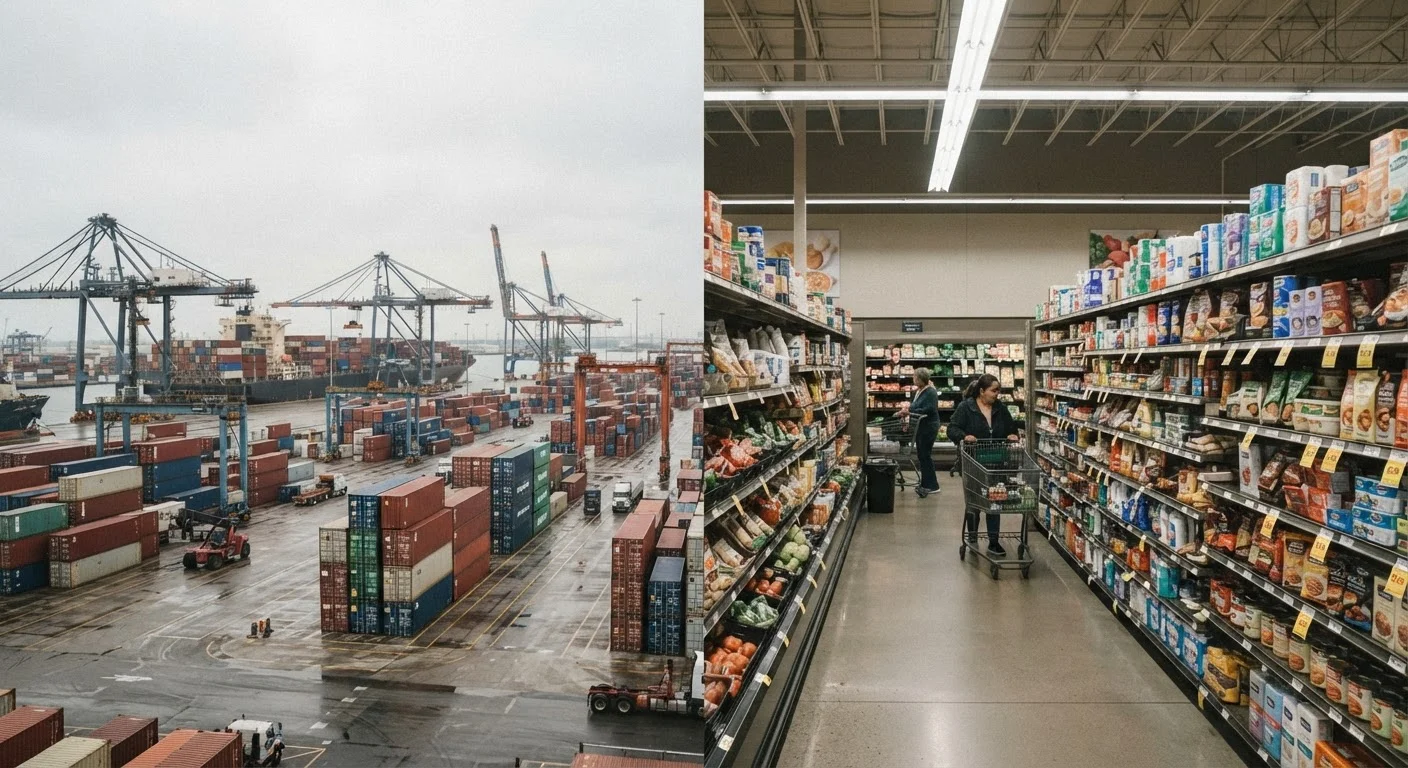
When a shipping container sits stranded at a congested port, it can feel like an abstract logistics problem. But that delay sets off a chain reaction that ends at the grocery store, the hardware shop, and the gas pump. Understanding how that sequence works helps explain why prices rise even when the original problem seems remote.
Every product on a store shelf passed through multiple hands: raw material extractors, component manufacturers, assembly plants, freight carriers, distribution warehouses, and finally retailers. Each link in that chain adds a margin to cover its own costs. When disruption hits any one of those links, costs increase - and usually travel downstream to consumers.
~$10,000
Average per-container ocean freight rate spike (2021 peak)
Drewry World Container Index recorded spot rates exceeding $10,000 per 40-foot container on major trade lanes during the 2021 shipping surge, compared to roughly $1,500 pre-pandemic.
3-4 weeks
Typical port dwell time during peak congestion
U.S. ports reported average container dwell times of three to four weeks during peak 2021-2022 congestion, compared to roughly two to three days under normal conditions.
~500,000
U.S. truck driver shortage estimate
The American Trucking Associations estimated a shortage of approximately 80,000 drivers in 2021, with projections suggesting the gap could widen to over 160,000 by the mid-2020s without intervention.
Where Disruptions Begin: Common Triggers
Supply chain stress rarely comes from a single cause. Economists and logistics analysts point to several recurring triggers:
- Port congestion and shipping delays: When more cargo arrives than ports can process - due to labor shortages, equipment failures, or surges in import volume - ships wait at anchor for days or weeks. That idle time costs money in demurrage fees, which shippers pass on through higher freight rates.
- Raw material scarcity: A shortage of key inputs - semiconductor chips, lumber, agricultural commodities - means manufacturers either slow production or pay premium prices to secure supply. Either outcome raises the cost of the finished product.
- Labor shortages: Warehouse workers, truck drivers, and dockworkers all play essential roles. When those workforces shrink, throughput slows, delivery times lengthen, and wages rise to attract workers - all adding cost.
- Geopolitical events and trade policy: Tariffs, sanctions, or regional conflicts can block established trade routes or raise the cost of imported components, forcing buyers to find pricier alternatives quickly.
These triggers frequently compound each other. A factory closure overseas can simultaneously create a parts shortage, spike air freight demand, and trigger labor overtime - multiplying cost pressures across the chain.
How Costs Cascade Through the Chain
Consider a basic household appliance. A manufacturer relies on steel and electronic components, both sourced internationally. If either becomes scarce or expensive to ship, the manufacturer faces a choice: absorb the cost or raise the price charged to wholesalers. Most businesses cannot absorb sustained losses, so costs move forward.
The wholesaler, now paying more per unit, similarly adjusts the price offered to retailers. Retailers then weigh how much of the increase they can absorb through tighter margins versus how much they must pass to shoppers through higher shelf prices. In highly competitive categories, retailers may hold prices briefly and shrink margins - but that strategy has a limit.
This mechanism is what economists call cost-push inflation: prices rising because production and delivery costs increase, not because consumers are spending more aggressively. It differs from demand-driven inflation, though both can occur simultaneously and reinforce each other. For a broader look at how these forces interact, see how inflation and deflation affect everyday budgets.
“Supply chains were built for efficiency, not resilience. When a single node fails, the entire network feels it - and those costs don't disappear. They redistribute, usually toward the consumer.”
— Willy Shih, Professor of Management Practice, Harvard Business School, and supply chain researcher
What This Means for American Shoppers
The practical result is that families often notice price increases before economists finish explaining them. Grocery bills, in particular, tend to feel steeper than official inflation measures suggest - partly because food prices are more volatile and visible than the broader basket used to calculate headline inflation. Why grocery costs feel higher than the official numbers explores that gap in more detail.
Some manufacturers respond to cost pressure not by raising prices but by reducing package sizes - a practice known as shrinkflation. Shrinkflation: the price increase you almost never notice explains where this tactic shows up most frequently.
When supply-driven price increases persist, household budgets tighten across the board. Families that spend more on staples have less to allocate to rent, debt repayment, and savings - an effect that connects to the broader pressures described in how housing costs ripple through the wider economy.
Shoppers looking to adapt can compare unit prices, consider timing larger non-urgent purchases, and weigh whether bulk buying or buying as needed makes more sense given current availability and storage constraints. Understanding which product categories face the most upstream pressure is one of the more reliable ways to anticipate where costs are likely to shift next.