
Inflation vs. Deflation: Two Economic Forces With Very Different Effects on Your Wallet

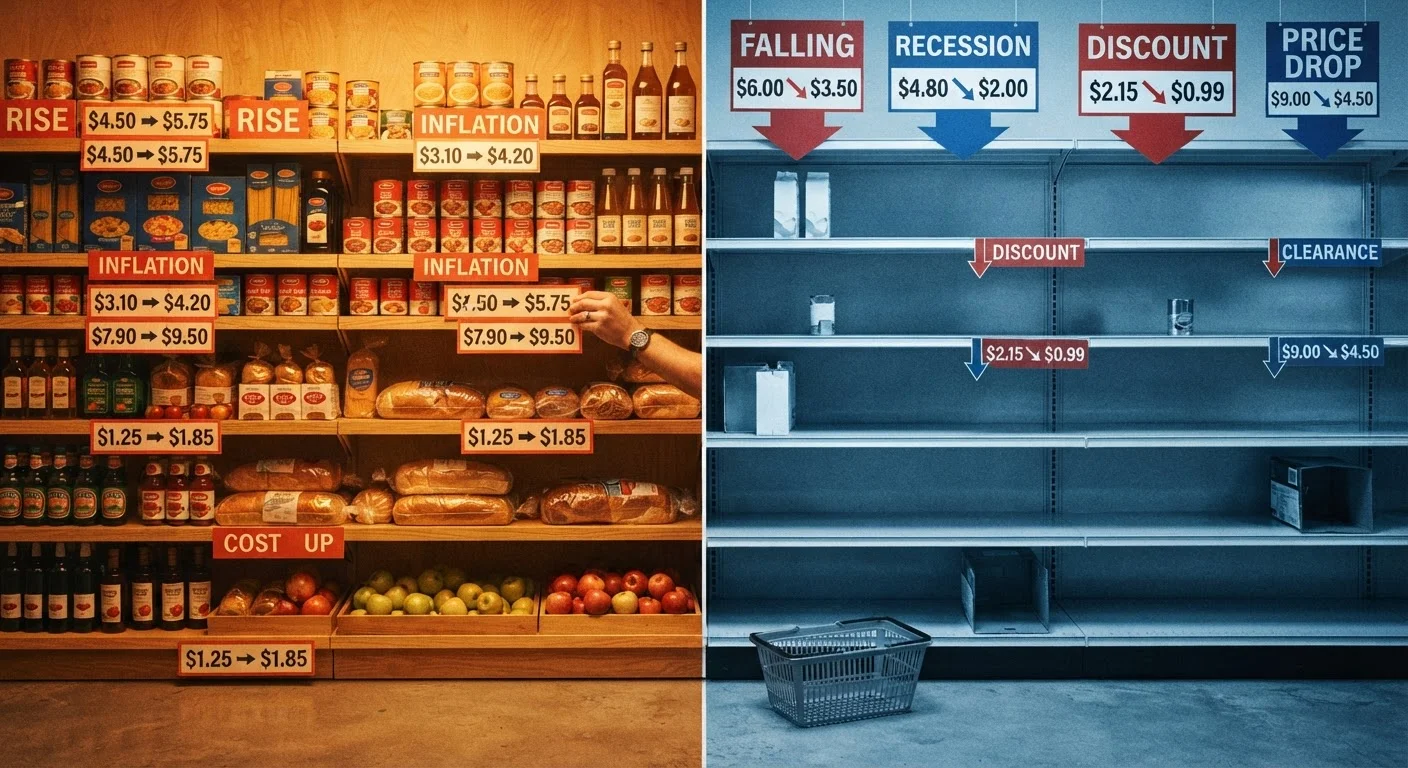
Key Takeaways
Option A
Inflation
The persistent rise in prices that erodes purchasing power over time.
Best for: Understanding why everyday goods cost more and why the Federal Reserve frequently adjusts interest rates in response.
Option B
Deflation
The sustained fall in prices that can quietly stall economic activity.
Best for: Grasping why 'cheaper prices' can actually signal economic trouble and trigger a damaging cycle of delayed spending.
If you carry significant fixed-rate debt like a mortgage
Inflation
Inflation gradually reduces the real value of fixed debt, meaning you repay with dollars that are worth less - a hidden benefit for long-term borrowers.
If you are living on a fixed income or holding substantial cash savings
Deflation
Falling prices increase what each dollar buys, benefiting those whose income does not change - though widespread deflation carries serious economic risks.
If you are worried about job security during an economic downturn
Inflation
A deflationary environment typically accompanies rising unemployment as businesses cut costs; moderate inflation generally correlates with stronger labor markets.
If you want to understand why the Fed raises interest rates
Inflation
Rate hikes are primarily a tool to cool inflation; understanding inflation explains most Federal Reserve policy decisions affecting mortgages and credit.
The Basic Mechanics: Prices Moving in Opposite Directions
Inflation and deflation describe opposite movements in the general price level of an economy. Inflation means prices are rising across a broad range of goods and services, so each dollar buys a little less than it did before. Deflation means prices are falling broadly, so a dollar stretches a little further at the checkout.
The U.S. government tracks consumer price changes primarily through the Consumer Price Index (CPI), published monthly by the Bureau of Labor Statistics. The CPI measures the average price change paid by urban consumers for a representative basket of goods - from groceries to rent to medical care. When that index rises year-over-year, the economy is experiencing inflation; when it falls, deflation. Economists also watch the Personal Consumption Expenditures (PCE) price index, which the Federal Reserve officially targets at around 2% annual inflation as a benchmark for a healthy economy.
It is worth noting that inflation does not mean every price rises, nor does deflation mean every price falls. Technology products, for instance, have dropped in price for decades even during inflationary periods. What matters is the broad average.
| Criterion | Inflation | Deflation |
|---|---|---|
| Price direction | Prices rise broadly over time | Prices fall broadly over time |
| Purchasing power | Each dollar buys less | Each dollar buys more |
| Impact on fixed debt | Real debt burden shrinks | Real debt burden grows |
| Impact on savings | Erodes value unless interest exceeds inflation | Increases real value of cash held |
| Employment outlook | Often accompanies stronger labor markets | Frequently linked to rising unemployment |
| Fed policy response | Raise interest rates to cool demand | Cut rates and stimulate to boost demand |
| Historical U.S. examples | 1970s oil shocks; 2021-2023 surge | Great Depression; brief 2008-2009 episode |
How Inflation Hits Your Household Budget
When inflation runs above wage growth, real purchasing power falls - meaning a paycheck covers less ground than it used to. Families may find themselves cutting discretionary spending, drawing on savings, or taking on debt to cover the same standard of living. Nominal pay increases can be wiped out by rising prices, a dynamic that frustrates many workers who see a bigger number on their paycheck but feel no financial relief.
Food and energy prices, which tend to be volatile, often hit lower-income households the hardest because those categories represent a larger share of their budgets. Many families report that their costs rise faster than official inflation figures suggest, partly because personal spending patterns differ from the averaged CPI basket.
On the borrowing side, inflation has a nuanced effect. Holders of fixed-rate mortgages effectively repay with cheaper dollars over time, which is a subtle benefit. However, new borrowers face higher interest rates, since lenders price in expected inflation. When the Federal Reserve raises rates to fight inflation, the effects travel quickly to mortgages, car loans, and credit cards.
9.1%
Peak U.S. CPI inflation rate
The Bureau of Labor Statistics recorded this four-decade high in June 2022, prompting the Federal Reserve's most aggressive rate-hiking cycle in decades.
2%
Federal Reserve's inflation target
The Fed officially targets a 2% annual rate of PCE inflation as consistent with price stability and maximum employment under its dual mandate.
~25%
U.S. price level drop, 1929-1933
During the Great Depression, broad deflation of roughly 25% accompanied catastrophic unemployment and remains the benchmark case for deflationary spirals.
Why Falling Prices Are Not Always Good News
Deflation sounds appealing - who wouldn't want cheaper groceries and lower gas prices? But sustained, broad deflation has historically accompanied some of the most severe economic contractions on record, including the Great Depression of the 1930s and Japan's so-called "Lost Decade" of the 1990s.
The core problem is behavioral. When consumers expect prices to keep falling, they delay purchases: why buy a refrigerator today if it will cost less next month? This collective hesitation reduces business revenue. Companies respond by cutting costs - often through layoffs. Rising unemployment further suppresses consumer spending, which drives prices down further still. Economists call this a deflationary spiral, and once it takes hold, it is extraordinarily difficult to reverse.
For households carrying debt, deflation is particularly painful. The nominal value of what is owed stays fixed while the purchasing power of each dollar rises - meaning the real burden of debt grows. A $300,000 mortgage does not shrink just because prices fall; in real terms, it becomes heavier.
Not All Price Drops Equal Deflation
A single category falling in price - such as gasoline after an oil glut - is not deflation. True deflation refers to a sustained, broad-based decline in the overall price level measured across the economy. Similarly, a slowdown in the rate of inflation (called disinflation) is different from deflation: prices are still rising, just more slowly. Distinguishing these terms helps readers interpret economic headlines accurately.
What History and Policy Tell Us
The U.S. economy has experienced both extremes in living memory. Consumer prices rose sharply during the 1970s oil shocks and again following pandemic-era supply disruptions and stimulus spending. The most recent episode saw CPI inflation reach a four-decade high of 9.1% in June 2022, according to Bureau of Labor Statistics data, before gradually declining as the Federal Reserve raised its benchmark interest rate aggressively.
Significant deflation has been rarer in the modern U.S. economy, partly because the Federal Reserve's mandate explicitly includes maintaining price stability and maximum employment - two goals that constrain how far policymakers will allow prices to fall. Brief deflationary episodes occurred during the 2008-2009 financial crisis, when broad demand collapsed, but policymakers intervened quickly with emergency rate cuts and quantitative easing programs.
For everyday Americans, the practical lesson is that both extremes carry real costs. Moderate, stable inflation - the kind that allows wages, savings, and investment returns to keep pace - is generally considered the least disruptive environment for household financial planning. Understanding which force is at work at any given moment helps consumers and workers interpret economic headlines and make more informed decisions about spending, saving, and borrowing.
This article is for general informational and educational purposes only and does not constitute financial or investment advice. Readers should consult a qualified financial professional for guidance specific to their circumstances.