
Fixed vs. Variable Expenses: Knowing the Difference When Budgeting During Inflation

Key Takeaways
Option A
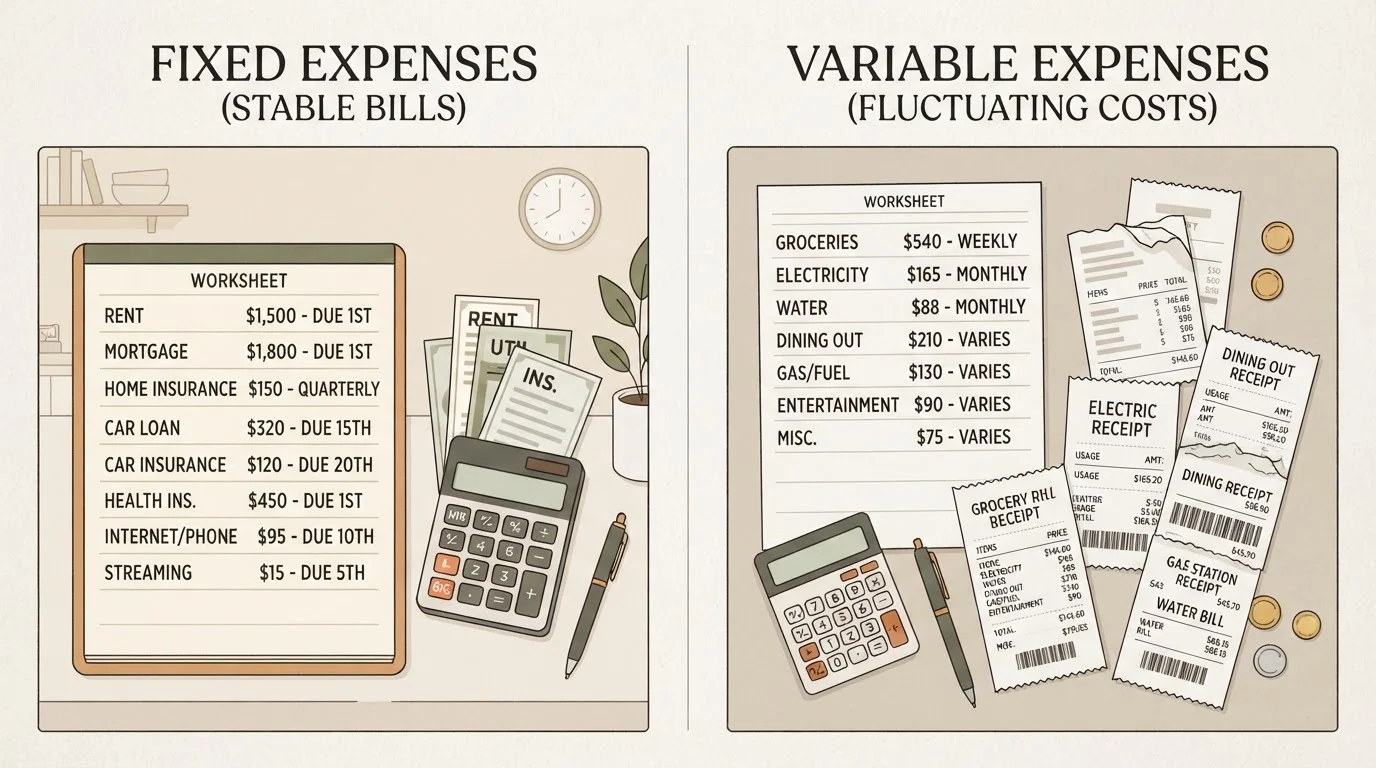
Fixed Expenses
The predictable, contract-bound costs that hold steady month to month.
Best for: Households seeking budget certainty and easier long-term financial planning.
Option B
Variable Expenses
The flexible, spending-driven costs that rise and fall with behavior and prices.
Best for: Areas where conscious choices and behavioral changes can meaningfully reduce spending.
If you want to build a stable budget foundation
Fixed Expenses
Locking in predictable costs like rent and insurance allows you to plan around a known baseline, making it easier to allocate the rest of your income.
If you need to cut spending quickly during a high-inflation period
Variable Expenses
Variable costs respond directly to behavioral changes - adjusting grocery choices, reducing dining out, or lowering thermostat settings can produce immediate savings.
If you are evaluating your long-term financial resilience
Fixed Expenses
Auditing fixed commitments periodically - such as insurance premiums or subscription services - can uncover locked-in costs worth renegotiating at renewal.
What Makes an Expense 'Fixed' or 'Variable'?
At its most basic, a fixed expense is any recurring cost that stays the same from one billing cycle to the next, regardless of how prices move in the broader economy. A mortgage payment, a car loan installment, or a renter's insurance premium are classic examples - the amount due is set by contract and doesn't change when the Consumer Price Index rises.
A variable expense, by contrast, changes based on consumption habits, market prices, or both. Your grocery bill, gasoline costs, utility usage, and dining-out spending all fall into this category. When inflation pushes food prices higher, those costs show up immediately in variable line items. As the broader economic dynamics of rising prices illustrate, the impact is rarely uniform across a household budget.
There is also a middle category sometimes called periodic fixed expenses - costs that are predictable in amount but don't recur monthly, such as annual car registration or semi-annual insurance premiums. Budgeters often divide these by twelve and set aside a monthly portion to avoid being caught off guard.
How Inflation Affects Each Category Differently
When inflation accelerates, fixed and variable expenses respond on very different timelines. Variable expenses feel the pressure almost immediately. Food prices, energy costs, and household supplies track closely with inflation data - and in many cases, families perceive those increases as even steeper than official figures indicate. That perception gap is real and documented: why grocery bills feel higher than official inflation numbers suggest is a question rooted in how spending frequency amplifies awareness of price changes.
Fixed expenses, on the other hand, are shielded - at least temporarily. A 30-year fixed mortgage doesn't reprice when inflation spikes. A locked-in auto loan rate remains constant. This is one reason financial planners generally view fixed-rate debt during inflationary periods as relatively favorable: the real cost of the debt may actually decline as the value of the dollar falls.
But fixed expenses aren't permanently immune. Lease renewals, insurance premium adjustments at policy renewal, and utility base-rate increases can all ratchet fixed costs upward over time - just on a slower, less frequent schedule. The structure of a rental lease is a practical example: a fixed-term agreement locks in rent, while a month-to-month arrangement exposes tenants to more frequent adjustments.
| Criterion | Fixed Expenses | Variable Expenses |
|---|---|---|
| Amount due each month | Stays the same | Changes with usage and prices |
| Inflation sensitivity | Low in short term | High; tracks market prices closely |
| Examples | Mortgage, car loan, insurance | Groceries, gas, utilities, dining |
| Ability to reduce quickly | Limited; bound by contracts | Higher; responds to behavior changes |
| Budget predictability | Very high | Lower; requires monitoring |
| Long-term cost risk | Rises at renewal or renegotiation | Rises with sustained inflation |
Practical Budgeting Strategies for Inflationary Times
The most effective household budgets treat these two categories separately rather than lumping all spending together. Start by listing every fixed commitment - mortgage or rent, loan payments, insurance premiums, and any fixed-rate subscriptions. This total represents your non-negotiable monthly floor. Everything above that amount is where behavioral choices actually matter.
For variable expenses, the key insight is that all reductions are not equal. Cutting a streaming subscription saves a fixed amount and immediately lowers that fixed floor. Reducing grocery spending saves a variable amount that depends on ongoing choices. Spending patterns that quietly drain budgets over time often blur this line - convenience fees and small recurring charges can masquerade as minor variable costs while functioning like fixed ones.
Economists and budget counselors typically recommend maintaining a buffer within variable expense categories to absorb price volatility. Rather than budgeting the exact amount spent last month on groceries, building in a 10-15 percent cushion accounts for price swings without requiring a budget revision every time commodity prices shift. This general approach is about flexibility in planning - individual circumstances vary widely, and readers should consider working with a financial professional for guidance specific to their situation.
~60%
Share of typical U.S. household budget that is fixed
The Bureau of Labor Statistics' Consumer Expenditure Survey indicates housing, transportation debt, and insurance together consume roughly 55-65 percent of average household spending, much of it contractually fixed.
13.5%
Grocery price increase over two years at peak inflation
The USDA's Economic Research Service tracked cumulative food-at-home price growth exceeding 13 percent between 2021 and 2023, illustrating the acute pressure on variable household costs.
This article is for general informational and educational purposes only and does not constitute personalized financial or budgeting advice. Readers should consult a qualified financial professional for guidance suited to their individual circumstances.