

Key Takeaways
Option A
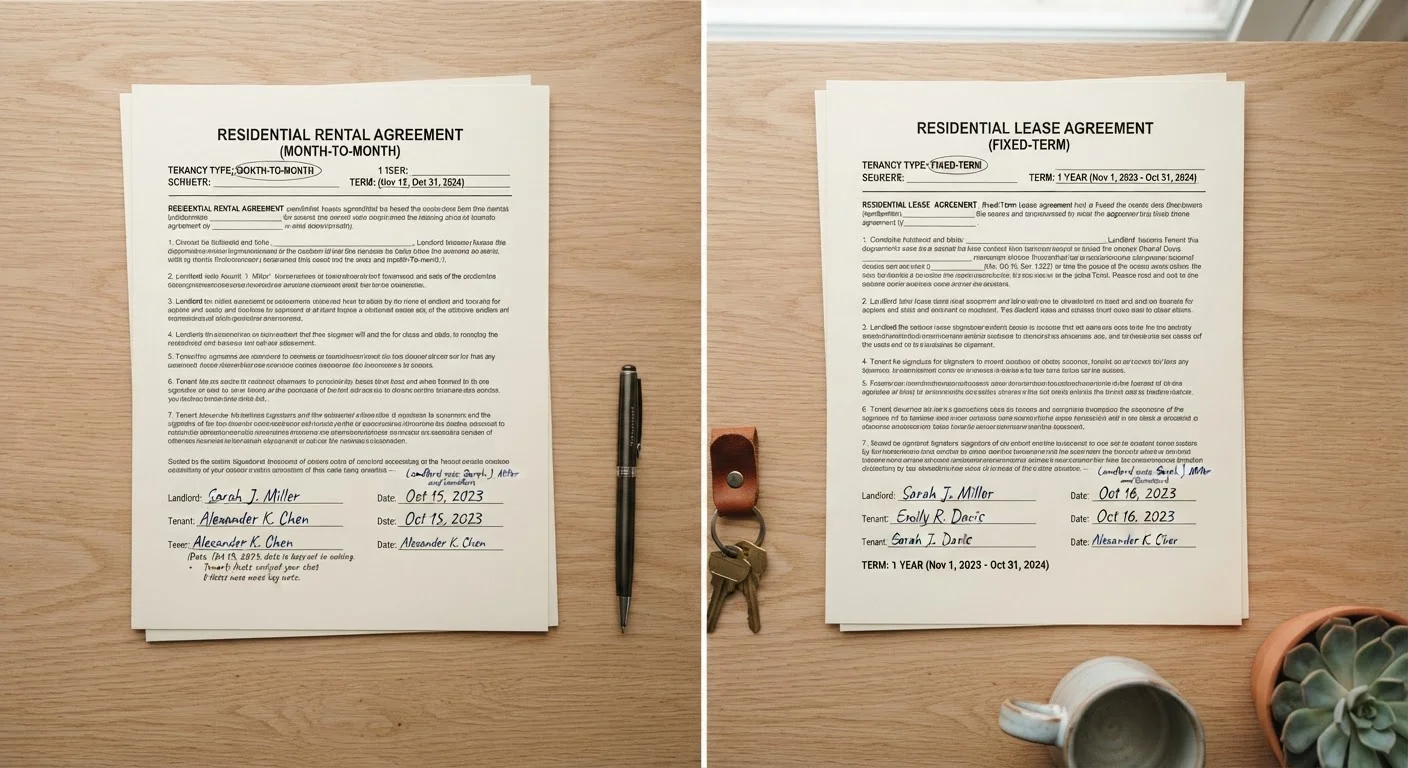
Month-to-Month Lease
The flexible, rolling rental agreement.
Best for: Renters who need mobility, are between major life transitions, or cannot commit to a year-long term.
Option B
Fixed-Term Lease
The stable, locked-in rental commitment.
Best for: Renters who have settled on a location, want predictable costs, and plan to stay put for at least a year.
If you expect to relocate within six months
Month-to-Month Lease
Rolling agreements let you exit with 30 days' notice in most states, avoiding the penalties that come with breaking a fixed-term lease early.
If you want rent certainty and long-term stability
Fixed-Term Lease
A fixed-term lease locks in your monthly rent for the full contract period, shielding you from mid-year rent increases.
If you're new to a city and unsure of the neighborhood
Month-to-Month Lease
A short rolling term lets you evaluate the area before committing to a longer contract, even if you pay a modest premium.
If you have a stable job, school enrollment, or other anchoring obligation
Fixed-Term Lease
When your timeline is predictable, a fixed-term lease typically offers better rates and protects your housing continuity.
If you have pets and have negotiated favorable pet terms
Fixed-Term Lease
Pet clauses negotiated into a fixed term stay in place for the contract duration; month-to-month arrangements can be renegotiated quickly by landlords.
What Each Lease Type Actually Means
A fixed-term lease is a rental contract with a defined start and end date - most commonly 12 months, though six-month and 24-month terms exist. Both the landlord and tenant are legally bound to the agreement for that period. The landlord generally cannot raise the rent or terminate the tenancy mid-term without cause, and the tenant cannot leave without facing penalties.
A month-to-month lease (sometimes called a periodic tenancy) renews automatically each month. Either party can typically end it with 30 days' written notice, though some states require 60 days. Month-to-month arrangements often arise when a fixed-term lease expires and neither party formalizes a renewal, or when a tenant specifically negotiates one from the start.
For a deeper look at what the fine print in either agreement actually obligates you to, see what your lease agreement is actually telling you.
| Criterion | Month-to-Month Lease | Fixed-Term Lease |
|---|---|---|
| Contract length | Renews monthly, no fixed end | Defined end date (typically 12 months) |
| Rent stability | Can change with notice | Locked in for full term |
| Typical monthly cost | Often higher (flexibility premium) | Often lower baseline rent |
| Exit with notice | 30-60 days' notice (state-dependent) | Penalties apply if leaving early |
| Landlord termination | With proper notice, for any reason | Generally only for lease violations |
| Best for | Uncertain or transitional timelines | Stable, anchored situations |
The Core Trade-offs: Flexibility vs. Stability
The central tension is straightforward: month-to-month leases trade financial predictability for personal flexibility, while fixed-term leases do the opposite.
Rent predictability is the biggest practical difference. Under a fixed-term lease, your rent is contractually set for the duration. A landlord cannot legally raise it until the term ends, even in a hot rental market. With a month-to-month arrangement, a landlord can increase rent with proper notice - the required notice period varies by state but is commonly 30 days.
Exit costs are equally significant. Leaving a month-to-month agreement is relatively painless; give proper notice and your obligation ends. Exiting a fixed-term lease before it expires is a different matter. The consequences - which can include forfeiture of your security deposit, liability for remaining rent, or legal fees - are detailed in breaking a lease early.
Security of tenure also differs. A landlord wanting to end a month-to-month tenancy simply needs to provide proper notice, even without cause in many jurisdictions. Under a fixed-term lease, a landlord generally must wait until the contract period ends to reclaim the unit, unless a tenant violates specific lease terms.
30-60 days
Typical notice required to end month-to-month tenancy
Most U.S. states require landlords and tenants to provide at least 30 days' written notice to terminate a month-to-month lease; some states require 60 days.
12 months
Most common fixed-term lease duration
One-year leases are the standard in the U.S. residential rental market, though six- and 24-month terms are offered by some landlords.
~10-20%
Estimated rent premium for month-to-month flexibility
Industry practice suggests month-to-month arrangements often command a premium above comparable fixed-term rents, though the gap varies significantly by market and property.
Cost Differences: What to Expect
Month-to-month leases typically carry a rent premium - landlords price in the uncertainty of shorter occupancy. The premium varies widely by market and property type, but it is a consistent pattern across the industry. In competitive urban rental markets, the gap can be meaningful on a monthly basis.
Fixed-term leases, in exchange for commitment, tend to offer a lower baseline rent. Some landlords also absorb move-in costs - such as offering a reduced first month - to secure a reliable long-term tenant.
Renters should also consider how their lease type interacts with their broader household budget. A month-to-month rent that can shift upward on short notice behaves more like a variable expense than a fixed one. Understanding that distinction matters when planning a budget, as explored in fixed vs. variable expenses during inflation.
Which Lease Structure Fits Your Situation?
The right answer depends on where you are in life, not just which option is cheaper today.
Month-to-month makes sense when your timeline is genuinely uncertain - you're job searching in a new city, waiting on a home purchase to close, or in the middle of a major life transition. It also suits renters who want to evaluate a neighborhood before committing. If you're renting with pets and still negotiating terms, review what to expect in that process at renting with pets.
Fixed-term leases make sense when your job, school, or family situation anchors you to a specific area for at least a year. The rent certainty alone can be worth the commitment, especially in markets where rents are rising. If you're also weighing whether renting long-term or purchasing makes more sense for your circumstances, renting vs. buying a home covers that decision in full.
Neither lease type is inherently better. The structure that serves you is the one that matches your actual timeline, risk tolerance, and financial situation.
State Law Governs Notice Requirements
The rules around notice periods, allowable rent increases, and grounds for termination vary meaningfully by state - and sometimes by city. Before signing either type of lease, review your state's landlord-tenant statutes or consult a local tenant rights organization to understand what protections apply to you specifically.