

Key Takeaways
Why Low-Light Plants Are a Smart Design Choice
Many American homes have at least one room that natural light seems to skip entirely - a north-facing living room, a windowless hallway, or a bedroom tucked behind tall neighboring buildings. These spaces can feel flat and lifeless, and furniture alone rarely fixes that. Plants, however, introduce texture, color, and a sense of aliveness that manufactured décor simply cannot replicate.
The challenge is that most houseplants sold at garden centers are actually sun-lovers in disguise. Place them in a dim hallway and they decline within weeks. The varieties listed below are genuinely adapted to low-light conditions, meaning they evolved in forest understories where direct sun rarely reaches. That makes them reliable performers in the kinds of rooms most people struggle to decorate.
Before diving in, it helps to understand what "low light" actually means. It refers to spaces that receive indirect, diffused light - typically more than six feet from a window, or near a north-facing window. True darkness (a closet, a basement with no windows) is too extreme for any living plant. If you're working to brighten the room itself alongside adding greenery, see our guide on making a dark room feel brighter using mirrors, paint, and light-reflective materials.
Pothos (Epipremnum aureum)
Pothos is arguably the most forgiving houseplant available to American gardeners. Its trailing vines and heart-shaped leaves look equally good cascading from a high shelf, spilling from a hanging planter, or climbing a simple moss pole. The golden and marble queen varieties maintain their variegation in low light better than most plants, though expect some color to deepen toward greener tones in very dim conditions.
Care is minimal: water when the top inch of soil is dry, and avoid letting it sit in standing water. Pothos tolerates infrequent watering well, making it suitable for busy households.
Pothos tolerates neglect better than almost any other trailing houseplant.
Snake Plant (Dracaena trifasciata)
Snake plants have become a design staple for good reason. Their upright, architectural form works beautifully as a floor plant in corners, beside sofas, or flanking a hallway console. The stiff, sword-shaped leaves with banded green and yellow patterns add strong vertical interest that softer, leafy plants cannot provide.
They are drought-tolerant to an exceptional degree - overwatering is the primary way most people lose them. In low-light rooms, water once every three to four weeks in winter and every two weeks in summer. They are well-suited to bedrooms and hallways where humidity tends to be lower.
Snake plants provide bold vertical structure that works particularly well in hallway styling.
ZZ Plant (Zamioculcas zamiifolia)
The ZZ plant's glossy, deep-green leaves reflect whatever light is available, giving the plant a polished, almost lacquered appearance that reads as intentionally decorative rather than incidental. It grows slowly, maintains a tidy mounded form, and rarely needs repotting - all practical advantages in a busy home.
Its underground rhizomes store water, meaning it handles irregular watering and weeks of neglect without visible distress. Place it in a ceramic pot at medium height - on a low dresser or side table - to show off its arching stems and reflective foliage.
The ZZ plant's glossy leaves reflect ambient light, making dim rooms feel subtly brighter.
Peace Lily (Spathiphyllum)
The peace lily is one of the few flowering plants that performs reliably in low-light interiors. Its white spathe blooms emerge several times a year even in indirect light, providing seasonal visual interest that purely foliage plants cannot match. Between blooms, the deep green, lance-shaped leaves remain attractive and full.
Peace lilies do communicate clearly when they need water - leaves droop noticeably, then recover quickly after watering. Keep soil consistently moist but not waterlogged. Note that peace lilies are toxic to cats and dogs, so placement matters in pet-owning households.
Peace lilies are among the only flowering plants that bloom reliably in genuinely low-light conditions.
Cast Iron Plant (Aspidistra elatior)
True to its name, the cast iron plant withstands conditions that would defeat most houseplants - deep shade, temperature fluctuations, irregular watering, and low humidity. Its broad, dark green strap-like leaves have an almost leather-like quality that pairs well with both traditional and contemporary interior styles.
Growth is slow, which means a mature specimen holds its shape for years without much intervention. It works particularly well as a floor plant in consistently dim areas such as north-facing living rooms or interior hallways where other plants have failed repeatedly.
Cast iron plants succeed where other species consistently fail, making them ideal for problem spots.
Chinese Evergreen (Aglaonema)
Chinese evergreens offer something most low-light plants do not: genuine color variety. Foliage comes in shades ranging from deep forest green to silver-grey, pink-tinged, and even red-variegated - all of which remain vibrant in dim conditions. This makes them unusually versatile from a styling perspective, allowing you to coordinate plant color with room palette.
They prefer evenly moist soil and moderate humidity but adapt well to typical home conditions. Like peace lilies, they are mildly toxic to pets and children if ingested, so consider placement accordingly.
Chinese evergreens bring color variety to low-light spaces where most plants only offer green.
Styling Tips for Low-Light Interiors
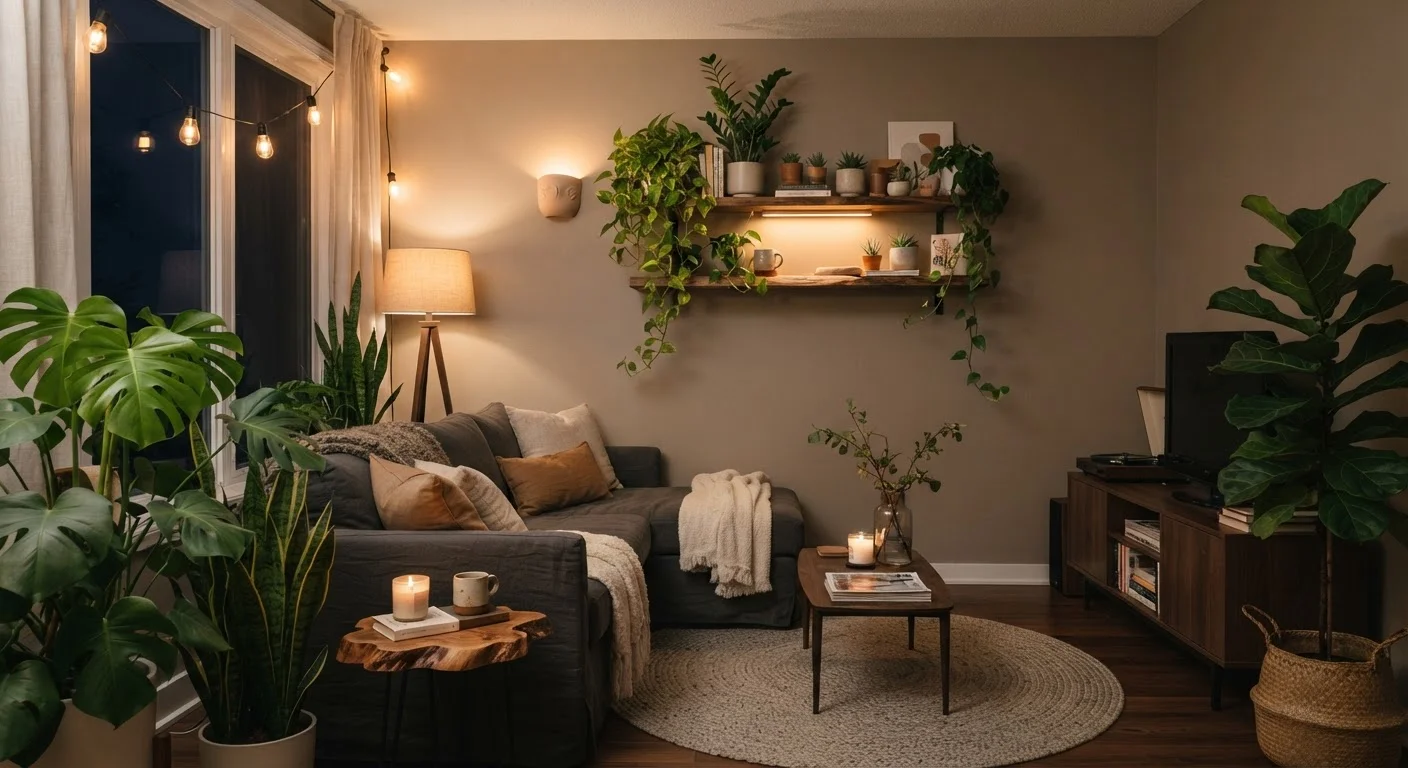
Choosing the right plant is only half the equation. How you display it determines whether it reads as décor or afterthought. Group plants in odd numbers - threes and fives tend to look more natural than symmetrical pairs. Vary heights by using floor plants, shelf specimens, and hanging or trailing varieties together to create visual layers.
Rotate Plants Every Few Weeks
Even low-light plants benefit from rotating their position a quarter-turn every two to three weeks. This encourages even growth on all sides and prevents the plant from leaning permanently toward its light source. A lopsided plant is harder to style effectively and may develop weaker stems over time.
Pot choice matters as much as the plant itself. Matte ceramic in neutral tones - warm whites, terracotta, charcoal - tends to complement low-light rooms without competing with the plant's foliage. Avoid glossy white pots in darker spaces; they can look clinical rather than cozy.
Low-light rooms also benefit from pairing plants with artificial lighting. A small spotlight or LED strip aimed at a cluster of plants after dark makes them feel intentional and sculptural. For a deeper dive into how layered lighting works, our article on ambient, task, and accent lighting explains how each type can be combined to transform a space. And if you're rethinking furniture placement at the same time, arranging furniture in tight spaces offers practical guidance that works well alongside a plant styling refresh.