

Key Takeaways
Native Plants
Native plants are species that evolved naturally in a specific region over thousands of years, without being introduced by humans. Because they developed alongside local soils, rainfall patterns, insects, and wildlife, they are inherently adapted to thrive in those conditions. In landscaping, 'native' generally refers to plants indigenous to a particular state, ecoregion, or watershed - not just the continent.
Ecologists distinguish between 'locally native' (indigenous to a specific ecoregion) and broadly native species. For landscaping purposes, selecting plants native to your specific USDA hardiness zone and ecoregion yields the strongest ecological and practical benefits.
Why Landscapers Keep Coming Back to Native Plants
If you've talked to a professional landscaper in recent years, chances are they've steered you toward native plants - not because it's fashionable, but because it works. Plants that evolved in your region over thousands of years have already solved many of the problems gardeners fight against: poor drainage, summer drought, clay soil, and unpredictable frost timing. A landscaper recommending natives is, at its core, recommending a lower-risk investment for your yard.
This doesn't mean native plants are effortless or that any plant labeled 'native' at a garden center is the right choice. It means that when you match the right species to your specific conditions, you're working with biology rather than against it. That distinction matters enormously for how much time and money you spend maintaining your outdoor space over the years.
“Bringing native plants back into our landscapes is not just gardening - it's one of the most powerful acts of conservation that homeowners can take. The cumulative effect of millions of yards adds up to something significant.”
— Doug Tallamy, Entomologist and author of 'Bringing Nature Home', University of Delaware
The Practical Benefits: Water, Soil, and Maintenance
The most immediate appeal of native plants for homeowners is reduced upkeep. Because these plants are calibrated to local rainfall averages, established native plantings typically require far less supplemental irrigation than exotic ornamentals. In drought-prone regions like the Southwest and parts of the Southeast, that difference can translate to meaningful reductions in water usage.
Native plants also tend to thrive in the soil types common to their region - whether that's the sandy, acidic soils of the mid-Atlantic or the heavy clay of the Midwest. Non-native species often require soil amendment, fertilization, and repeated intervention to stay healthy. Natives, once established, generally maintain themselves with standard care. This pairs naturally with broader low-effort landscaping approaches; see design principles that reduce weekly outdoor work for how native plant choices fit into a larger strategy.
~80%
Of US outdoor water use goes to landscaping
The EPA estimates that landscape irrigation accounts for nearly one-third of all residential water use nationally, and a substantial portion is applied inefficiently to non-native lawns and ornamentals.
35x
More caterpillar species supported by native oaks vs. non-native trees
Research by entomologist Doug Tallamy found that native oak trees support over 500 caterpillar species, while many ornamental exotic trees support fewer than 15 - a difference with cascading effects on birds and wildlife.
40%
Decline in North American bird populations since 1970
A 2019 study published in Science estimated a loss of nearly 3 billion birds since 1970, with habitat degradation and insect scarcity - both linked to loss of native plants - among the contributing factors.
The Ecological Case: Supporting What Lives in Your Yard
Beyond the practical savings, native plants play a functional ecological role that exotic ornamentals largely can't replicate. Research by entomologist Doug Tallamy and others has documented that native trees and shrubs support dramatically more native caterpillar and insect species than non-native plants - and those insects are the primary food source for songbirds, especially during nesting season.
Native flowering plants are also better matched to the life cycles of native pollinators. A native bee's emergence often coincides with the bloom time of native flowers in the same region - a synchrony that exotic species disrupt. Incorporating natives into your yard effectively turns ordinary landscaping into functional wildlife habitat. This complements strategies like companion planting that consider the ecological relationships between plants.
Lawns, by contrast, support almost no native insect life. Reducing turf area and replacing it with native groundcovers, shrubs, or meadow plantings is one of the higher-impact changes a homeowner can make to the ecological value of their property.
Start With One Area, Not the Whole Yard
Converting an entire lawn to native plants at once can be overwhelming and expensive. Instead, identify one problem area - a dry corner, a shaded slope, or a struggling strip of turf - and start there. Once you see how native plants perform with minimal intervention, expanding gradually becomes much easier to manage.
Common Misconceptions About Native Plants
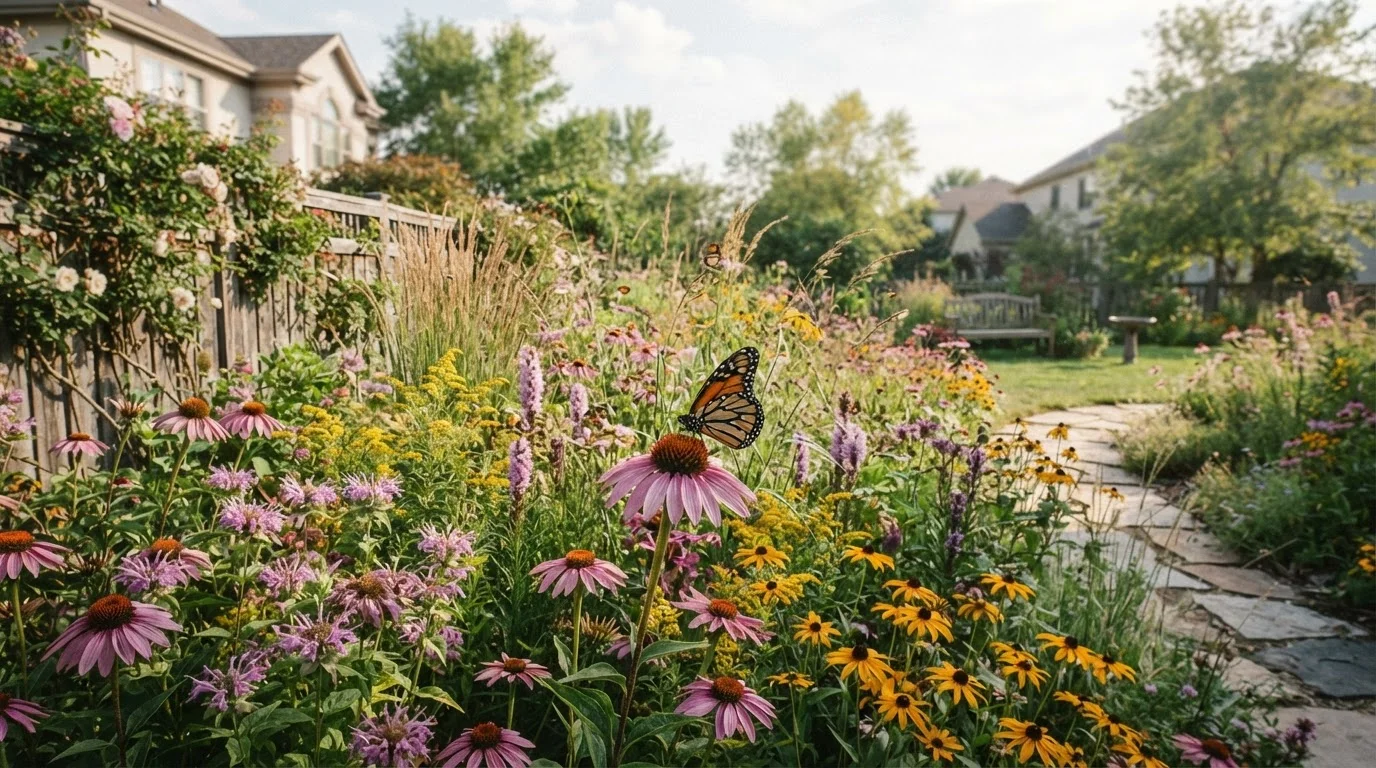
One persistent myth is that native plants look wild or unkempt - a concern many homeowners raise when the subject comes up. In practice, native plant gardens can be as structured and intentional as any traditional landscape. Choices like native coneflowers, black-eyed Susans, native grasses, and flowering shrubs are visually appealing throughout multiple seasons and can be arranged in formal or naturalistic designs alike.
Another misconception is that 'native to North America' is specific enough. A plant native to the Pacific Northwest may be just as unsuited to Georgia conditions as a plant from Europe. Specificity matters - local ecotype and ecoregion are more meaningful than continental origin. Your county's cooperative extension office or a regional native plant society can point you to species that are genuinely indigenous to your area. Also worth noting: some popular 'nativar' (native cultivar) plants have been bred for color or size in ways that reduce their wildlife value, so when ecological benefit is the goal, straight species or minimally altered cultivars are preferable. For a reality check on other common gardening assumptions, gardening myths that mislead beginners is a useful companion read.