

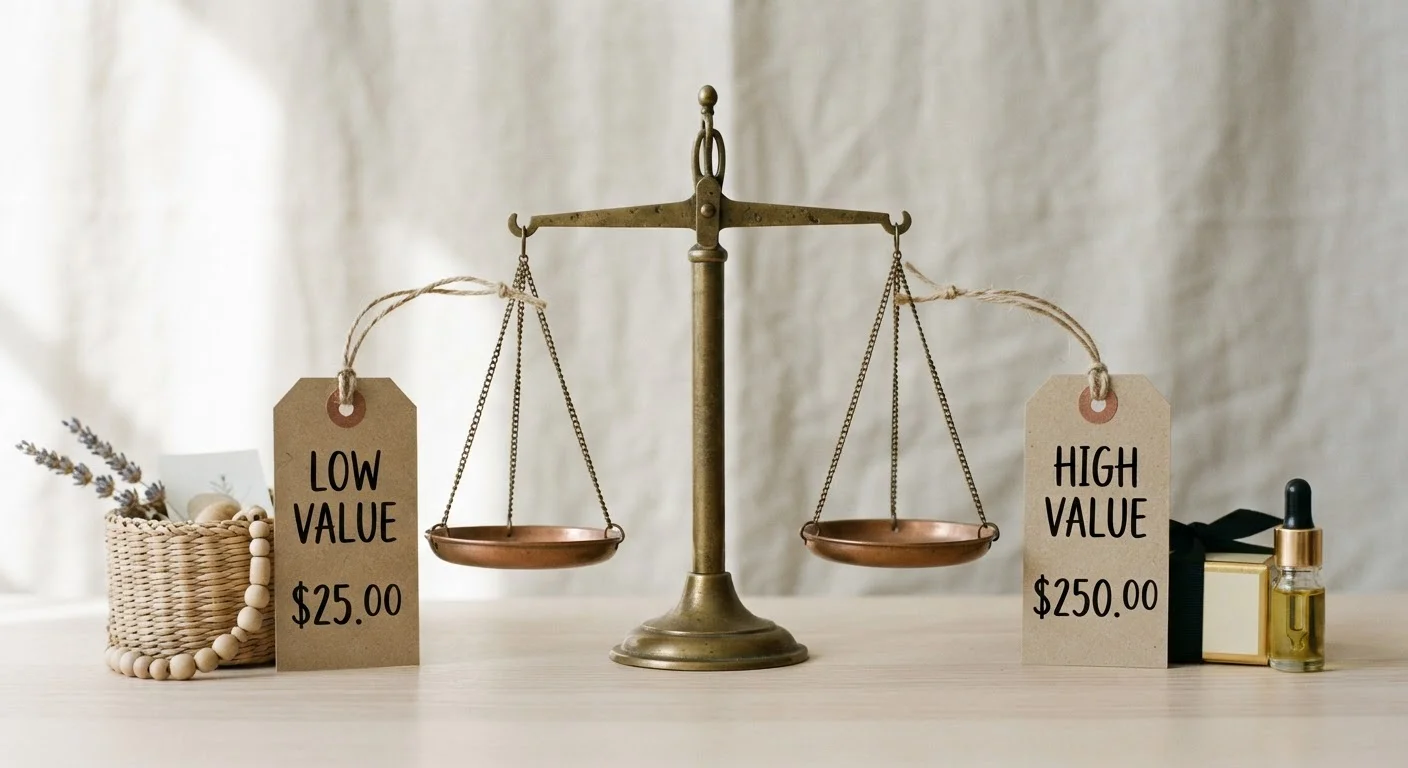
Key Takeaways
Option A
Sticker Price
The number you see at the register.
Best for: Quick budgeting decisions when the purchase is low-stakes, disposable, or used only once.
Option B
Long-Term Value
The true cost spread across the full life of ownership.
Best for: Durable goods, recurring purchases, and anything you'll use frequently over months or years.
If you need something for a single use or short-term situation
Sticker Price
When longevity and performance over time are irrelevant, paying less upfront is usually the rational choice. Avoid over-engineering low-stakes decisions.
If you're buying an appliance, tool, or item you'll use weekly
Long-Term Value
Frequent-use items accumulate replacement and maintenance costs fast. Modeling total cost of ownership almost always favors the more durable option.
If you're on a strict short-term budget
Sticker Price
When cash flow is constrained, the lower upfront cost may be the only viable option even if long-term value is lower. Acknowledge the trade-off explicitly.
If you're comparing recurring consumable purchases
Long-Term Value
Items bought repeatedly - filters, cartridges, blades - have compounding cost differences. A slightly higher unit cost can mean significantly less spending annually.
What Sticker Price Actually Measures
Sticker price is the most visible number in any purchase decision - it's what's displayed on the shelf, listed on the product page, and processed at checkout. It answers exactly one question: how much does it cost to acquire this item right now?
That's genuinely useful information, but it's a narrow slice of the total financial picture. Sticker price tells you nothing about how long the item will last, how much it costs to run or maintain, how often you'll need to replace it, or whether it will perform adequately over time.
For low-stakes purchases - a notebook, a party decoration, a one-time tool rental - sticker price is often all that matters. But the moment you're buying something you intend to use repeatedly or rely on over time, sticker price becomes an incomplete metric. Treating it as the whole story is one of the most common and costly shopping mistakes consumers make. For a deeper look at how seemingly low prices can accumulate into higher total spending, see why the cheapest option is often the most expensive choice.
What Long-Term Value Actually Measures
Value, in the consumer sense, is best understood as what you get relative to what you spend - across the full life of ownership. It incorporates the sticker price but folds in several additional factors:
- Lifespan: How long will this item perform at an acceptable level before needing replacement?
- Maintenance and consumables: Does it require ongoing spending - batteries, filters, cartridges, professional servicing?
- Replacement frequency: A cheaper item that needs replacing twice as often is rarely cheaper in practice.
- Performance adequacy: An item that technically works but requires workarounds, more time, or extra effort has a hidden cost in friction.
The most practical distillation of this is cost-per-use: divide the total expected spend (purchase price plus maintenance) by the number of times you'll realistically use it. A $90 item used 300 times costs $0.30 per use. A $40 item used 80 times before replacement costs $0.50 per use - and that's before accounting for the time spent repurchasing.
| Criterion | Sticker Price | Long-Term Value |
|---|---|---|
| What it measures | Acquisition cost only | Total cost across ownership lifespan |
| Accounts for lifespan | No | Yes |
| Accounts for maintenance costs | No | Yes |
| Best for single-use purchases | Yes | Less relevant |
| Best for frequent-use items | Incomplete picture | Yes |
| Ease of comparison | Immediate, visible | Requires estimation and research |
| Risk of overspending long-term | Higher | Lower when modeled accurately |
For a more comprehensive framework on modeling these numbers, total cost of ownership covers the full methodology in detail.
When Each Lens Applies - and When Both Miss the Point
Neither framework is universally correct. The right lens depends on the purchase context.
Prioritize sticker price when: the item will be used once or very few times, the category is inherently disposable, cash flow is constrained in the short term, or the performance difference between options is negligible.
Prioritize long-term value when: you'll use the item frequently, the purchase involves ongoing consumable costs, durability differences between options are meaningful, or the higher-priced option comes with a warranty or support structure that reduces replacement risk.
It's also worth noting that high price is not a reliable proxy for high value - a point examined thoroughly in the myth of "you get what you pay for". Premium pricing reflects many things beyond product quality: branding, packaging, retail margin, and marketing spend among them.
Price Isn't the Same as Cost
Economists distinguish between the price of something (what you pay to acquire it) and its cost (the full value of resources consumed over its use). In everyday shopping, conflating the two is easy but expensive. When in doubt, ask: what will this item actually cost me over the next two to three years, not just today?
The same principle applies in larger financial decisions. When evaluating housing, for example, the lower monthly cost of renting versus the equity-building potential of buying requires the same kind of long-term value framing - as explored in renting vs. buying in a high-price market.
For a practical checklist on what to examine before finalizing any purchase comparison, price comparison done right covers warranties, return policies, shipping costs, and more. More strategies for spending smarter across categories are available in the Smarter Spending hub.