

Key Takeaways
Rates vs. Prices Relationship
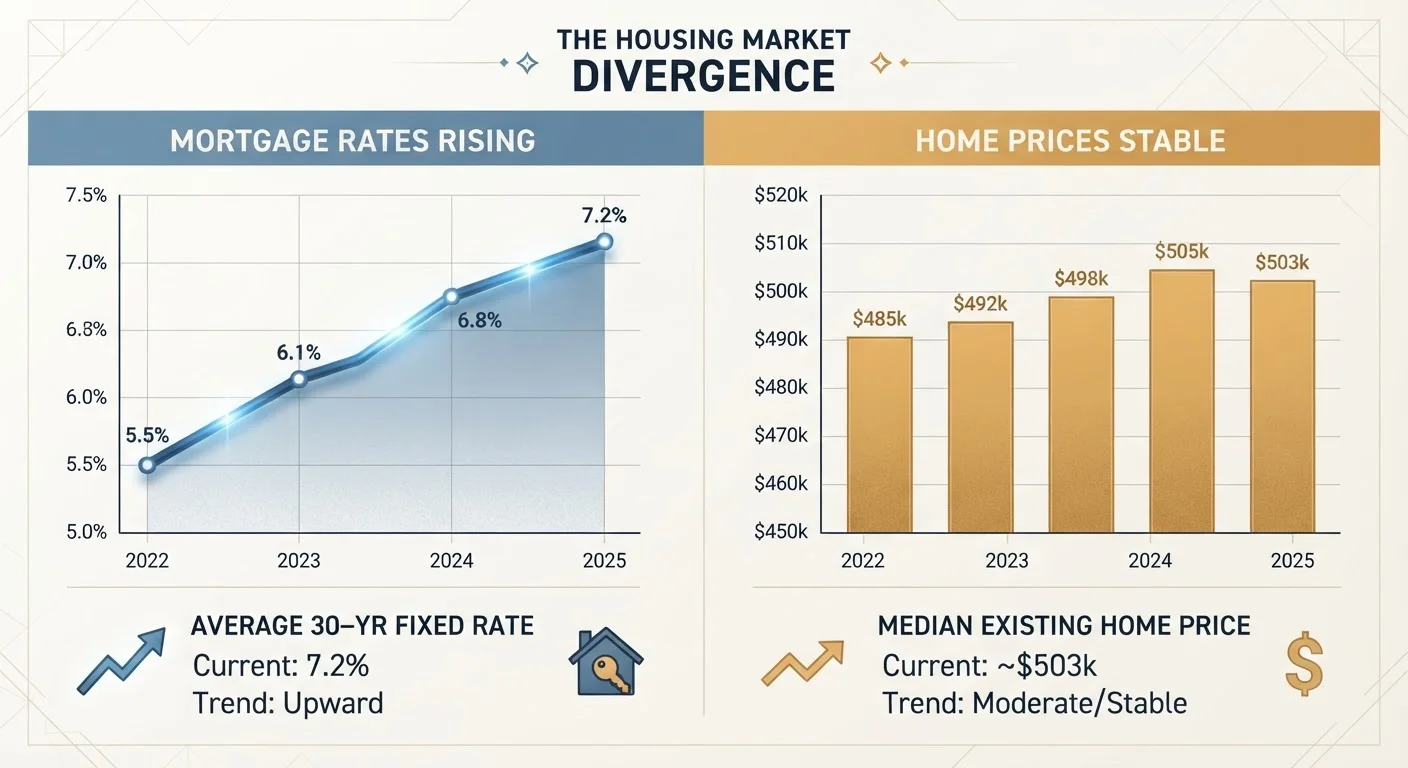
Many people assume that when mortgage rates rise, home prices must fall - and vice versa. In practice, the two are influenced by overlapping but distinct economic forces, meaning they can and often do move in the same direction or remain disconnected for extended periods. Understanding why requires looking beyond a simple cause-and-effect assumption.
Economists study the price elasticity of housing demand alongside credit supply conditions; the relationship between rates and prices is empirically inconsistent across different market cycles and geographies.
The Assumption Everyone Makes - And Why It's Incomplete
The intuition seems logical: when borrowing money becomes more expensive, fewer people can afford to buy homes, so sellers must lower their prices to attract buyers. But the U.S. housing market has repeatedly defied this simple model. During 2022 and 2023, mortgage rates climbed sharply while national median home prices remained historically elevated - a combination that puzzled many observers expecting a correction.
The core problem with the inverse-relationship assumption is that it treats housing like a commodity with a single price driver. In reality, home prices are set at the intersection of local supply, local demand, construction activity, employment, and sentiment - only one of which is mortgage rates. For a fuller picture of how these forces interact, see our overview of the U.S. housing market.
~4M
Estimated U.S. housing unit shortfall
Freddie Mac and other housing researchers have estimated the U.S. faces a structural shortage of several million homes, a key factor keeping prices supported even when demand cools.
~90%
Homeowners with sub-6% mortgage rates (circa 2023)
According to data cited by the Federal Housing Finance Agency, the vast majority of outstanding mortgages carried rates well below prevailing market rates in 2023, reinforcing the lock-in effect.
3x+
Increase in affordability burden since 2020
The National Association of Realtors' Housing Affordability Index fell dramatically between 2020 and 2023 as the combined effect of rising prices and rising rates compounded simultaneously.
Supply Is the Variable Most People Underestimate
Even when demand weakens - which higher rates do cause - prices don't fall if there aren't enough homes to meet even that reduced demand. The U.S. has faced a persistent housing supply shortfall for over a decade, driven by underbuilding after the 2008 financial crisis, restrictive zoning laws in high-demand metros, and rising labor and materials costs that make new construction expensive.
One particularly important dynamic economists have noted is the lock-in effect: homeowners who financed or refinanced at low rates during 2020 and 2021 have strong financial incentives to stay put rather than sell and take on a new mortgage at a higher rate. When potential sellers don't list, inventory stays thin, and buyers competing for limited homes can keep prices from declining even as affordability deteriorates.
Focus on Monthly Payment, Not Just Rate or Price
When evaluating housing affordability, calculate the full monthly payment - principal, interest, taxes, insurance, and any HOA fees - rather than fixating on the list price or the headline rate alone. A small change in rate can shift a monthly payment by hundreds of dollars on a typical loan. Online mortgage calculators can help you run these scenarios quickly before speaking with a lender.
What Actually Drives Each Variable
Mortgage rates are set primarily by bond markets - specifically yields on 10-year U.S. Treasury notes - and by lender risk pricing. They respond to Federal Reserve policy, inflation expectations, and global capital flows. Home prices, meanwhile, are driven by hyperlocal factors: job growth in a metro area, net migration patterns, school district quality, and the pace of new construction permits.
This means rates can rise sharply (a macroeconomic event) while a specific city's prices stay firm because a major employer is expanding there, or fall in a market that was already overbuilt regardless of what rates are doing. National median price statistics can obscure these local divergences, making it easy to draw misleading conclusions from headline figures.
Affordability: The Metric That Ties It Together
Rather than tracking prices and rates in isolation, housing economists often use affordability indices - measures that combine home price, prevailing mortgage rate, and local household income into a single signal. When rates rise and prices hold steady, affordability worsens even though one of the two headline numbers hasn't moved. When rates fall sharply, affordability can improve without any change in the price of the home itself.
For prospective buyers, this reframing matters practically. A home that costs less on paper may carry a higher monthly payment if rates are elevated. Conversely, the rent-vs.-buy calculus shifts when rate changes alter the true cost of ownership relative to renting. Understanding the type of mortgage you're comparing also affects these calculations significantly.
The housing market's relationship to the wider economy adds another layer - when affordability deteriorates broadly, spending patterns and local economies feel the strain well beyond the real estate sector itself.
This article is for general informational and educational purposes only and does not constitute financial, investment, or legal advice. Readers should consult a qualified financial adviser or licensed real estate professional before making decisions specific to their circumstances.