

Key Takeaways
Why Enrichment Matters for Every Pet
Household pets - whether dogs, cats, birds, rabbits, or reptiles - evolved from ancestors that spent most of their waking hours foraging, exploring, problem-solving, and interacting with a complex environment. Modern domestic life compresses or eliminates many of those demands, which is convenient for us but cognitively understimulating for them.
Boredom isn't just a mild inconvenience. Understimulated animals frequently develop behavioral problems: destructive chewing in dogs, overgrooming in cats, feather-plucking in parrots, and repetitive pacing in small mammals. If you're noticing these signs, our starter guide to animal behavior can help you interpret what your pet is communicating.
The good news is that enrichment doesn't require elaborate setups or expensive equipment. The activities below are organized by species and grounded in how each animal naturally processes and interacts with the world.
Puzzle Feeders and Foraging for Dogs
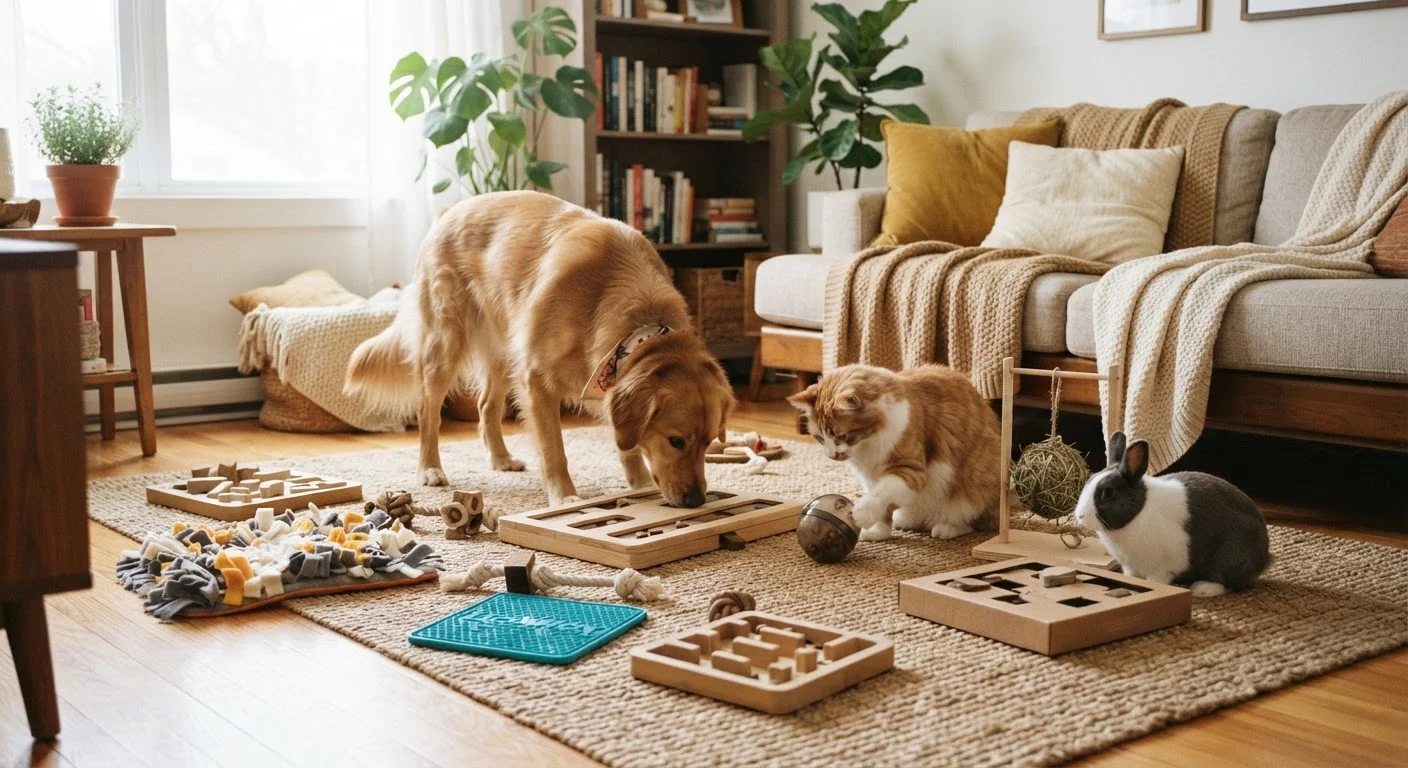
Dogs are natural problem-solvers with a strong foraging drive. Replacing or supplementing the standard food bowl with a puzzle feeder - a device that requires manipulation to release kibble - engages a dog's nose, paws, and reasoning in combination. Research in canine cognition consistently links food-based problem-solving to reduced stress hormones and improved behavioral outcomes.
Start with simpler puzzles that your dog can succeed at, then gradually increase difficulty. Hiding small portions of food around a room or yard (called scatter feeding) is an equally effective low-cost alternative that taps into the same olfactory-driven foraging instinct.
Replacing even one meal a day with a puzzle feeder engages a dog's brain far more than eating from a bowl.
Scent Work and Nose Games for Dogs
A dog's nose contains roughly 300 million olfactory receptors compared to about six million in humans. Scent-based activities exploit this natural advantage and are mentally exhausting in the best possible way - many owners report that twenty minutes of nose work tires a dog more thoroughly than an hour-long walk.
Start by hiding a strongly scented item (a favorite toy or a small container with a novel smell) in an easy location and rewarding discovery. As your dog improves, increase the hiding spots and difficulty. Formal nose work classes are available through many training organizations if you want a structured progression.
Scent work can tire a dog more effectively than physical exercise, making it ideal for low-mobility or senior animals.
Vertical Space and Hunting Simulations for Cats
Cats are obligate predators whose behavioral repertoire centers on the hunt cycle: stalk, pounce, catch, consume. Indoor environments that offer no outlet for this cycle contribute to frustration and overeating. Installing wall-mounted shelves, cat trees, or window perches gives cats vertical territory to patrol and observe from, which directly addresses their need for environmental control.
Pair vertical access with interactive play sessions using a wand toy or a laser (always end laser sessions with a tangible "catch" - a small treat or toy - so the cat experiences successful prey capture). For a comprehensive look at indoor feline needs, see our guide on keeping an indoor cat mentally and physically stimulated.
Cats need to complete the full hunt cycle - stalk, pounce, catch - to feel behaviorally satisfied.
Foraging and Social Interaction for Birds
Parrots and other companion birds spend the majority of their wild waking hours foraging - searching for, extracting, and processing food across a varied landscape. A bird given unrestricted access to a full food bowl has no need to work for sustenance, eliminating a significant portion of its natural daily occupation.
Wrap portions of food in paper, tuck pellets into hanging foraging toys, or stuff food inside untreated wooden objects the bird must shred to access. Rotate toy types frequently. Social interaction - talking, training simple behaviors, or simply spending calm time near your bird - also addresses the flock-bonding need that drives much of avian anxiety when left alone.
Birds that forage for their food show fewer stress-related behaviors like feather-plucking and repetitive vocalizations.
Tunnels, Digging Boxes, and Novel Objects for Small Mammals
Rabbits, guinea pigs, hamsters, and rats each have distinct behavioral profiles, but share a need for environmental complexity that standard cage setups rarely provide. Rabbits are burrowing prey animals - a cardboard box with entry holes and shredded paper inside satisfies both the digging and hiding drive simultaneously. Guinea pigs benefit from social housing (they are highly social) and foraging opportunities embedded in hay. Hamsters, being nocturnal foragers, need sufficient space and substrate depth to engage in natural tunneling.
Rats are among the most cognitively sophisticated small mammals kept as pets and can learn complex sequences of behaviors. Regular handling and training sessions using positive reinforcement give rats the social stimulation and problem-solving challenge they need to thrive.
Rats can learn complex trick sequences, making them uniquely responsive to structured positive-reinforcement training.
Environmental Variation and Heat Gradients for Reptiles
Reptile enrichment is frequently overlooked because these animals express engagement and boredom more subtly than mammals. However, behavioral science has made clear that reptiles - particularly species like bearded dragons, monitors, and ball pythons - benefit significantly from environmental complexity.
Provide multiple hides at different temperature zones so the animal can actively thermoregulate, which is itself a cognitively engaging behavior. Introduce novel objects (clean rocks, different substrate textures, new branches) periodically. Feeding live or semi-live prey items (where legal and appropriate to the species) reinstates predatory behavior. Even supervised out-of-enclosure exploration in a safe space contributes measurably to activity levels and reduces the inactive, glass-gazing behavior associated with understimulated reptiles.
Active thermoregulation - choosing between warm and cool zones - is a form of environmental engagement for reptiles.
Building a Sustainable Enrichment Routine
The most effective enrichment isn't a one-time event - it's a consistent practice woven into your pet's daily schedule. Even ten to fifteen minutes of focused mental engagement per day can produce noticeable improvements in mood, behavior, and sleep quality across species.
Start Small and Build Gradually
Introducing too many enrichment changes at once can overwhelm anxious or newly adopted animals. Begin with one or two activities and observe your pet's response before adding more. A calm, curious engagement with a new activity is the goal - not frantic overstimulation. Track which activities your pet returns to voluntarily, as these are often the best indicators of genuine preference.
Rotate activities regularly to prevent habituation. An animal that encounters the same puzzle feeder every day will eventually stop engaging with it. Introducing variety - new scents, rearranged furniture, novel textures - keeps the environment genuinely stimulating rather than predictably dull.
For new pet owners still getting their footing, our guide on bringing a pet home for the first time covers how to build daily routines that support long-term wellbeing. And if your dog's restlessness feels more like anxiety than boredom, the distinction matters - see our piece on separation anxiety vs. boredom in dogs for behavioral cues that differentiate the two. For a deeper dive into species-specific cognitive strategies, enrichment matched to how pets actually think offers research-informed approaches beyond the basics covered here.
This article is for general informational purposes only. If your pet displays sudden behavioral changes, significant distress, or signs of illness, consult a licensed veterinarian.