

Key Takeaways
Our Verdict
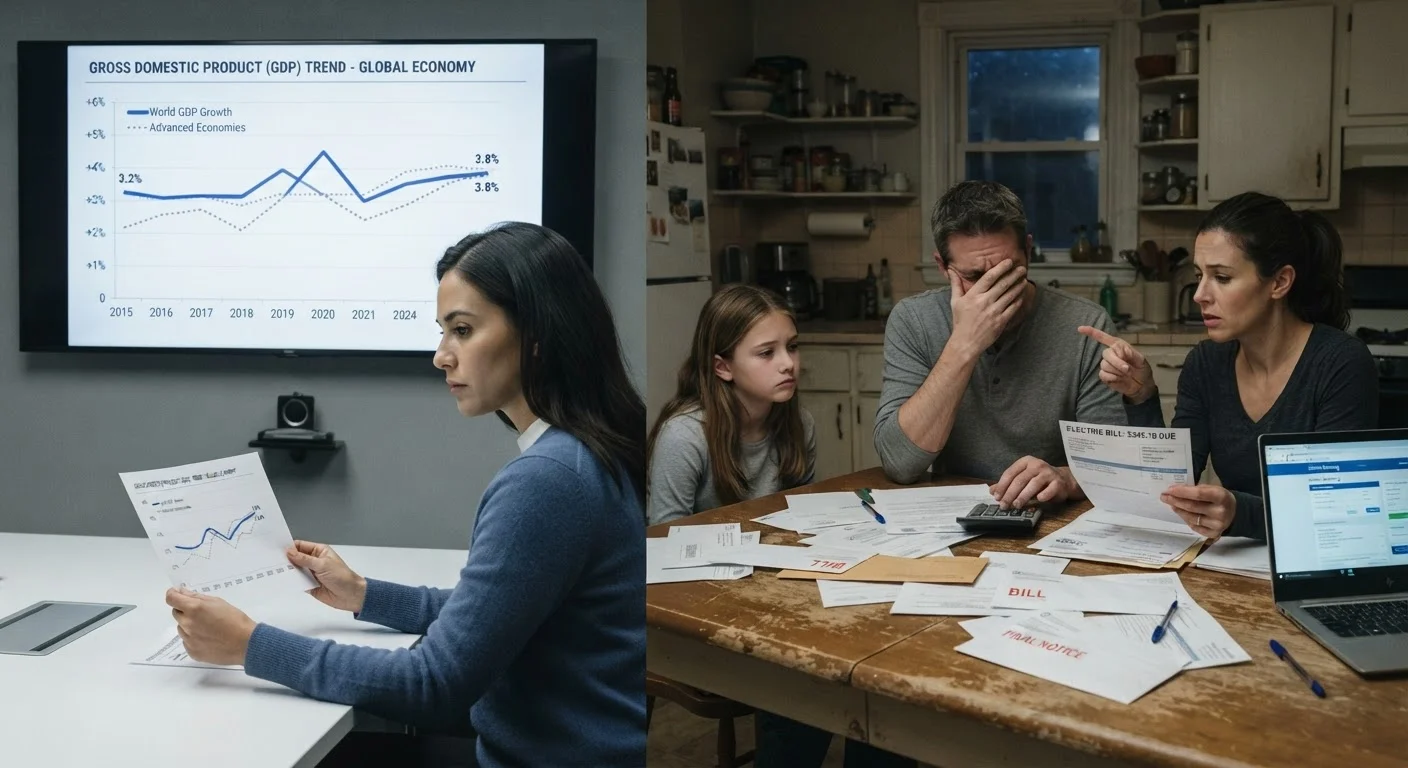
The technical definition of a recession and the lived experience of economic hardship rarely line up neatly. GDP can be growing while household budgets are shrinking, and official recoveries can feel hollow when wages stagnate or costs remain elevated. Understanding both measures helps families contextualize news headlines alongside their own financial reality.
| Best for | Recommended |
|---|---|
| Readers trying to understand economic news coverage | The technical GDP-based definition |
| Households assessing their own financial vulnerability | The kitchen-table lens - jobs, prices, and cash flow |
What Economists Mean by a Recession
In the United States, a recession is commonly described as two consecutive quarters of negative gross domestic product (GDP) growth. GDP is the total market value of all goods and services produced in the country during a given period. When that number contracts for six months in a row, the shorthand definition of a recession is met.
However, the official arbiter of U.S. recession dates is the National Bureau of Economic Research (NBER), a nonprofit research organization whose Business Cycle Dating Committee uses a broader and more nuanced framework. The NBER looks at depth, duration, and diffusion across multiple indicators - including employment levels, personal income, consumer spending, and industrial production - before formally declaring that a recession has begun or ended. This means the NBER's official call often comes months after the fact.
The two-quarter rule is a useful shorthand taught in economics courses and cited routinely in news coverage. But even economists acknowledge it can mislead: a single sharp quarter of contraction followed by a mild second quarter might technically qualify, while a prolonged period of near-zero growth with rising unemployment might not.
| Technical / Official Measure | Household / Lived Experience | |
|---|---|---|
| Primary indicator | GDP growth rate (quarterly) | Income, job security, prices, savings |
| Who defines it | NBER Business Cycle Dating Committee | Each household's own cash flow reality |
| Timing of recognition | Months to years after the fact | Felt in real time, often before official call |
| Impact of inflation | Partly captured in real GDP calculations | Directly and immediately reduces purchasing power |
| Distribution sensitivity | Aggregates mask inequality | Varies sharply by income, wealth, and location |
| Recovery signal | Positive GDP for two-plus quarters | Stable bills, job security, reduced debt pressure |
What a Recession Feels Like at Home
For most American families, the question isn't whether GDP shrank by 0.3 percent. It's whether the grocery bill is manageable, whether someone in the household is worried about their job, and whether there's anything left over at month's end. These concerns don't track neatly with official economic calendars.
Several forces shape how families experience downturns differently from aggregate statistics. Inflation is one of the most significant. GDP can register growth while rising prices erode the purchasing power of wages - a scenario that feels decidedly recessionary to a household watching its real income fall. The 2021-2023 period illustrated this tension vividly: GDP expanded, unemployment fell, and yet surveys consistently showed that a large share of Americans described their personal financial situation as worsening.
Job quality matters too. An economy adding positions in low-wage sectors while shedding higher-wage manufacturing or office jobs may show strong employment numbers on paper while leaving workers in less stable circumstances. Signs of structural budget strain - like relying on credit cards to cover routine expenses or skipping healthcare visits - can emerge well before any official recession is declared.
~6-18 months
Typical NBER recession declaration lag
The National Bureau of Economic Research often takes six months to over a year after a recession begins to formally announce it, based on historical dating patterns.
Bottom 20%
Income group hit hardest by downturns
Federal Reserve research has consistently found that households in the lowest income quintile experience job loss and income decline disproportionately during economic contractions.
~60%
Americans living paycheck to paycheck
Multiple consumer finance surveys conducted between 2022 and 2024 found that roughly six in ten U.S. adults reported having little to no financial cushion between paychecks.
Why the Gap Exists - and Why It Matters
The divergence between official metrics and household experience comes down largely to aggregation and distribution. GDP is an average of economic activity across the entire country. It does not, on its own, reveal how gains and losses are distributed. When corporate profits rise and stock portfolios swell while wage growth lags, GDP can look healthy even as many working families feel squeezed.
Wealth inequality amplifies this gap. Higher-income households, which hold more financial assets and have larger income buffers, can weather an official recession with relatively modest disruption. Lower-income households, with thinner margins and fewer assets, may enter a personal financial crisis during what headlines are calling a period of expansion. Research from the Federal Reserve has consistently found that economic shocks hit households in the bottom income quintiles harder and earlier than those at the top.
This also affects how recoveries are perceived. The NBER may declare that a recession ended 18 months ago while families are still dealing with the lingering effects - debt accumulated during the downturn, reduced hours that haven't fully returned, or a local employer that never reopened. For a thorough perspective on how economic headlines can diverge from ground-level conditions, the same dynamic plays out in housing: common misconceptions about housing market crashes show how aggregate data can obscure vastly different local realities.
Understanding both lenses - the technical and the experiential - gives readers better tools to interpret economic news without either dismissing it or assuming it maps directly onto their own circumstances.